Benzinger
Compact5
Towards automated jewellery manufacturing
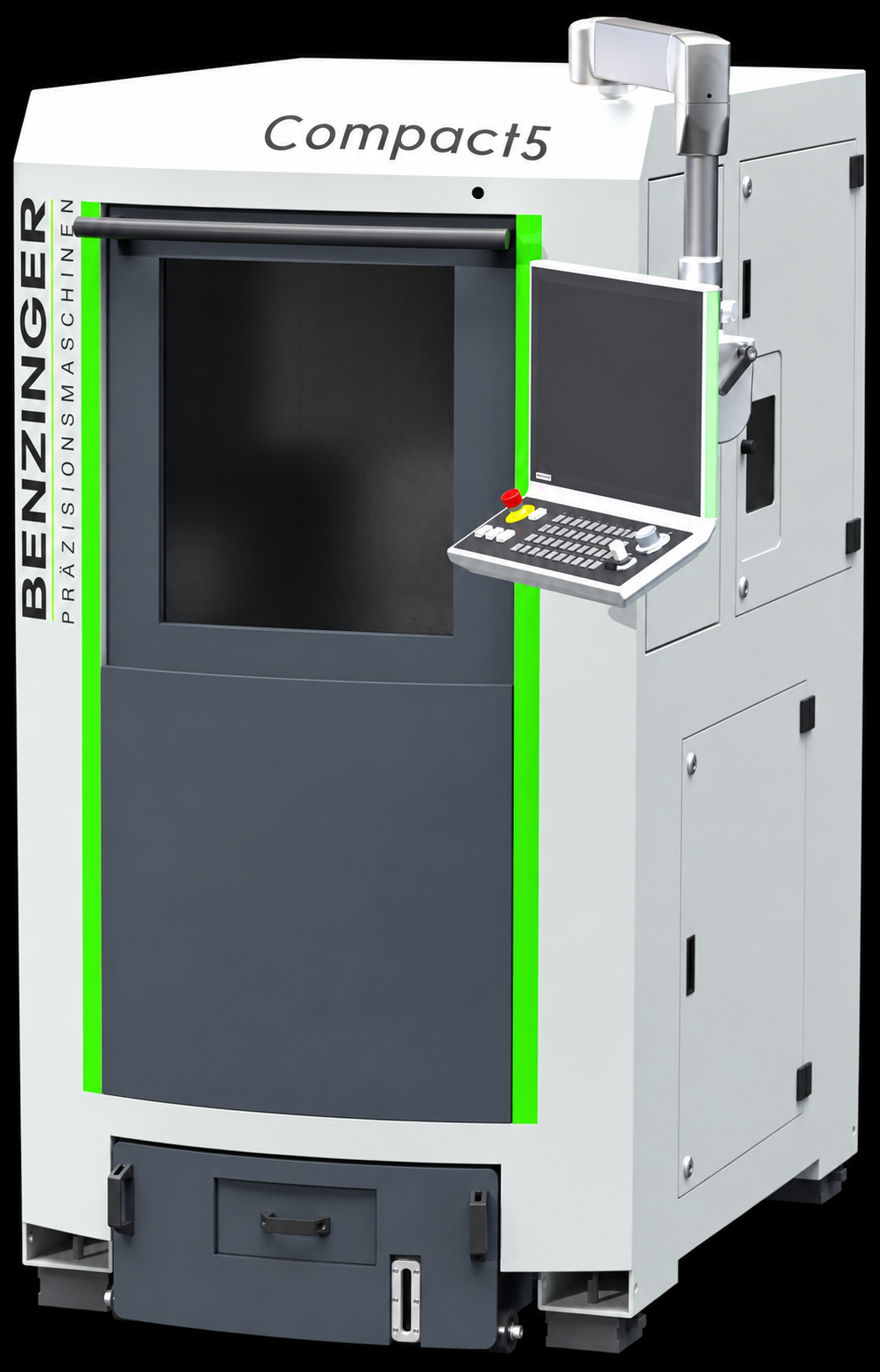
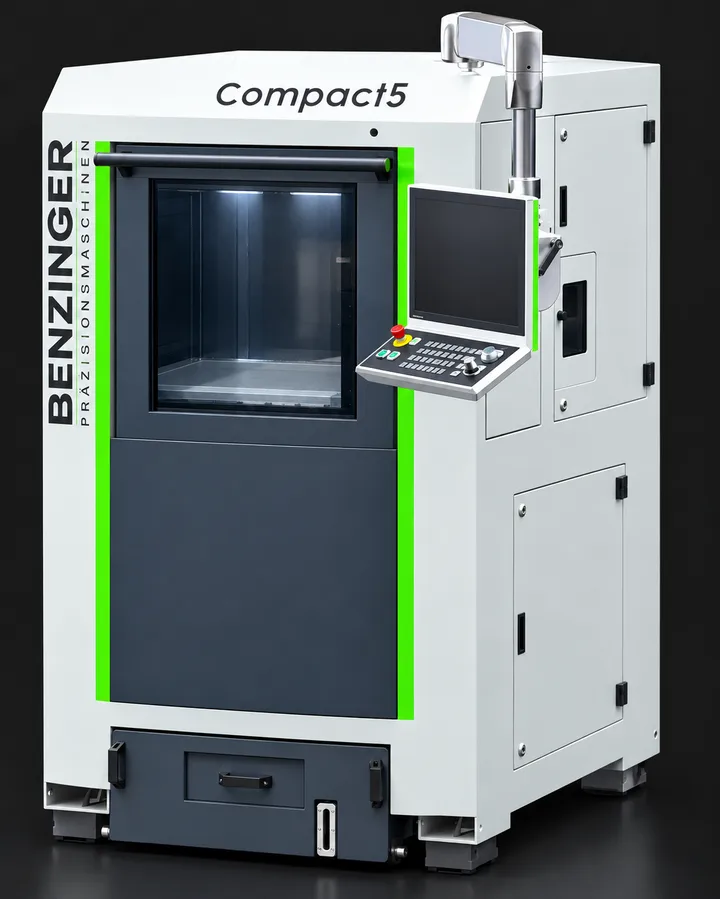
Benzinger’s new Compact5 brings five-axis machining and optional automatic gemstone setting into a small industrial machine. Its promise is a more connected route from a designed surface to a stone-set component. For jewellery manufacturers, the opportunity depends on the stones, the metal and the repeatability of the complete process.
PRIVATE EDITORIAL REVIEW / IMAGES NOT CLEARED FOR PUBLICATION
A new machine with an established idea
A row of stones around a ring asks for more than even spacing. Each stone needs a seat that fits, enough surrounding metal to hold it and an appearance that survives close inspection. Repeat that row across a collection, then across different ring sizes, and the appeal of a controlled manufacturing process becomes easy to see.
Compact5 is Benzinger’s 2026 answer to that production challenge. The company announced its first presentation at T.Gold/VicenzaOro 2026; the January fair ran from 16 to 20 January. Its January jewellery brochure already includes the model. This is a genuinely new machine for the September New Product spotlight, rather than an older platform presented as a launch.
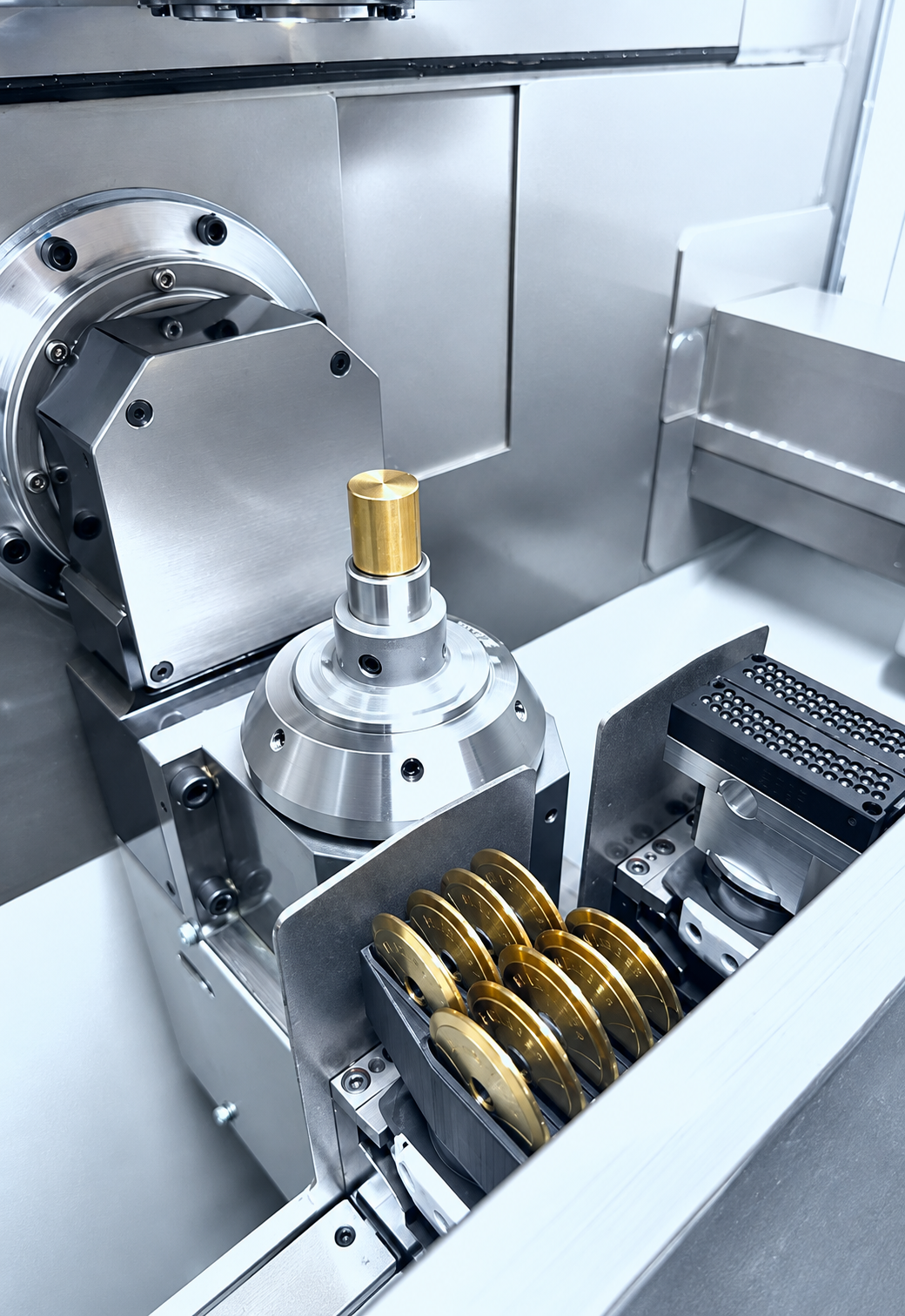
The proposition joins a compact five-axis machining centre with optional automatic stone setting and workpiece handling. A manufacturer could use it for a qualified sequence of surface machining and setting on suitable jewellery or watch components. The word “optional” matters: a basic machine and a configured stone-setting installation are different purchases.
Automatic setting itself is established within Benzinger’s range. An official 2018 document for the larger 5@work describes fully automatic gemstone setting using the separate FourC measuring system. Compact5 carries that established approach into a smaller platform. It should not be credited with inventing machine setting.
There is also experience outside the supplier’s catalogue. Croatian jewellery maker Križek reports using a 5@work for eternity wedding rings and praises its setting quality, while acknowledging an initial programming phase. That is a customer’s account of the earlier machine, not a Compact5 production benchmark. Its practical lesson is useful: owning the equipment is only the start of learning to manufacture with it.
The interesting question is how much of a repeatable collection can move through one controlled route while preserving the finish and security expected of fine jewellery.
The September news value
Compact5 is a 2026 platform. Earlier automated setting provides context; configuration and application qualification determine what a buyer can actually produce.
What automatic setting really means
The claim here concerns gemstones secured in a jewellery component. It should not be confused with placing stones in a wax pattern before casting, or dispensing adhesive to decorate an object. Benzinger explicitly describes fully automatic gemstone setting on Compact5, alongside metal-machining operations. The public material does not disclose every movement of its setting tool, so a universal sequence of nozzles, grippers and closing tools cannot responsibly be drawn from the brochure. [1]
The essential distinction is between positioning and retention. A stone can sit neatly in a hole without being securely set. In conventional metal setting, the seat supports it and the setting’s metal holds it in place. GIA’s workmanship guidance for bead-set diamonds in platinum treats stone security and the adequacy of the retaining beads as quality concerns. A successful automated process must deliver a similarly inspectable result appropriate to its particular design. [7]
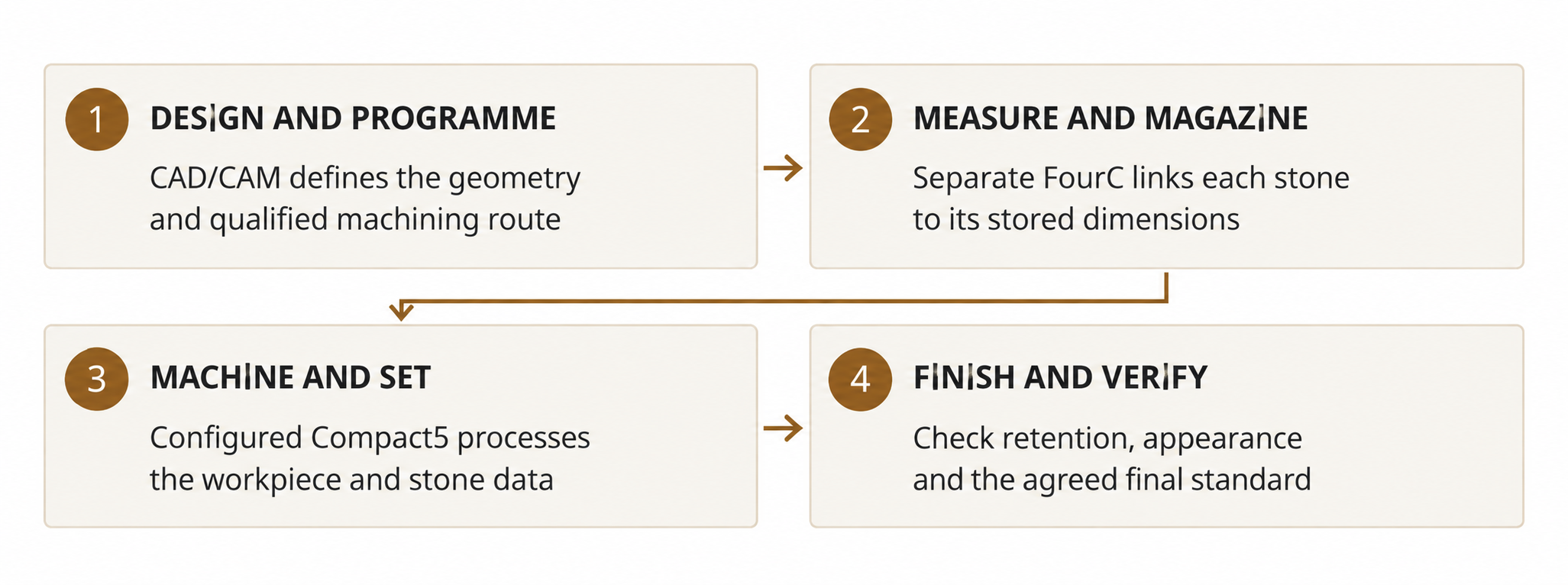
Benzinger’s documented route begins upstream. FourC measures each stone’s external dimensions, places it separately into a special magazine and stores the corresponding measurements. The January 2026 brochure explicitly says those magazines and data are then processed by 5@work or Compact5. FourC is a separate measuring and sorting machine; it is not a grading laboratory hidden inside Compact5. [3,8]
The published material names brilliant, baguette and princess forms. That establishes a useful starting point for discussion, not universal compatibility with every cut, gemstone species or size. Measurement range, orientation and handling requirements need to be confirmed for the intended stone parcel. There is no basis for assuming that irregular cuts or fragile treated stones can simply be substituted into an established job.
For the workshop, the data trail matters as much as the magazine. The stone associated with one measurement must remain associated with the correct position and programme. A mixed-up magazine would turn good measurement into the wrong manufacturing instruction. This is a process-control requirement to test during commissioning.
Five axes and the digital pattern
Compact5 is also a surface-making machine. Benzinger lists diamond milling, engraving, guilloché, faceting and turning among its applications for rings, bangles and jewellery or watch parts. “Diamond milling” describes machining with diamond tooling; it does not mean cutting the gemstones themselves. The value is being able to approach different surfaces and combine operations in an engineered setup.
Consider a ring with a repeating motif and a line of stones. The motif, seats and setting locations have to agree around the circumference. Every unnecessary transfer between fixtures introduces another task: find the part again, establish its position and make sure the new operation matches the last one. A multi-axis route can reduce those transfers where the workpiece, tooling and programme permit. It cannot make an obstructed surface accessible through a fixture.
Benzinger Creative is the additional CAD/CAM package supporting this route. Its published functions cover pattern construction, tool and machining-strategy definition and NC programme creation, with real-time simulation available. The Compact5 product description says designs for milling and setting can be constructed in CAD and converted into five-axis milling programmes. This is programmed manufacturing; no artificial-intelligence capability is established by these sources.
Simulation is valuable preparation, but a digital toolpath cannot alone certify a finished setting. The programmer still needs representative material, actual stones, workholding that preserves the intended position and a method for examining the result. Changes to ring size or surface curvature should be treated as engineering changes until the process has been checked.
The published technical sheet gives a 55,000 rpm milling spindle and HSK-E25 tooling. It marks the 70-position tool changer, automatic setting, stone orientation and integrated chain magazine as options. These specifications describe the platform’s equipment, not a guaranteed number of finished rings per shift.
Compact5 at a glance
|
Published item |
Manufacturer specification |
|
Milling spindle |
55,000 rpm; HSK-E25 tool holder |
|
Tool changer |
70 positions; optional on the technical sheet |
|
Setting and orientation |
Optional automatic setting and stone orientation |
|
Automation |
Optional chain magazine; external robot integration offered |
|
Control |
Siemens SINUMERIK ONE |
Small footprint complete workflow
The headline footprint is approximately 1.4 square metres. That is compelling for a production floor where every machine competes with benches, inspection space and material storage. It is also easy to misread. Compact5’s machine footprint is not the floor area of a complete jewellery manufacturing department.
A configured workflow may need the separate FourC, access for loading and maintenance, stone and workpiece storage, and facilities for cleaning, inspection and finishing. The product page also offers connection to an external robot cell. Any external cell, associated guarding and access arrangements must appear on the actual installation plan.
The distinction is especially important when comparing the compact machine with a manual route. A fair layout comparison includes the people and peripheral equipment needed on both sides. Moving work off a bench does not automatically remove the need for a skilled person to prepare, supervise and verify it.
Integrated handling can be useful when a repeat family of parts shares dependable workholding. It also makes replenishment, tool condition and interruption recovery worth testing. What happens when a stone is missing, a part cannot be clamped or a tool reaches its change limit? A proposed unattended run should be demonstrated with agreed responses to these conditions, rather than judged only by a fault-free showroom cycle.
The supplier’s January brochure and technical sheet differ slightly on overall height. That discrepancy does not undermine the compact-footprint proposition, but it reinforces a simple purchasing rule: use the approved layout for the quoted configuration. Published figures are a starting point for a factory conversation, not an installation drawing.
The limits live in the jewel
The most useful first candidates are pieces whose repeating operations can be defined clearly: a family of stone-set rings, a patterned bangle component or a watch bezel. These are editorial application suggestions, not a list of designs already qualified on Compact5. The machine’s jewellery focus is encouraging; suitability still belongs to the individual job.
Begin with the metal. The public Compact5 documents do not provide a comprehensive setting matrix for gold karats, platinum alloys, silver or their heat-treated conditions. A successful demonstration in one alloy cannot be assumed to transfer unchanged to another. Ask for a trial in the actual production alloy and condition, with enough material left around the stone seats to meet the agreed design.
Then examine the geometry. A slender wall, a deep recess or a surface interrupted by another setting may constrain tool access. Part support and clamping must hold the work securely without marking a visible surface or distorting a delicate component. A casting that varies from piece to piece creates a different challenge from a closely controlled machined blank.
The stone introduces its own limits. GIA’s research on gemstone durability distinguishes hardness, toughness and stability and discusses their relevance to setting, cleaning and repair. A stone’s ability to resist scratching is not a guarantee that it will tolerate every setting load. Gem identity, treatments, inclusions and vulnerable edges belong in the application review.
Nor do the public Compact5 pages establish that every pavé, channel, flush, claw or invisible-setting design is supported. Those names describe different geometries and retention methods. Obtain the precise setting style, stone range and approved process in writing instead of borrowing capabilities from another Benzinger model.
Finally, inspect the finished piece. Look for consistent height and alignment, secure retention, unmarked stones and an acceptable metal surface after the intended finishing sequence. Keep representative accepted samples as references. The standard should be the jewellery the customer will receive, rather than an attractive close-up taken before final polishing.
Application limits still to confirm
Exact alloy and condition; stone material, cut and dimensional range; setting style; minimum surrounding metal; usable part envelope; finish, retention and rejection criteria. No universal compatibility claim is supported by the reviewed documents.
The business case needs a real batch
A short demonstration can show that a machine works. A repeat batch reveals whether the workshop can use it economically. Separate time spent engineering the first design from time spent making repeat orders. Then measure the complete route, including measurement, loading, tool changes, inspection, rework and finishing.
This approach is particularly important when the attraction is labour availability. Automation can shift work towards programming, preparation and quality assurance. It does not establish that those tasks disappear. A skilled setter’s judgement remains valuable when defining an acceptable result, evaluating damaged or unusual stones and deciding which designs should stay with the bench.
Adoption evidence should also be read carefully. In a supplier-sponsored MaschinenMarkt article dated 8 September 2026, Benzinger reported that Compact5 projects had already been realised and highlighted favourable customer response to its integrated automation. No customers, jewellery installations or independently measured output figures were identified. The claim supports commercial activity by September, but not a quantified installed base or proven return for a specific jewellery line.
The public sources reviewed do not establish a machine price, an India-installed price, a standard stones-per-hour rate or an agreed payback period. An automatic setting option, CAD/CAM, measuring equipment and handling configuration could materially change the scope of a quotation. A headline machine price, if later obtained, should be read alongside what it includes.
For a pilot, use the same design and finish on the current route and the proposed machine route. Count accepted pieces, rather than attempted cycles. Record damaged stones, rework, consumables and recoverable metal separately. A quicker cycle loses much of its value if it produces more intervention downstream.
The most persuasive result would be a repeat order that meets the same acceptance criteria after an ordinary changeover, with costs and delivery time the production manager can reproduce.
Compare accepted output
|
Measure |
Why it belongs in the trial |
|
Engineering and setup time |
Separates first-design effort from repeat production |
|
Accepted finished pieces |
Includes inspection, rework and downstream finishing |
|
Stone and metal balance |
Makes damage, rejects and recovery visible |
|
Repeat order after changeover |
Tests whether the result can be reproduced |
An opportunity for Indian manufacturers
For an Indian jewellery business, Compact5 is most interesting when it addresses a specific production difficulty. A manufacturer with recurring ring or bangle families could investigate repeatable surface work and setting. A design-led business could test a motif that becomes difficult to reproduce consistently as a collection grows. An exporter could examine whether a controlled process helps meet a buyer’s agreed workmanship standard.
These opportunities do not require a claim that every workshop should automate. A small flow of varied, intricate one-off pieces may give programming and setup too little repeat work over which to spread their cost. Repair work, unusual stones and designs that depend on continual visual adjustment deserve a different assessment from a stable production family.
The first commercial conversation should also verify the support route. Benzinger’s worldwide contact page lists Indian partners within its industrial-machinery section, while directing jewellery-machinery enquiries outside Turkey to Benzinger itself. That is not confirmation that a named Indian distributor supports Compact5 jewellery installations. Obtain the responsible application engineer, commissioning plan, training scope, spare-parts arrangements and service response in the quotation.
A useful trial brief can be very concrete: one repeat design, its exact alloy, a representative stone parcel, the permitted dimensional variation and a finished reference sample. Include a second batch after a changeover. That turns an equipment discussion into a test of whether the manufacturer can deliver its own product reliably.
Compact5 earns attention because it packages a serious manufacturing proposition in a small machine. The next step is to identify where a setter’s standards can be translated into a repeatable process, and where skilled hands and judgement should remain central. The machine that sets the stones becomes valuable when it repeatedly makes jewellery worth selling.
The demonstration worth asking for
Your alloy, your stone parcel and your finished reference standard, repeated after a normal changeover. That is a more useful test than a machine-only speed claim.