Could this technology print tomorrow’s gold jewellery?
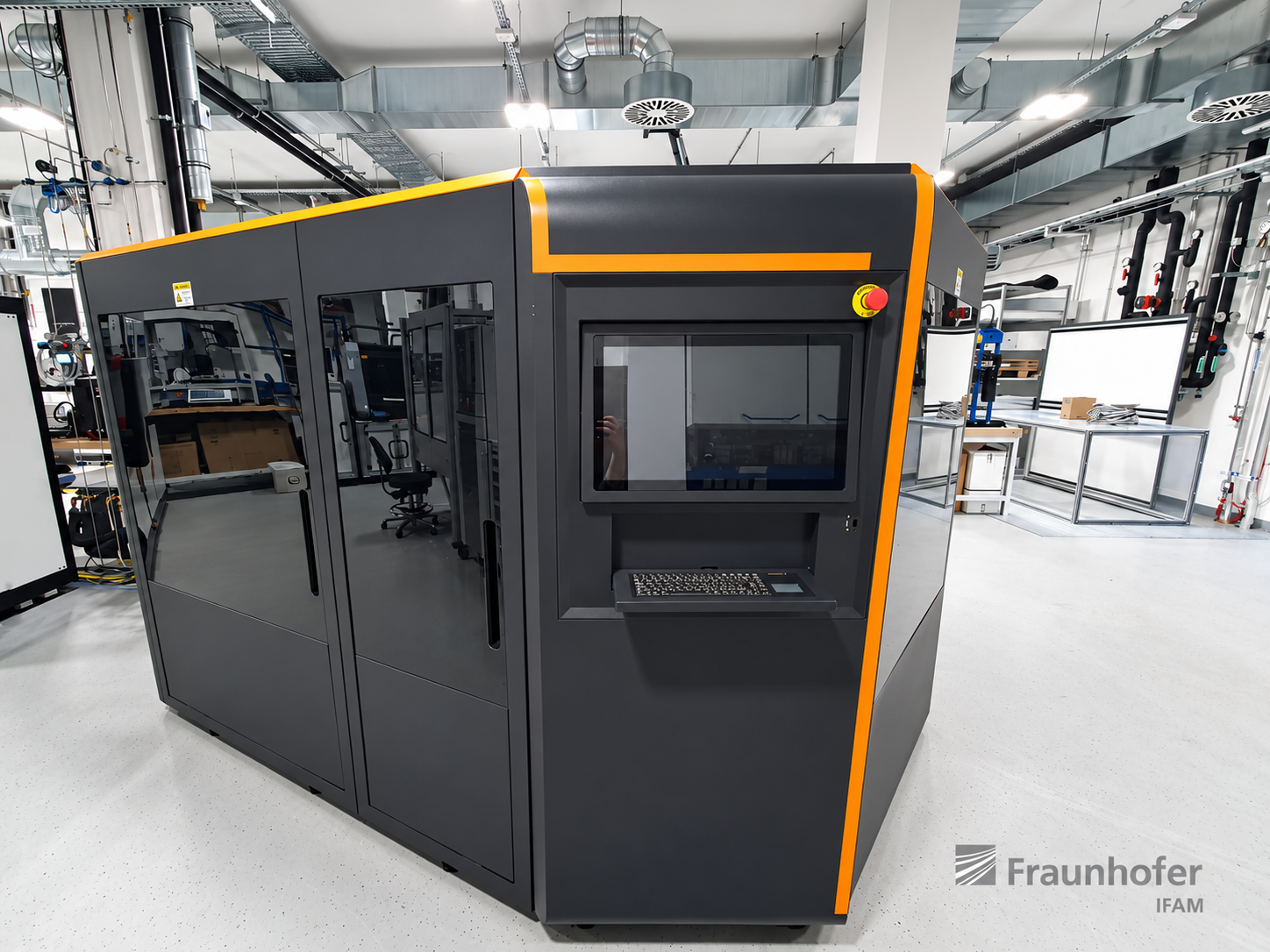
A machine that prints a mould, fills it with metal paste and repeats the process is opening a new route to precious-metal jewellery. With Legor announcing validated gold and platinum pastes for Tritone’s MoldJet technology in June 2026, the question has moved from whether the idea is possible to where it can earn a place on the production floor.
The precious metal moment
Imagine a pendant with an open lattice inside its curved shell. The designer wants lightness without making the piece look thin. The manufacturer sees another set of questions: how will it fill, how will it be cleaned, and how much work will be needed before the surface is ready for a customer? Tritone’s Dominant invites the industry to examine a different route to that same object.
Dominant is an industrial metal additive-manufacturing system built around MoldJet. Instead of directing a laser into a powder bed or pouring molten metal into an investment mould, it builds the shape in a temporary mould using metal-bearing paste. The printed object subsequently passes through a furnace to become a dense metal component. It is an approach worth understanding before attaching a jewellery-production promise to it.
The timely development comes from Legor. On 12 June 2026, the precious-metals specialist announced a partnership with Tritone and said it had developed and validated gold and platinum pastes for MoldJet. It also became Tritone’s manufacturing service partner for the jewellery and luxury market. Legor’s current 3D Metal Hub page lists gold as available upon request. This is a concrete service offering, although the public announcement does not disclose gold karats, platinum finenesses or a catalogue of qualified jewellery geometries.
There is an important distinction for this Machine of the Month. The announcement concerns MoldJet technology; it does not identify the model installed at Legor. Dominant itself was introduced in 2019. Its place in the New Product segment reflects a fresh jewellery application and renewed relevance, rather than a claim that the machine launched this year.
For an Indian manufacturer, the useful first question is therefore specific: can this route produce a particular design, in the required alloy, with an acceptable finish and a competitive delivered cost? A service-made sample can answer more than a general discussion about whether printing will replace casting.
What the public evidence establishes
|
Development |
What it means |
|
Gold and platinum pastes |
Legor reports development and validation for MoldJet in June 2026 |
|
Gold service |
Legor lists gold upon request; confirm the exact alloy and project specification |
|
Dominant model |
An established industrial platform; Legor’s installed model is not named in the announcement |
How a mould becomes metal
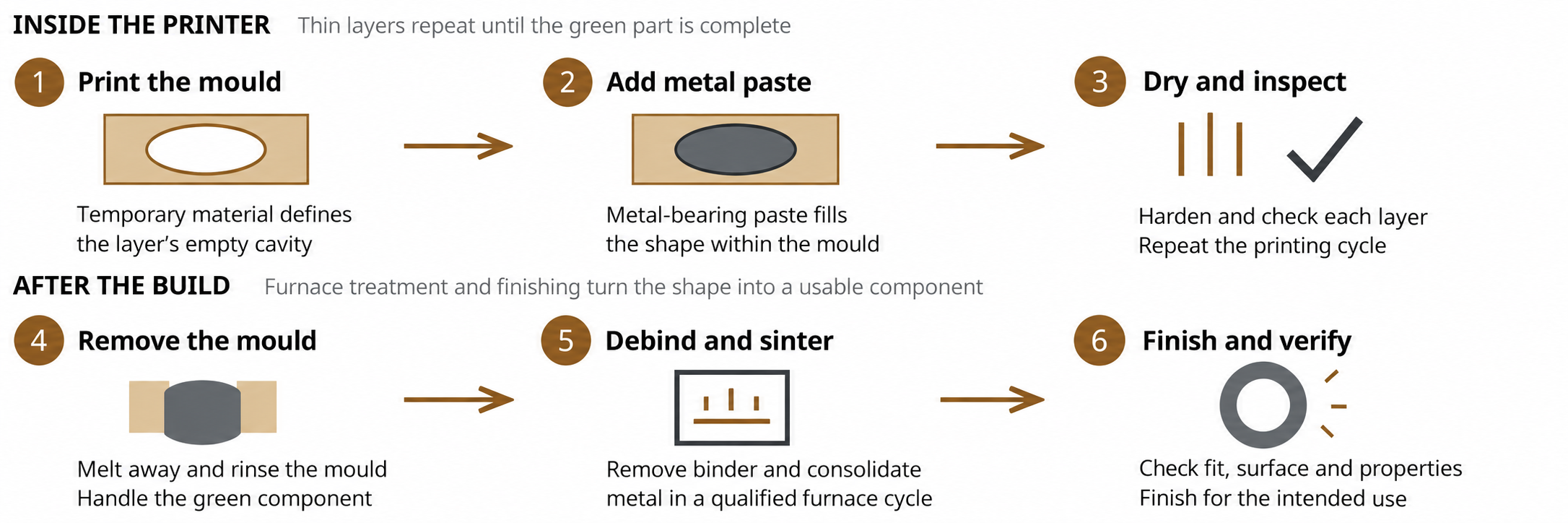
The simplest way to understand MoldJet is to picture a shape being constructed one thin slice at a time. For each slice, an inkjet system deposits the temporary mould material around the spaces that will become the component. Metal paste is spread into those spaces. The mould defines the outline and supports the work as it grows.
The paste contains metal powder held in a processable mixture. Tritone’s description of the system as powder-free refers to handling paste instead of a bed of loose powder. It does not mean that the feedstock contains no metal particles, or that ordinary material and furnace safety controls disappear.
After deposition, drying and hardening stabilise the layer. A camera-based inspection system checks it before the next layer is added. Tritone says a faulty layer can be removed and rebuilt. This can catch printing problems early; it cannot certify the metallurgy or polished appearance of an object that has yet to enter the furnace.
The cycle repeats until a tray contains complete green parts inside the temporary mould. Green here means formed but not yet sintered. Fraunhofer IFAM’s technical assessment highlights the strength of MoldJet’s green parts, which assists handling after the mould has been removed. Tritone’s current workflow uses melting and a solvent rinse to clear the mould material.
Thermal debinding then removes the remaining binder, and sintering bonds the metal particles into a consolidated component. Those furnace steps are central to the manufacturing route. A printed shape leaving the machine is not a finished gold ornament. It may still need dimensional correction, machining, polishing, joining and stone setting, depending on the design. The attraction is that the shape is already present in metal-bearing material, without first producing a wax positive and casting it.
A machine built around batches
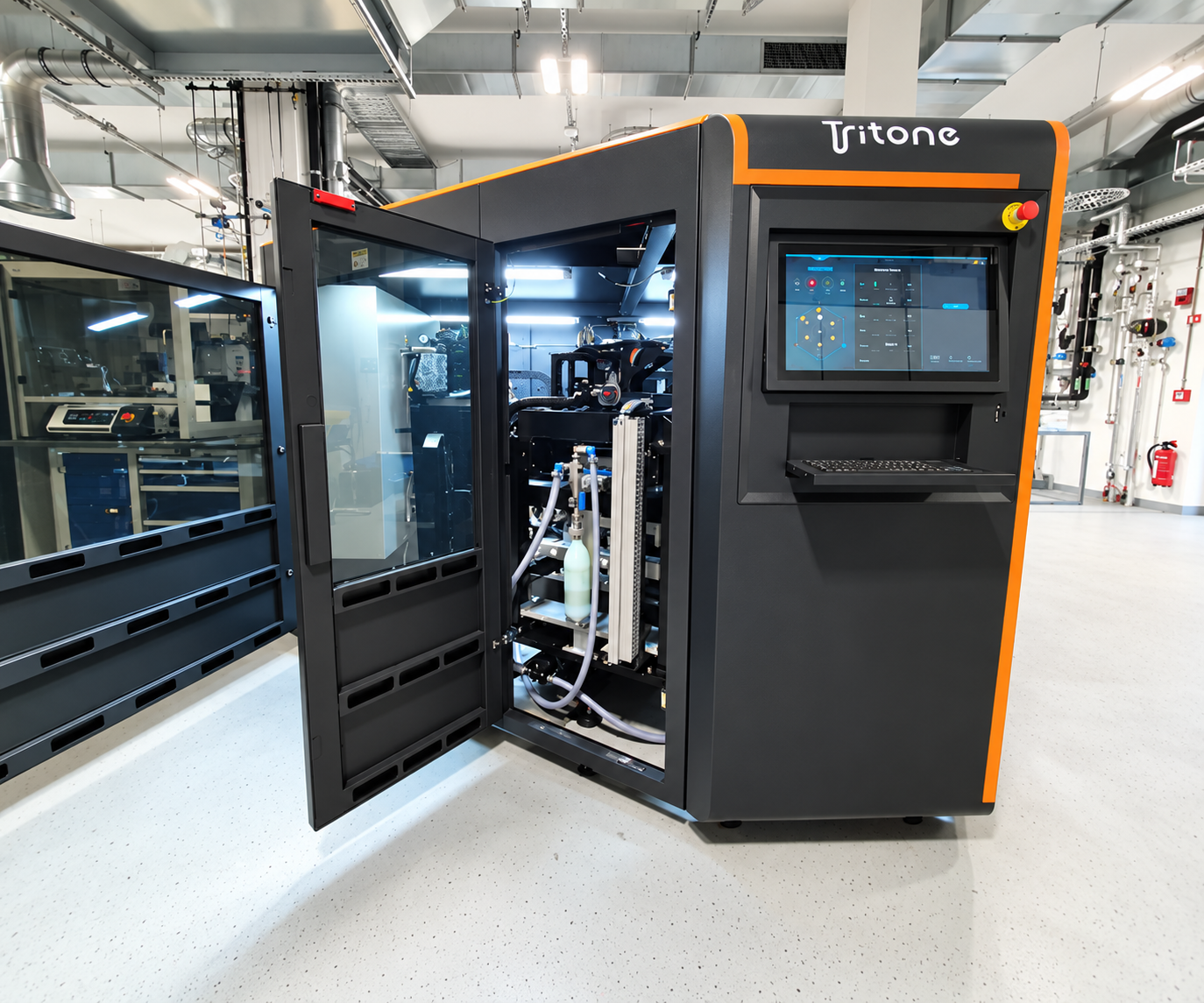
Dominant’s scale becomes clearer when its trays are considered. The current specification lists six independent trays working simultaneously, each with a nominal build space of 400 × 240 × 120 mm. Small components can be arranged across a tray and in successive levels, making the use of available build volume an important part of job planning.
This is useful for a jewellery business with several related designs, sizes or personalised versions. Digital variation does not require every part in a run to share the same geometry. The production planner must still group work sensibly by material and downstream requirements; six trays should not be read as permission to mix arbitrary precious alloys in one qualified process.
Tritone’s current Dominant page gives throughput of up to 1,200 cubic centimetres per hour and nominal layers adjustable from 25 to 150 micrometres. Both need careful interpretation. A layer thickness is a printing setting, not a promise of final dimensional accuracy. A machine throughput ceiling is also not a measured gold-jewellery output rate.
The work continues after printing. Loading efficiency, the time needed to remove mould material, furnace capacity, shrinkage compensation and finishing labour all affect how many saleable pieces leave the workshop. A fast printer can simply move the queue to the sintering furnace or polishing bench if the rest of the route is undersized.
Fraunhofer IFAM installed a MoldJet system in Dresden in 2021 and uses the technology for material, geometry and process-development work. That research setting is a useful reminder that qualifying an application is part of the route.
Dominant is a factory-scale machine, with published dimensions of 3.2 × 3.5 × 2.2 metres. Space for access, associated equipment, materials and work in progress sits beyond that headline envelope. For many jewellers, commissioning parts from a specialist is a more proportionate first experiment than beginning with an equipment purchase.
Dominant at a glance
|
Published specification |
Current manufacturer rating |
|
Build trays |
6 simultaneous, independent trays |
|
Each tray |
400 × 240 × 120 mm |
|
Throughput |
Up to 1,200 cc/h |
|
Nominal layer thickness |
Adjustable from 25 to 150 µm |
|
Machine envelope |
3,200 × 3,500 × 2,200 mm |
The furnace decides the fit
Jewellery makes small deviations visible. A ring must reach its intended size; mating components must meet; stone seats need sufficient material for the setter. Sintering therefore deserves as much attention as the printing stage. As the particles consolidate and the binder leaves, the component becomes smaller, and the design and process must allow for that change. Tritone’s own Ansys engineering guide discusses distortion, orientation and compensated geometry during sintering. Support-free printing does not guarantee fixture-free furnace treatment.
Fraunhofer IFAM’s 2021 assessment reported shrinkage of roughly 11–15 per cent for the process conditions it discussed. That range is useful for understanding the scale of the engineering problem, but it is not a shrinkage allowance to copy into an eighteen-carat gold design. The actual compensation depends on the alloy, paste, geometry and furnace cycle.
More recent research provides evidence of the route’s industrial development. A 2026 study of MoldJet 316L stainless steel reported 99.9 per cent relative density under its optimised conditions using small cubic samples. Such results support investigation of the process; they do not establish equivalent properties in gold or platinum jewellery. Material identity, sample shape and processing conditions travel with the result.
The surface introduces another practical test. A decorative lattice can look compelling in CAD while presenting corners that polishing tools cannot reach. A bright finish may reveal pores or layer texture that were unobtrusive on an unfinished sample. Any comparison should therefore follow the piece through the intended finish, rather than stop at a photograph of the green or freshly sintered part.
For a precious-metal trial, agree the target alloy, fineness, colour, dimensions and surface condition before making the sample. Then examine representative pieces after the same setting, joining or polishing operations planned for production. A repeat batch is valuable: the business needs a reproducible route, not one attractive demonstration. These are practical acceptance tests, not a claim that every MoldJet material already meets a jewellery specification.
Design freedom with a purpose
The most interesting opportunity lies in designs where conventional production forces an awkward compromise. A sculptural pendant might gain an internal lattice. An earring could distribute metal where stiffness is needed and remove it where it only adds weight. A complex decorative component might combine features that would otherwise need separate manufacture and joining. These are candidate applications, subject to qualification in the chosen alloy.
Because the temporary mould supports the geometry during printing, MoldJet does not require the same sacrificial metal supports associated with some laser metal-printing routes. That helps explain its appeal for complex forms and packing parts through the build height. It does not remove all support questions: delicate features must survive demoulding and furnace treatment without unacceptable distortion.
Hollow shapes deserve particular care. Designers need a workable plan for removing mould material and for cleaning and sintering the interior. An attractive enclosed cavity on a screen is not sufficient proof that the finished piece can be manufactured consistently. Agree the internal geometry with the process specialist before committing to a design.
There is already a jewellery-shaped example in the public record. Tritone has shown a ring designed by ERPRO GROUP and identified its material as 17-4PH stainless steel. It is a useful demonstration of form. It should not be presented as a gold or platinum ring, and it does not prove the finish or economics of a precious-metal collection.
Likely early candidates include statement rings, openwork pendants, sculptural earrings and selected watch or luxury-accessory components. Thin claws, tightly fitted mechanisms and highly polished uninterrupted surfaces call for especially careful trials. The best first application is a design whose value comes from the geometry, with accessible surfaces and measurable acceptance criteria. Merely moving a straightforward casting to a printer may offer little benefit.
Candidate applications to investigate
|
Jewellery idea |
What a trial must prove |
|
Openwork pendants and earrings |
Mould evacuation, shape stability and access for finishing |
|
Sculptural statement rings |
Final size, polishability and setting behaviour where relevant |
|
Selected watch or luxury components |
Fit, surface, wear and repeatability in the exact alloy |
Where it can challenge casting
The fair comparison is with a modern jewellery casting operation. Digital wax-pattern printing already gives manufacturers intricate shapes, personalisation and repeatable CAD-driven development. For example, 3D Systems explicitly positions its wax printers within established lost-wax casting workflows. Design complexity belongs on both sides of the comparison.
MoldJet may become attractive when it avoids a difficult wax assembly, investment route or casting problem, or when several parts can be consolidated into one useful geometry. Producing varied designs together could also help collections with many versions and modest quantities per version. Whether those advantages survive the furnace and finishing stages must be demonstrated with the actual pieces.
Casting remains a strong starting point for designs that already run reliably in a workshop’s established alloys. The manufacturer has experience with its trees, flasks, machines, metal recovery and finishing sequence. A repeat order of a successful conventional design gives that accumulated knowledge real economic value. Changing routes introduces qualification work which must buy a worthwhile improvement.
Neither route deserves a universal cost or waste claim. Printing may avoid sprues and some assembly work, but precious metal remains tied up in feedstock, unfinished parts and recoverable residues. Casting also recovers valuable metal from trees and process scrap. The comparison needs a metal balance and an agreed refining route, alongside labour, consumables, furnace use, rejected pieces and subcontract charges.
Similarly, there is no sound basis for translating an industrial throughput figure into a promised number of finished rings per shift. A quotation should state what is included: alloy, build preparation, sintering, inspection, finishing, recovery and delivery. Compare accepted pieces at the same specification and order quantity. That is where a technically exciting process either becomes a useful manufacturing option or remains an interesting sample.
Compare the whole manufacturing route
|
Question |
MoldJet route |
Printed wax and casting |
|
Shape creation |
Temporary mould and metal paste |
Positive wax pattern and investment mould |
|
Thermal control |
Debinding and sintering; shrinkage and distortion |
Burnout, melting and pouring; filling and solidification |
|
Decision metric |
Accepted finished pieces in the specified alloy |
The same finish, alloy, dimensions and accepted quantity |
The first collection should be a test
A sensible pilot can begin with a small family of parts rather than a catalogue. Include one known design that gives a casting benchmark, one geometry that is difficult to make today, and one design conceived for the possibilities of the new process. Together they show whether the benefit comes from efficiency, from design, or from neither.
Ask the service provider to confirm the precise precious alloy and the qualified route in writing. Establish finished dimensions, acceptable surface condition, minimum features, any sintering supports and the treatment of recovered metal. For pieces intended for sale, fineness and the applicable market’s quality requirements must be part of that agreement. A published statement that gold is offered upon request is an invitation to a technical discussion, not a specification sheet.
Record the full journey to an accepted piece. How much engineering and finishing time was needed? Did the design hold its shape? Could the setter and polisher work as intended? Were the cost and lead time repeatable on the next batch? Keep the benchmark honest by giving the casting route an equally well-prepared design and process.
This approach also limits the risk for an Indian workshop. Legor offers a visible entry point for evaluating precious-metal MoldJet, but service terms, logistics, alloy choices and delivery need a project-specific quotation. Public sources do not establish an India-specific Dominant price, local service commitment or ready-made payback period. None is necessary to begin asking the right engineering questions.
The reason to watch Tritone Dominant is the combination of a batch-oriented industrial platform and a newly announced precious-metal route. The opportunity is tangible enough to test. Its strongest future in jewellery may begin with pieces that are difficult, distinctive and worth engineering carefully, then expand as repeatable quality and economics are established. The next convincing headline will be a well-finished design produced again at an agreed cost.
Agree the acceptance criteria first
|
Confirm before printing |
Measure after finishing |
|
Alloy, fineness and target dimensions |
Assay, fit and dimensional consistency |
|
Surface standard and downstream operations |
Polishability, joining and setting performance |
|
Included services and recovery route |
Full cost, accepted yield and metal balance |