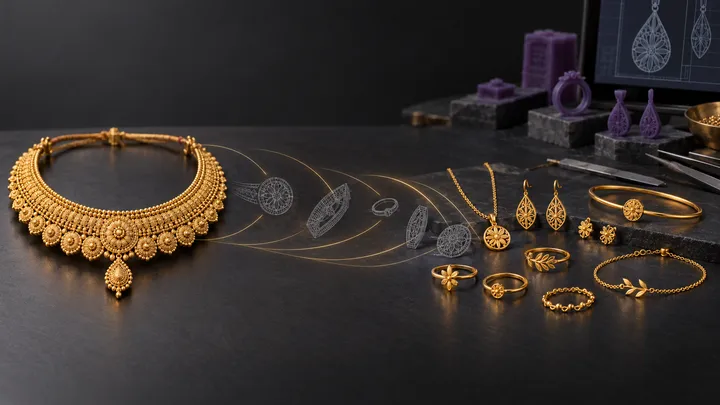
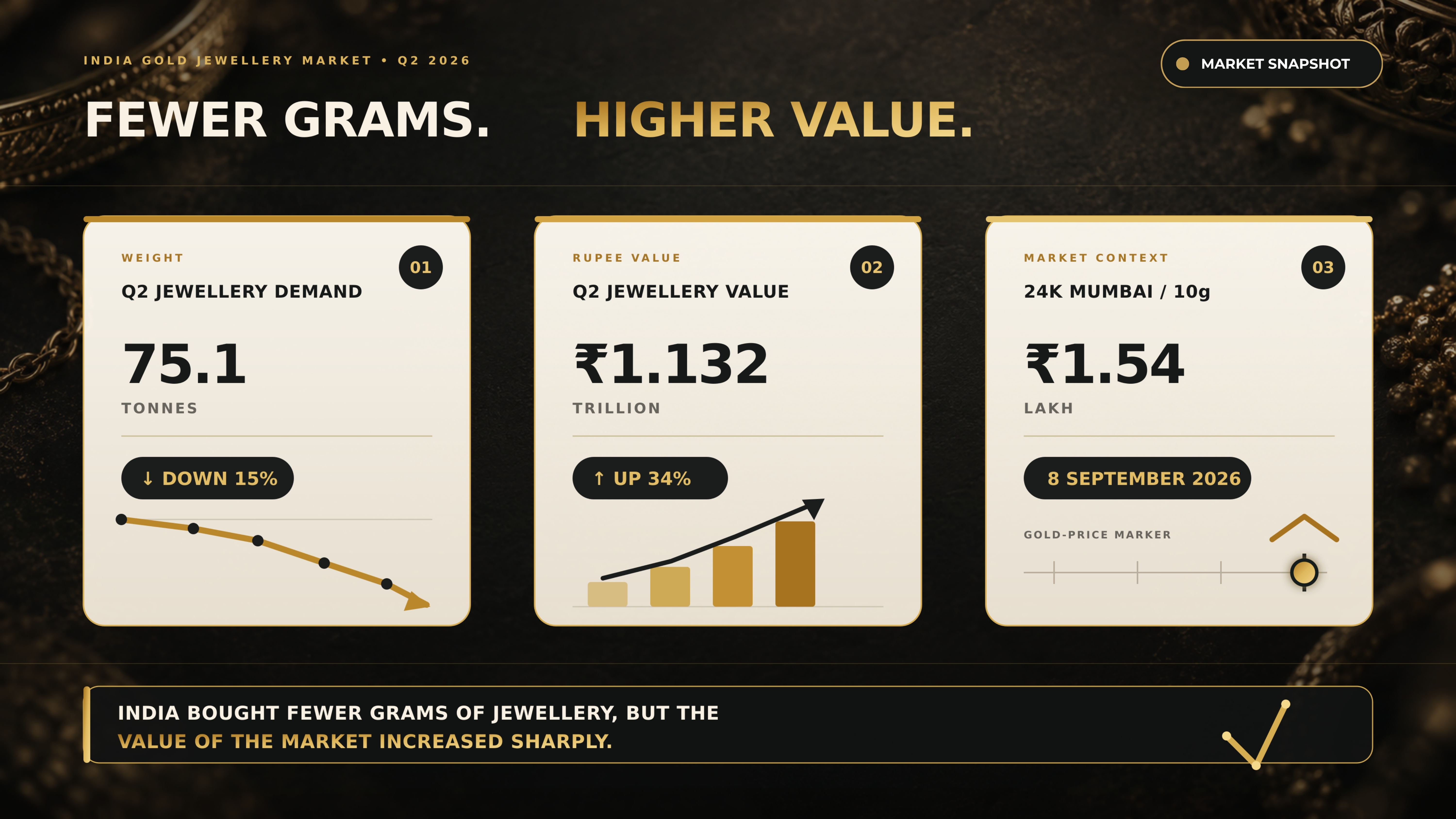
Record gold prices are changing India's jewellery economics. The market can sell fewer grams while creating more pieces, more designs and more production activity per kilogram.
|
Q2 Jewellery Demand |
Q2 Jewellery Value |
24K Mumbai Gold |
|
75.1 tonnes |
₹1.132 trillion |
₹1.54 lakh per 10 grams |
|
Down 15% year-on-year |
Up 34% year-on-year |
8 September 2026 |
The next growth metric may be revenue, designs and inventory turns per kilogram rather than kilograms sold.
Data as of 8 September 2026. This is industry analysis, not investment advice.
CURRENT SCENARIO
More Jewellery Business with Fewer Grams of Gold
Record gold prices are not killing India's jewellery business. They are changing its unit economics. The more useful questions now concern design value, SKU velocity, inventory turns and revenue per gram, not only the number of kilograms sold.
The Contradiction That Matters
India's gold-jewellery demand fell 15% year-on-year to 75.1 tonnes in Q2 2026, yet the rupee value of that demand rose 34% to ₹1.132 trillion. On 8 September 2026, 24K gold in Mumbai was shown at ₹1.54 lakh per 10 grams. Together, these figures describe a market in which consumers may buy less metal while the commercial value of jewellery sales remains high.
The World Gold Council evidence cited in the source says affordability pressure is pushing consumers toward lighter-weight, lower-carat and studded products. That response changes both the product mix and the work required to produce it.
Why Factory Workload Can Rise When Tonnage Falls
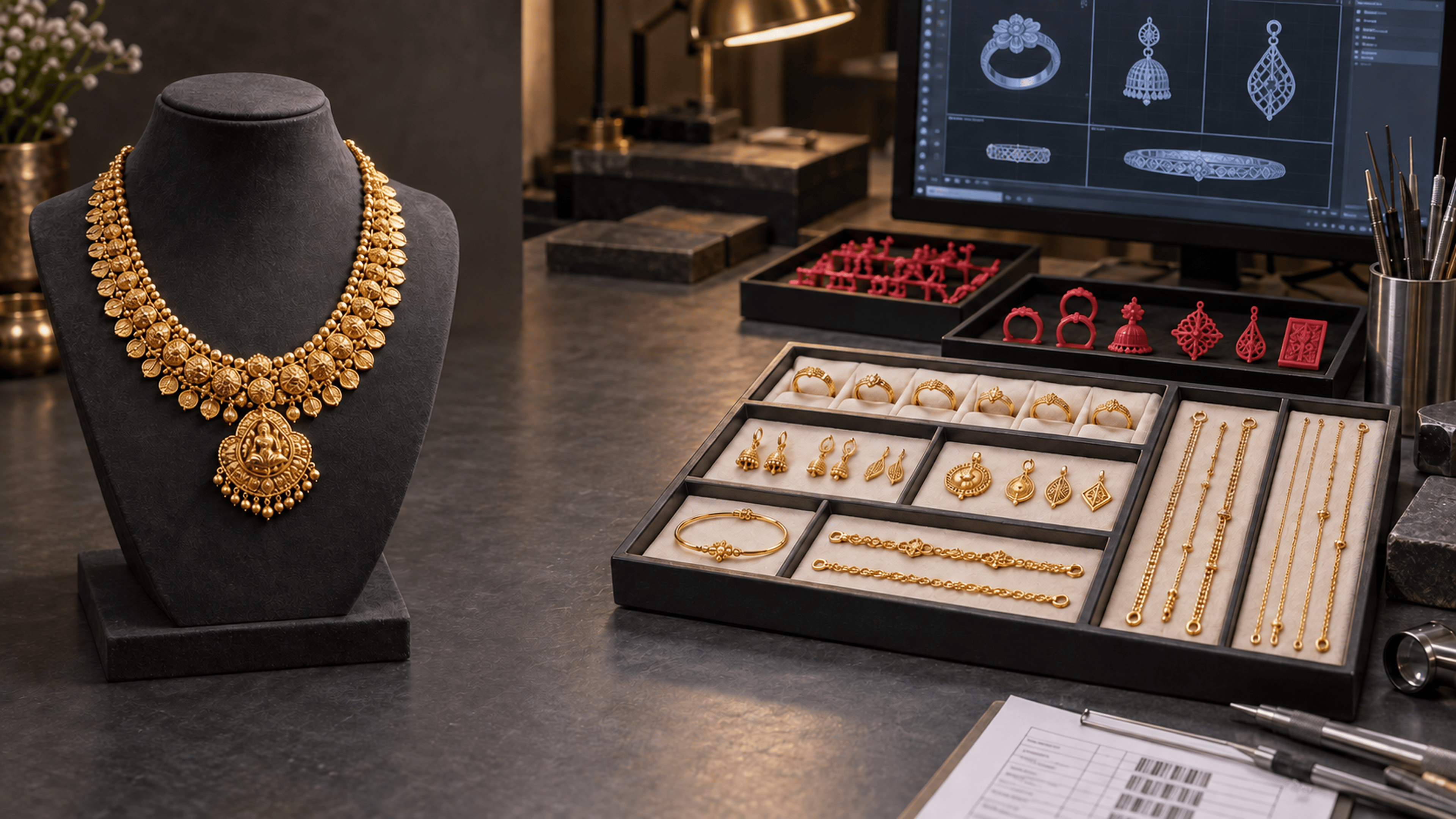
A high-gold-price market can produce fewer grams but more individual pieces. One heavy 50-gram necklace may be replaced by several products in the 10-to-15-gram range across different designs. Total metal demand can fall while the number of CAD files, wax patterns, casting cycles, production trays and SKUs increases.
This explains why a manufacturing floor can feel busier even when national jewellery tonnage is lower. Gold weight is only one measure of activity. Each new design creates engineering, printing, inspection, handling and scheduling work, regardless of its finished weight.
Fewer grams can still mean more designs, more pieces and more factory transactions.
The IIJS to Factory Conversion Signal
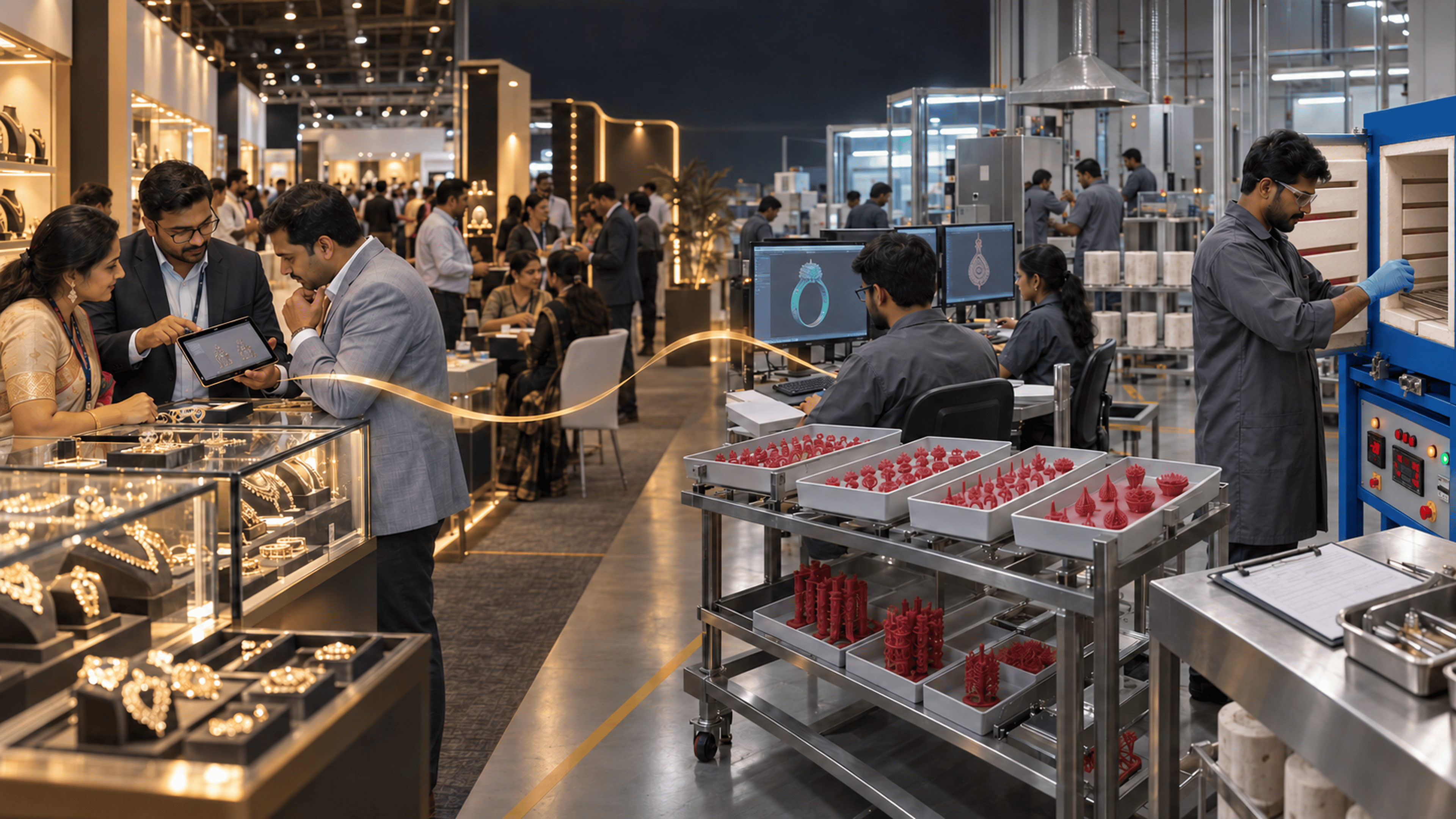
Strong trade-show activity becomes more meaningful when it is followed by actual CAD, wax-printing and casting workload. IIJS Bharat Premiere 2026 was reported with more than 2,100 exhibitors, more than 3,600 stalls and more than 50,000 trade visitors.
|
IIJS Bharat Premiere 2026 indicator |
Reported scale |
|
Exhibitors |
2,100+ |
|
Stalls |
3,600+ |
|
Trade visitors |
50,000+ |
Exhibition footfall by itself does not prove manufacturing growth. The stronger signal appears when exhibitor optimism is followed by overloaded rapid-prototyping capacity. In that case, at least part of the show activity is converting into real orders instead of ending with enquiries at the venue.
Why 3D Wax Printing Can Boom
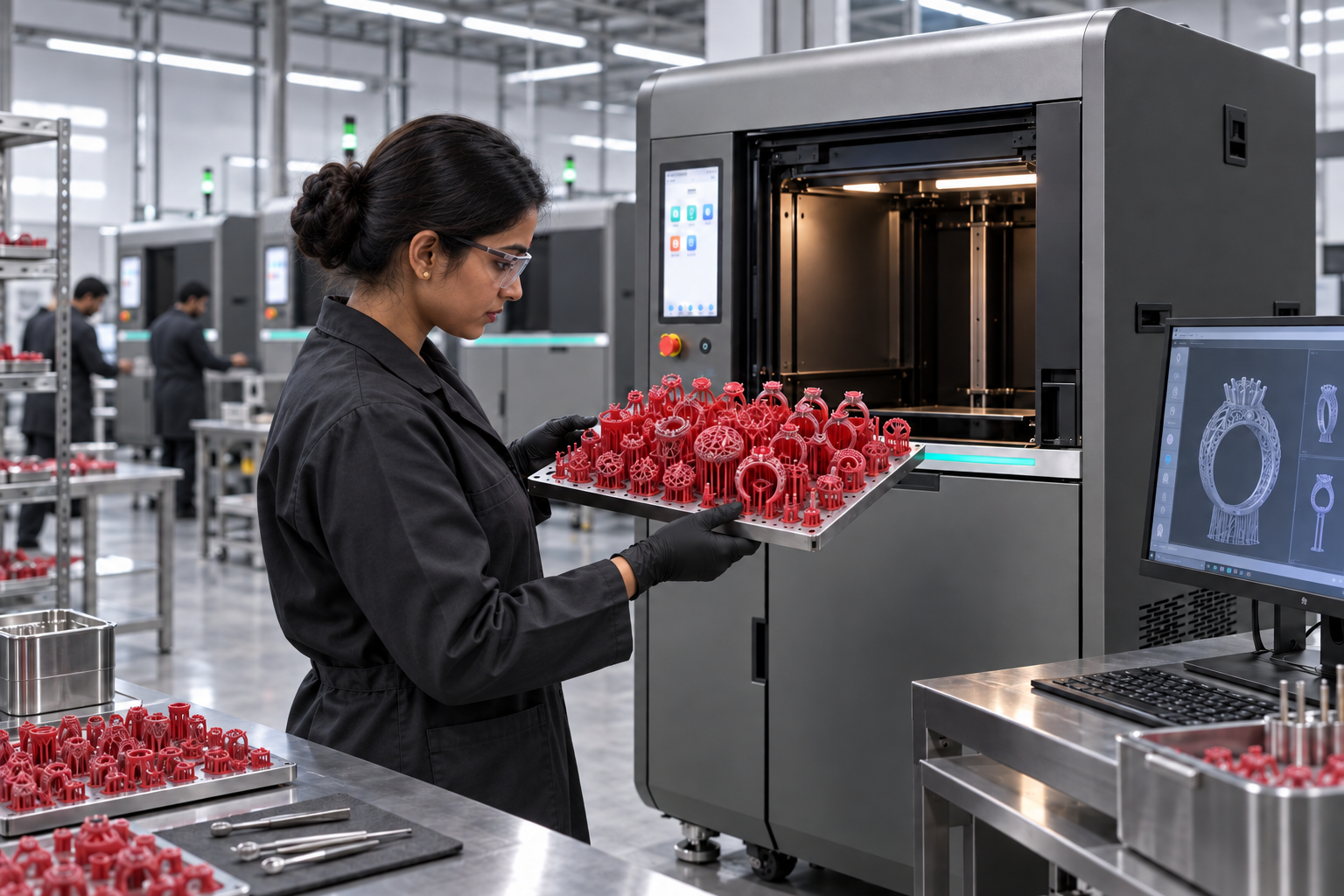
The source reports anecdotal evidence of unusually high rapid-prototyping job-work load in parts of the market. This is a production signal rather than a national statistical measure, so it should be read with that limit in mind.
The signal fits the economics of 2026. Retailers want more variety with lower average weight, shorter runs and faster replenishment. Every additional design family can create CAD and printing work even if total fine-gold tonnage does not rise. A wax-printing bureau may therefore see more files, builds and deadlines while each finished product contains less gold.
What Manufacturers Should Measure
CAD files released and revised per week, not only grams of wax printed.
Printer builds, patterns and unique SKUs completed per shift.
Backlog age, promised turnaround and first-pass print acceptance.
Conversion of exhibition enquiries into approved jobs and repeat orders.
Metal loss and recovery per finished gram after casting and finishing.
IPO Capital Becomes Inventory Capital
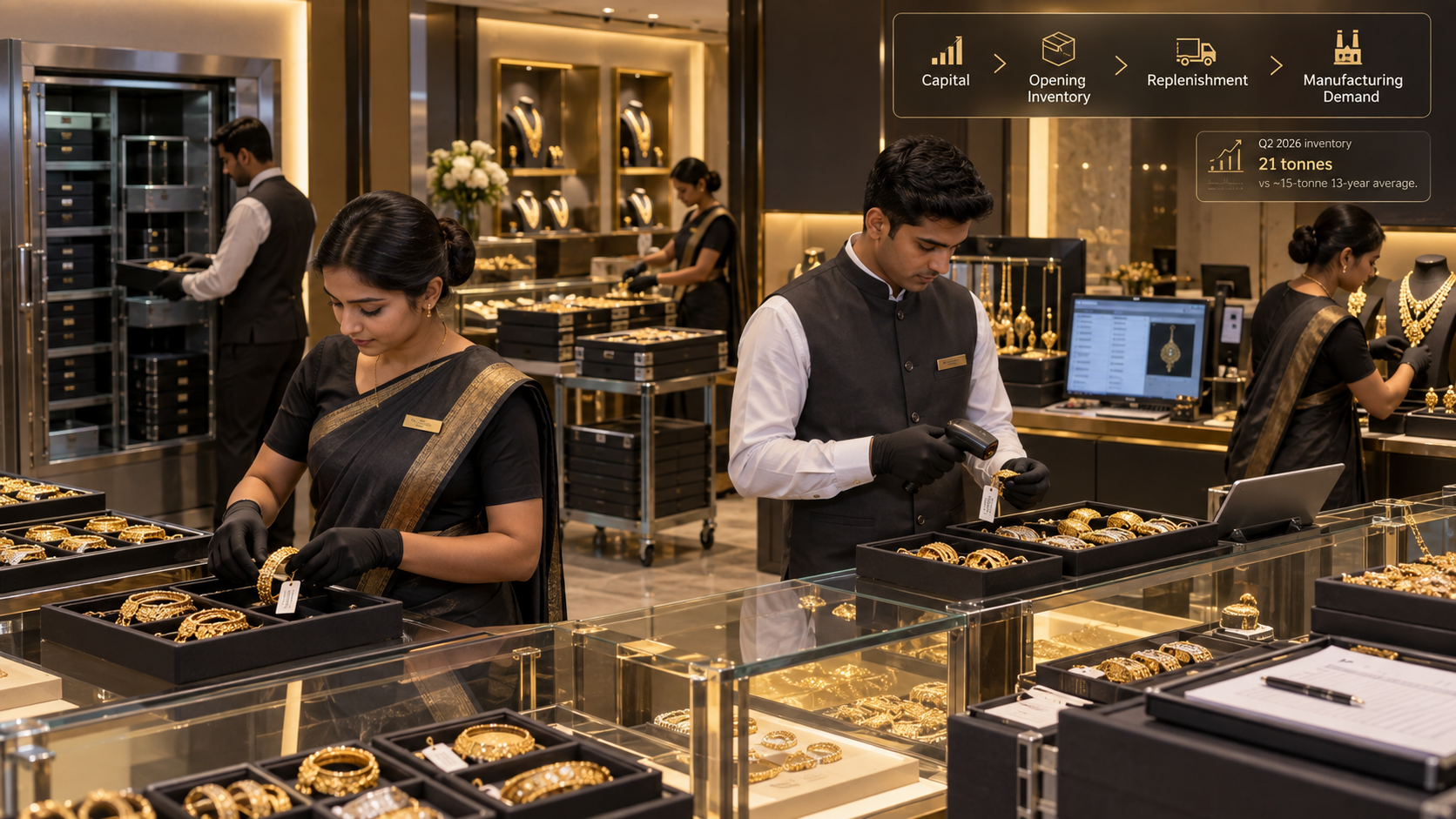
The jewellery IPO wave is another structural signal because public capital can strengthen working capital, inventory and expansion. The source identifies three examples and keeps their uses separate.
|
Company |
Capital allocation cited in the source |
|
Deepa Jewellers |
About ₹215 crore of fresh-issue proceeds for long-term working capital, including jewellery inventory procurement and expansion. |
|
Shanti Gold |
₹200 crore for long-term working capital. |
|
Shankesh Jewellers |
₹38 crore for working capital and ₹158 crore for debt reduction. |
More equity capital does not automatically guarantee higher sales. It does, however, improve the ability of an organised retailer to carry inventory, open stores and replenish ranges. That matters because every new showroom requires opening stock before it produces customer revenue.
Store Expansion Has a Gold Cost
Industry inventory reached 21 tonnes in Q2 2026 compared with a 13-year average of about 15 tonnes. New stores and larger networks create physical-gold and manufacturing demand through opening inventory and continuous replenishment. This requirement appears before the first customer purchase at a new location.
11 September 2026 Means Liquidity Rather Than Physical Gold

The premature-redemption date for Sovereign Gold Bond 2019-20 Series X falls on 11 September 2026. Eligible investors can redeem through the Reserve Bank of India, and the proceeds are paid in Indian rupees.
That distinction is central to the market interpretation. SGB redemption releases financial liquidity to investors. It does not place physical bullion into the domestic jewellery market. Some recipients may choose to buy jewellery or physical gold after receiving the money, but that would be a new purchasing decision rather than metal released by the bond redemption itself.
The Real Physical Supply Story
Prime Minister Narendra Modi's May appeal was to avoid non-essential gold purchases for one year. It was not a blanket ban on gold imports. The distinction matters because a voluntary appeal and a legal import restriction would have very different effects on supply and trade.
India's Q2 gold supply fell to 120 tonnes, while net bullion imports were 98 tonnes. With high prices and lower supply, the industry has a stronger reason to watch domestic inventory, exchange and recycling behaviour. These channels can influence how much fresh bullion the jewellery sector needs.
Old Gold Is Becoming a Business Model
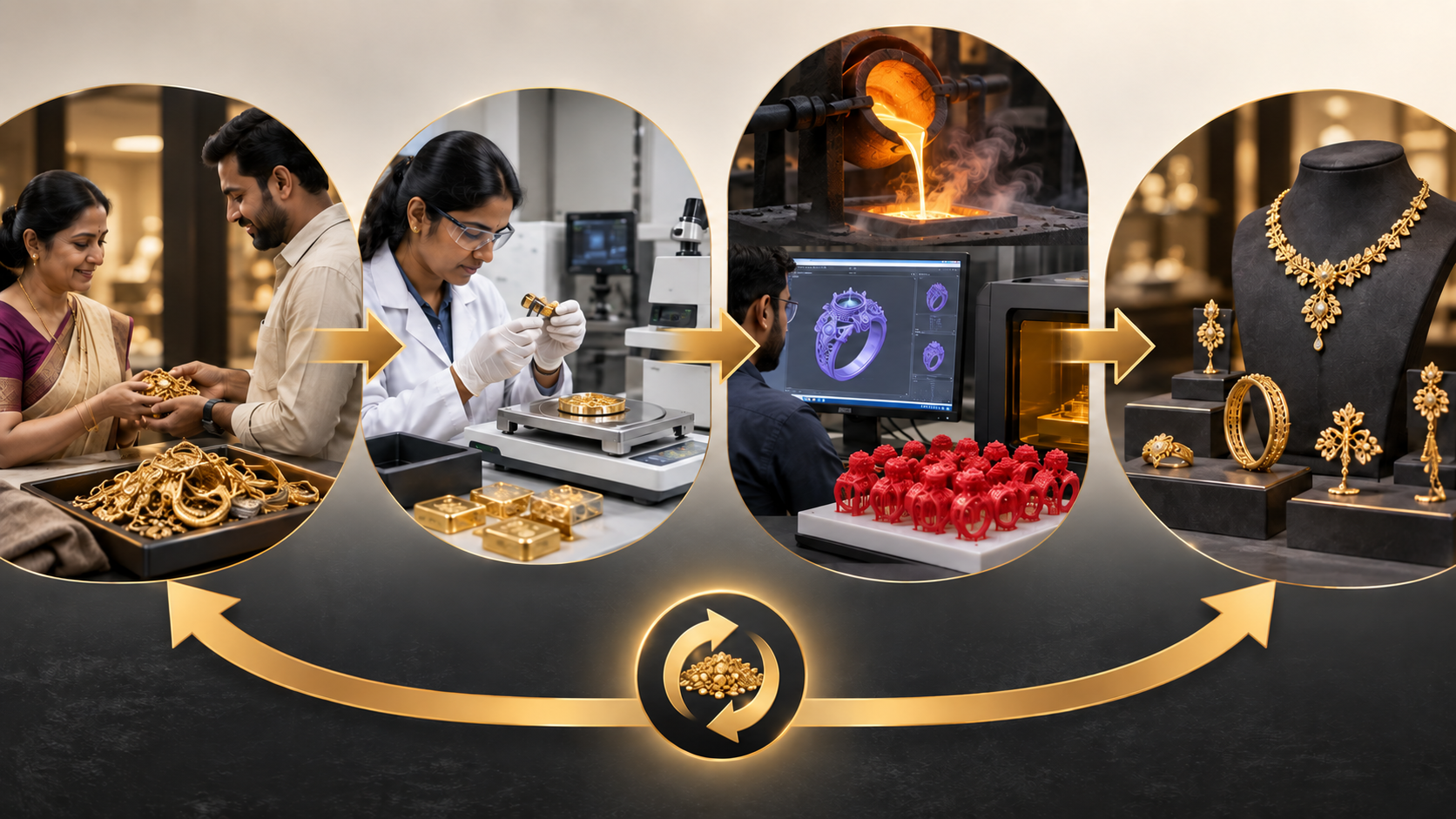
Among major listed retailers, old-gold exchange represented roughly 43% to 55% of sales in the April-to-June quarter. Exchange does not create new gold supply. It mobilises metal already held by households and can reduce the fresh imported bullion required to make replacement jewellery.
The commercial model depends on disciplined intake, identity checks, accurate weighing, assay, refining accountability and transparent valuation. Once verified, old metal can return to manufacturing through a controlled route and emerge as a new lightweight product designed for the current price environment.
The Emerging Circular Gold Economy
The complete loop is simple to describe but demanding to control. Household old gold enters through an exchange transaction, moves through assay and refining, becomes feedstock for a new design, and returns to the market as lightweight jewellery. CAD and 3D wax printing help manufacturers create more design variety and shorter production runs from the available metal.
This loop does not eliminate the need for bullion imports, and it does not create additional gold. Its value lies in keeping existing metal active inside the formal jewellery economy and reducing part of the fresh-metal requirement for replacement products.
Operating Implications for Jewellery Businesses
|
Business area |
Practical implication |
|
Retail |
Plan assortments by ticket size, design count, sell-through and replenishment speed as well as total grams. |
|
CAD and product development |
Expect more files and revisions when ranges become lighter and more varied. Standardise design checks and naming. |
|
3D wax printing |
Plan capacity around builds, patterns, SKUs, turnaround and first-pass acceptance instead of wax weight alone. |
|
Casting and finishing |
More pieces can create more handling, inspection and scheduling work even when total metal input is lower. |
|
Inventory and finance |
Track inventory turns and opening-stock requirements alongside store expansion and working-capital deployment. |
|
Old-gold exchange |
Control identity, weight, assay, valuation, refining recovery and the complete metal audit trail. |
Editorial Verdict
The strongest 2026 signal is not that India suddenly wants more kilograms of jewellery. The industry is learning to generate more commercial activity from each kilogram. High gold prices are accelerating lightweighting. Organised retailers are expanding. IPO capital is supporting inventory. Old-gold exchange is keeping metal inside the system. Digital manufacturing is enabling more designs and shorter production runs.
The next jewellery boom may be measured in value, designs and pieces per tonne rather than tonnes alone.
The conclusion should still be tested against operating data. A busy exhibition, a full printer queue or a rising sales value does not by itself prove broad volume growth. The more reliable view combines demand weight, market value, SKU activity, inventory investment, production workload, old-gold exchange and metal loss.
What to Watch Next
|
Indicator |
Why it matters |
|
Gold price and USD to INR |
Sets affordability pressure and the rupee cost of imported metal. |
|
Old-gold exchange percentage |
Shows how much household metal is returning to organised retail channels. |
|
Inventory turns |
Tests whether capital is producing sales or remaining locked in stock. |
|
New store openings |
Signals future opening inventory and replenishment requirements. |
|
3D wax-printing load |
Shows design and job activity, especially for lighter ranges and shorter runs. |
|
Metal loss per gram |
Tests whether higher piece counts are being produced with adequate process control. |
Sources and Data Note
Source references identified in the original Current Scenario article include World Gold Council Q2 2026, GJEPC IIJS Bharat Premiere 2026, RBI Sovereign Gold Bond rules, PIB, Reuters and Moneycontrol. Data are stated as of 8 September 2026.
This article is industry analysis and not investment advice.