How Femtosecond Lasers Are Expanding Jewellery Design
Yes, in specific materials and geometries. A femtosecond laser can carve fine relief without a cutting edge touching the stone, or help release a three-dimensional structure from inside suitable glass. Boucheron’s onyx Checkers set shows the first route in finished high jewellery. Glass microfabrication points towards another design territory. The opportunity is real, provided designers distinguish a striking demonstration from a durable, repeatable piece a customer can wear.
What has already changed in jewellery
A necklace that reads like woven fabric is a useful place to begin. For Checkers, part of Boucheron’s July 2026 Human Being collection, the maison says it used a femtosecond laser to remove material from 163 onyx stones. Extensive CAD work made the houndstooth design appear continuous across the stones. Boucheron records 1,990 hours of work for the set. Its account says the machining preserved the stones’ integrity; it does not disclose the machine supplier or a transferable processing recipe.
The important design achievement is the relationship between the stones. Each surface contributes to an image that the eye reads across the assembled necklace. That asks the designer to think about relief, viewing direction and the position of each component together. Digital machining can become part of the visual language rather than an invisible production shortcut.
Does this prove that light can make jewellery that tools cannot? The precise answer is that lasers expand the combinations of scale, access and material that are practical. A rotating cutter has a physical diameter and needs room to approach. A focused beam applies energy without that cutting edge. In suitably transparent glass, it can also reach selected points below the surface. The resulting freedom is valuable when it enables a design that ordinary carving, drilling or assembly would struggle to realise economically.
This case does not disclose production economics or a laser cycle time. For a workshop, the next step is to identify the difficult feature worth developing, then test it in the intended material. Every successful demonstration still leaves a practical question: can the workshop reproduce the result at the required quality and price?
See the actual Checkers set and Boucheron’s account: Human Being collection
Read the evidence at its own scale
|
Evidence |
What it establishes |
|
Boucheron Checkers |
A finished high-jewellery application in onyx |
|
Published glass experiments |
Demonstrated geometries in research samples |
|
FEMTIKA product documentation |
Commercially offered equipment and supplier specifications |
What a femtosecond changes
One femtosecond is one quadrillionth of a second, written as 10 to the power of minus 15 seconds. Commercial ultrafast processing commonly uses pulses lasting hundreds of femtoseconds. Concentrating energy into such brief pulses makes very high peak intensity possible, even when the average power sounds modest. Pulse duration, wavelength, energy, repetition rate and focusing must be considered together.
The short interaction can confine energy deposition and reduce heat spreading into surrounding material. That is why ultrafast machining is attractive for fine features and brittle materials. However, the convenient phrase “cold machining” must not become a promise of zero heat or zero damage. In a March 2026 experiment on alkali-free glass, Zheng and colleagues directly investigated heat accumulation and found a stronger effect at the higher repetition rate they studied.
Imagine repeatedly returning the beam to nearly the same spot. Even though each pulse is brief, the material may not cool fully between pulses. The operator must balance removal, overlap and thermal behaviour. Increasing the headline laser power alone does not guarantee a better surface or a faster acceptable part. Research on glass ablation also shows that laser settings and later treatment influence roughness and optical transmission.
For a jeweller, the specification to request is therefore a result on the intended material: the depth and edge quality achieved, the effect on appearance, and the defects found after inspection. A machine’s positioning accuracy describes how its motion system places the beam. It is not automatically the tolerance of a completed stone after machining, cleaning and finishing. The same distinction applies to the tiniest feature shown in a laboratory and the smallest feature a supplier can reproduce across a production batch.
Specify the finished result
Ask for measured geometry, inspected surfaces and accepted yield on the exact material. A short pulse or a precise stage is only part of that result.
Two processes with different design rules
The first route is ablation. A focused beam removes material from an accessible surface through controlled scans and repeated passes. It can produce relief, grooves, holes or textures. Boucheron’s description of material removal on onyx belongs on this side of the discussion. Surface machining still requires optical access, suitable focus and a way to manage the removed material. A recess hidden behind an opaque wall is not automatically reachable simply because the tool is light.
The second route is selective laser-induced etching, often shortened to SLE. In suitable transparent material, the laser writes regions whose structure has been changed. A subsequent chemical step preferentially dissolves those modified regions. The beam can trace a three-dimensional route within the glass before the etchant removes it. This is subtractive manufacturing, even when the resulting shape looks like an intricate 3D print.
The difference matters to design. In surface ablation, ask whether the beam can reach and remove the unwanted material. In SLE, ask whether the beam can form the required modification and whether the chemistry can reach it afterwards. An internal channel needs a path for the etchant and reaction products. A completely sealed cavity cannot simply be emptied through an intact glass wall. The access holes and the decision to close them later belong in the drawing from the start.
The “inside glass” description also needs care. Laser-written optical effects or refractive-index changes do not necessarily involve removing material. A channel made by etching is different from a decorative mark left within the bulk. FEMTIKA lists several processes, including ablation and refractive-index modification, alongside selective etching. The supplier and designer should identify the actual route before discussing durability, cost or what the finished object will look like.
Choose the route before the geometry
|
Route |
Beam step |
Removal step |
|
Surface ablation |
Acts on an accessible surface |
Material is removed during laser processing |
|
Selective laser etching |
Modifies selected regions within suitable glass |
An etchant preferentially removes the modified material |
What glass makes possible
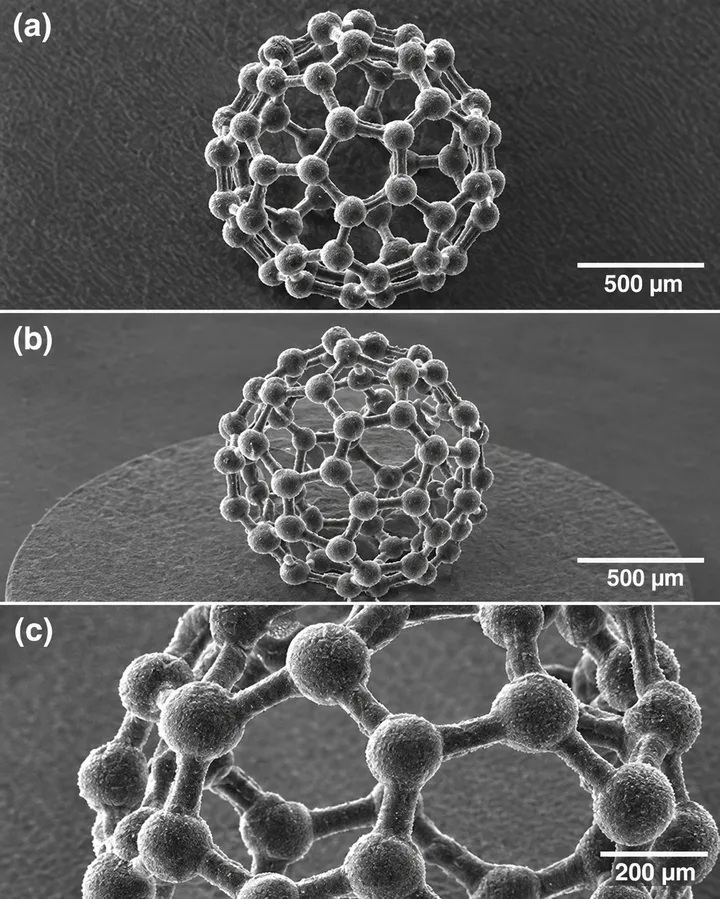
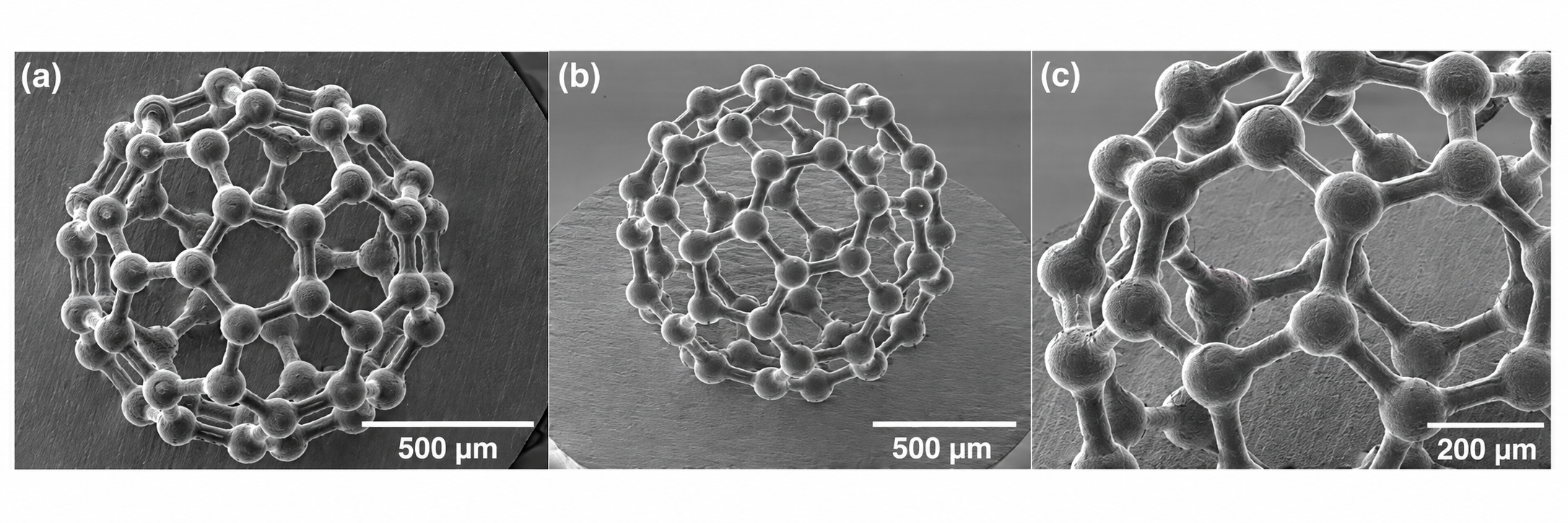
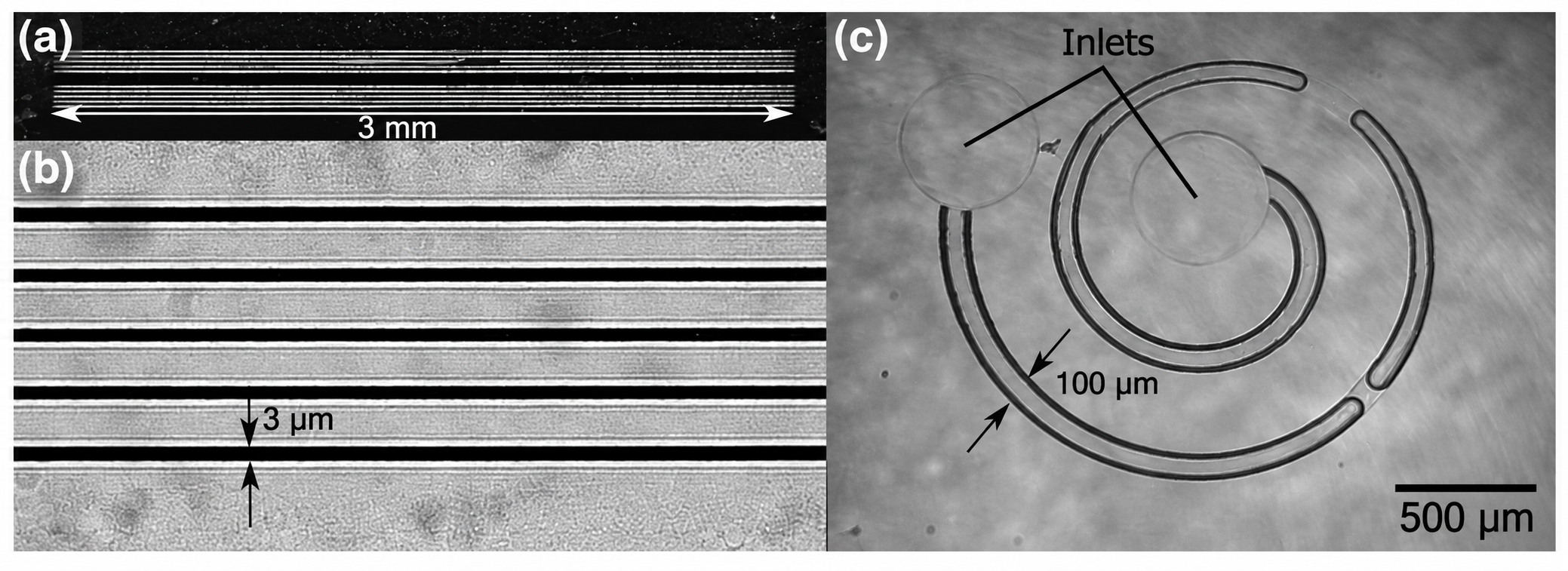
A published laboratory example makes the geometric opportunity tangible. In 2022, Butkutė and colleagues demonstrated a glass structure shaped like a fullerene molecular model, as well as embedded channels. The fullerene’s open, three-dimensional architecture was produced by laser-assisted etching. These are genuine fabricated research objects, not finished jewels or evidence of a commercial jewellery collection.
For a designer, such work suggests questions worth testing: could a transparent element contain a curved void that catches light; could a lattice be formed as one piece rather than assembled; could a hidden passage carry a fine connection? These are proposed design directions. Turning them into jewellery requires appropriate dimensions, comfortable edges, reliable attachment and a reason for the wearer to value the effect. Enlarging a microscopic demonstration is a new engineering exercise.
There is now a commercial equipment reference as well. EPHJ’s 2026 product listing presents Lithuania-based FEMTIKA’s Glass Laser Machine for complex structures made from, within and on transparent materials, explicitly identifying luxury jewellery as an application. This is a supplier proposition, not independently measured jewellery production performance.
The company’s 2026 catalogue states a smallest feature size greater than 1 µm, a minimum micro-hole diameter of 5 µm and a maximum object height of 20 mm. These figures describe different things. The stated XYZ positioning accuracy of ±0.5 µm must not be substituted for the feature-size specification. The catalogue names glass and other transparent materials; it does not establish a qualified jewellery process for sapphire, diamond or gold.
The timing deserves equal precision. An earlier FEMTIKA leaflet, carrying a January 2025-dated filename, advertised a June launch in Munich. This feature therefore treats the machine as part of the 2026 market, not as an invention first unveiled in 2026. No named jewellery installation or finished-jewellery case study for this particular machine was verified in the sources reviewed. Boucheron’s undisclosed equipment remains a separate case.
Can the surface control light
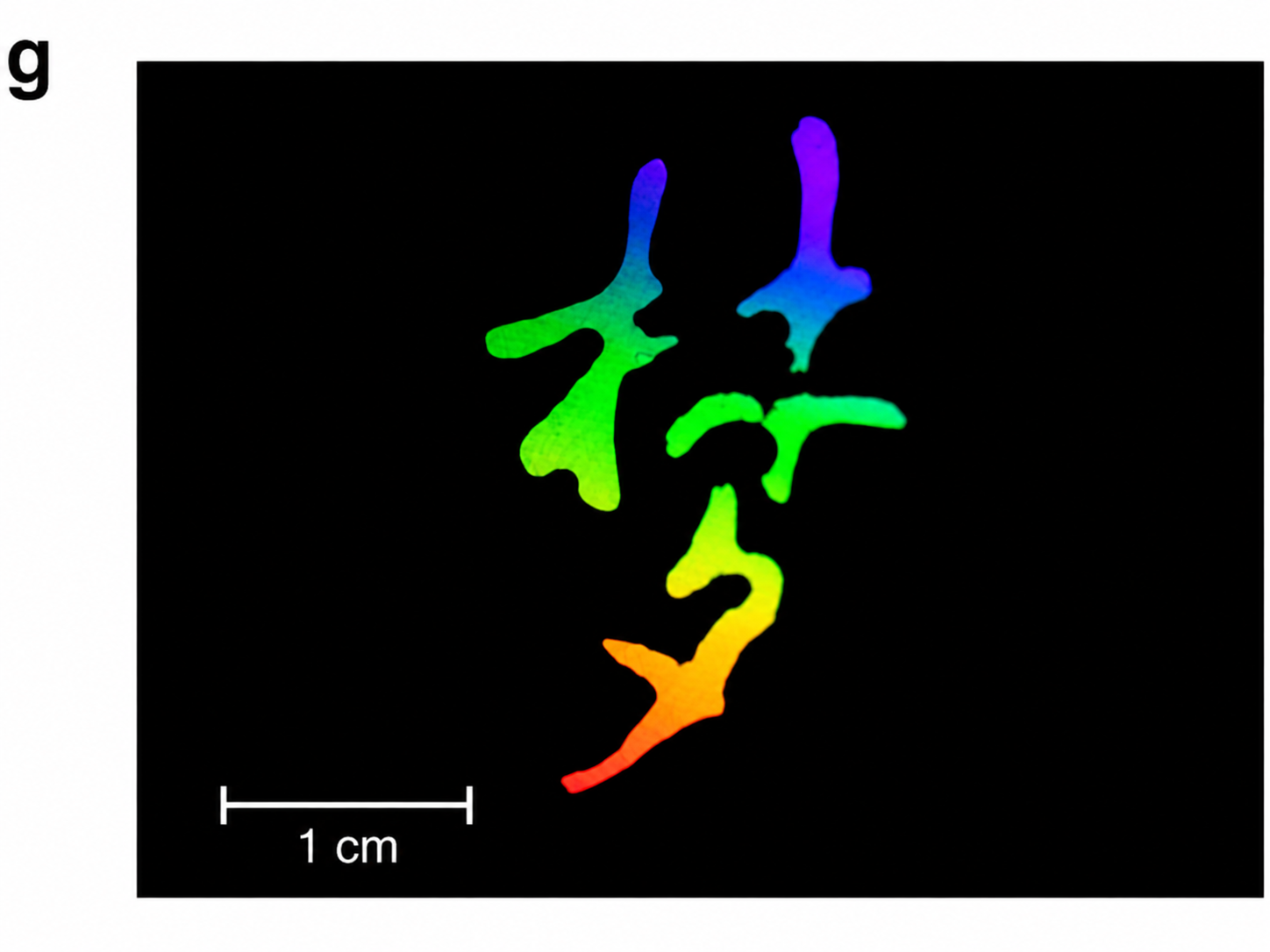
Yes, and this is a second opportunity beyond cutting a shape. Very fine surface structures can change how light is reflected, scattered or diffracted. In a 2022 experiment, Geng and colleagues used femtosecond processing to create nanogratings on specially prepared semiconductor-on-metal films, demonstrating structural colours among other functions. Those engineered films are a research example, not evidence that the same colour can be written onto any gold ring.
For jewellery development, the questions are visual as well as mechanical. Does the effect survive a change in viewing angle? Does it still appear under diffuse shop lighting rather than the photographer’s carefully placed lamp? What happens after fingerprints, cleaning and abrasion? A texture that depends on fine relief should be evaluated after the actual finishing sequence. Polishing that improves one region may erase the detail responsible for an optical effect.
Industrial femtosecond texturing itself predates the current interest. GF Machining Solutions’ December 2020 release already positioned its LASER P 400 U Femto Flexipulse for aesthetic and functional texturing in watches and jewellery, including work with reflective materials such as gold. This establishes a relevant industrial category; it supplies neither a universal recipe nor proof that the new FEMTIKA glass machine performs those jobs.
Surface finish also limits the “crystal-clear” promise. A 2025 study by Schrödter and colleagues found that the optical quality of ablated glass depended strongly on laser parameters and chemical or thermal post-treatment. A transparent starting block may acquire a scattering surface when machined. Conversely, a deliberately frosted region can be useful if the design calls for it. The brief should specify which surfaces must remain optically clear, which may be textured, and how both will be assessed on a finished sample.
What must be proved before it is worn
Geometry comes first. Thin bridges, sharp internal corners and the area around a hole deserve particular attention because they can concentrate stress. Ask the process partner to propose minimum walls and edge distances for the exact material and shape. A catalogue’s smallest machinable feature is not a safe minimum wall thickness for a pendant or ring.
Material strength requires evidence beyond an attractive photograph. Bellouard’s 2011 experiments demonstrated high bending strength in carefully made fused-silica flexures, with results influenced by etching and surface condition. That is encouraging evidence for the process, but those specimens were tested under defined laboratory loading. Their results cannot certify a glass jewel dropped on a hard floor or squeezed by a metal setting.
Our recommendation is to test complete prototypes through assembly and realistic handling. Inspect representative pieces for cracks and chips; measure critical dimensions after finishing; evaluate attachment points and any load introduced by setting. Include the intended cleaning method and a wear or impact programme appropriate to the product. Preserve the failure results. A sample that breaks during assembly tells the designer something that an unmounted display model cannot.
Internal features add an inspection challenge. Request evidence that unwanted material and residues have been removed and that narrow passages remain open. The inspection method must suit the feature: an external photograph cannot establish the condition of a hidden cavity. Decide how production pieces will be accepted before making a large batch.
The process also changes the workshop’s safety responsibilities. Selective etching can involve hydrofluoric acid or potassium hydroxide. HF can cause severe, potentially life-threatening injury; KOH can cause skin and eye burns. Neither belongs in an improvised jewellery-bench workflow. Use trained personnel, engineered containment, a chemical risk assessment, suitable waste handling and an emergency plan approved for the facility. Laser enclosure, extraction and safe maintenance require their own assessment. Outsourcing the hazardous step may be the practical first route, but the buyer should still understand how the finished piece is cleaned and verified.
How an Indian jeweller should start
Begin with one design problem rather than a machine purchase. Select a feature customers can see and value, then ask whether a specialist can produce it in the intended stone or glass. A relief on an opaque stone, an etched glass component and a textured precious-metal surface are separate development briefs. Combining their best brochure specifications into one imagined process leads to the wrong investment decision.
India already has relevant research capability. IIT Kanpur’s February 2025 account describes its collaboration with CMTI and a FemtoQube femtosecond oscillator demonstration at IMTEX 2025. It identifies a micromachining-system development as a next target. That is evidence of domestic technical activity, not confirmation of a ready-to-buy Indian jewellery production line or a current commercial service commitment.
A sensible first commission is a paid feasibility trial with a qualified provider. Supply the material specification, a representative CAD design, the required finish and the intended assembly method. Ask for accepted and rejected samples, a process description, dimensional results and a quotation for the whole route. FEMTIKA also offers contract production; confirm each provider’s suitability and availability.
Compare the cost per accepted finished component. Include programming, material, fixturing, laser time, etching, cleaning, inspection, finishing, rejects and assembly. For valuable stones, agree how loss or damage will be handled. For metal processing, establish recovery responsibilities. A rapid scan speed is only one motion parameter; it says little about the elapsed time for writing a volume, chemically removing it and approving the result.
Then repeat the trial with a fresh batch. A single successful sample proves feasibility. Repeatable quality, documented acceptance and a workable delivery time make it a production option. If ownership is later justified, examine service support in India, training, facilities, consumables and the equipment configuration actually quoted.
Our answer is yes: femtosecond processing can make a worthwhile design possible by changing how small features are made and how hidden regions of suitable glass can be reached. The strongest starting point is a specific design advantage backed by a qualified material and process. The jeweller’s judgement remains central, especially when deciding whether a remarkable structure will also be beautiful, durable and worth making.