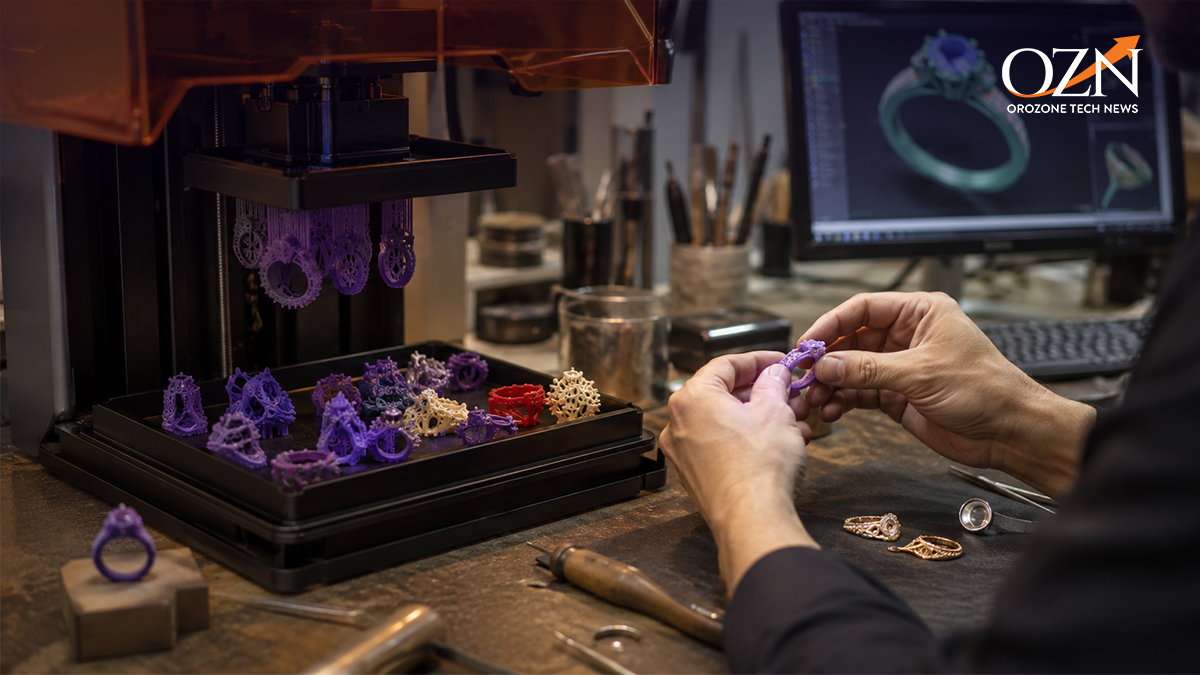
Instead of depending only on manual wax carving or long mould-making processes, jewellers can now convert CAD designs directly into wax patterns. These patterns can be used for lost-wax casting, making the technology highly practical for jewellery manufacturers. It does not break the traditional casting process; it improves it by making the design-to-production journey faster, cleaner and more controlled.
Solving Different Jewellery Design Challenges
Every jewellery style has its own production challenge. Middle Eastern and Arabic designs often include thin wires, twisted pipes, ornamental textures and fine decorative details. These designs need sharpness and precision. If the wax pattern is weak or unclear, the final cast piece may lose its beauty.
Wax 3D printing helps create detailed and accurate patterns that support such complex jewellery forms. It allows designers to produce fine motifs, delicate shapes and intricate surfaces with better consistency. For manufacturers working on traditional or highly ornamental pieces, this can reduce trial-and-error and improve production confidence.
Better Accuracy for Pavé and Stone Setting
Pave and stone-setting jewellery is another area where accuracy is extremely important. Rings, pendants and bangles with multiple stones require proper spacing, clear prongs and accurate seat positions. Even a small mistake can create difficulty during stone setting.
With 3D printed wax patterns, jewellers can check the design before casting and produce patterns that support more accurate stone placement. This is useful for micro-prongs, small gaps and detailed stone layouts. It helps manufacturers save time during finishing and reduces the risk of production errors.
Design Freedom for Fusion Jewellery
Fusion jewellery has become popular because it combines traditional inspiration with modern styling. These designs are often lightweight, hollow, delicate and visually bold. Creating such pieces manually can be difficult because the forms may be thin, curved or complicated.
Wax 3D printing gives designers more freedom to create these new-age jewellery forms. Hollow structures, lightweight filigree, complex curves and fine textures can be developed more easily through digital design and printing. This is especially useful in markets where customers want jewellery that looks grand but remains controlled in weight.
Smooth Finish for Western and Bold Designs
Western-style jewellery and men’s rings often include broader surfaces, clean geometry and heavier forms. In such designs, surface finish becomes very important. A large ring top, smooth band or bold pendant must come out clean and balanced.
Wax 3D printing helps manufacturers achieve better shape control and surface consistency. It supports design validation, direct casting patterns and even master-pattern development. This makes the process useful not only for delicate jewellery but also for solid, modern and premium designs.
Consistency in Manufacturing
In jewellery production, making one good sample is not enough. Manufacturers need the same quality repeatedly, especially for export orders, retail collections and batch production. Traditional handwork can sometimes create small variations from piece to piece.
3D printing brings repeatability into the workflow. Once a CAD design is finalised, the same pattern can be printed again with consistent detail and proportion. This gives manufacturers better control over quality and reduces dependency on repeated manual correction.
Faster Sampling and Scalable Production
One of the biggest advantages of wax 3D printing is speed. A design that earlier required multiple manual stages can now move faster from CAD to sample. This helps jewellers show new designs to clients, get approvals quickly and launch collections faster.
The same technology can support both small and large businesses. A small jewellery studio can use it for custom orders and sampling, while a larger manufacturer can use it for daily production and high-volume pattern making. This flexibility makes wax 3D printing valuable across different levels of the industry.
Technology That Supports Craftsmanship
Wax 3D printing should not be seen as a replacement for human craftsmanship. Jewellery still needs the eye of a designer, the experience of a caster and the skill of a finisher. The machine can create an accurate pattern, but the final result depends on CAD quality, material handling, support removal, investing, burnout, casting and finishing.
The real power of this technology lies in combining digital accuracy with traditional jewellery knowledge. It helps artisans and manufacturers work faster, reduce errors and focus more on refinement.
Why It Matters for India
India is one of the world’s most diverse jewellery markets. From bridal jewellery and temple-inspired pieces to lightweight daily wear, diamond jewellery and export-focused designs, Indian manufacturers deal with a wide range of styles. This makes wax 3D printing especially relevant for the country.
As customer demand shifts towards customisation, fast delivery and lightweight but detailed jewellery, manufacturers need tools that can support both creativity and production efficiency. Wax 3D printing offers that bridge. It helps jewellers develop complex designs, reduce development time and bring more consistency into the casting process.
The Future of Jewellery Manufacturing
The future of jewellery manufacturing will not be purely handmade or purely machine-made. It will be a smart combination of both. Traditional skills will continue to define beauty, while technologies like wax 3D printing will improve speed, accuracy and scalability.
For jewellers, the message is clear: wax 3D printing is not just a machine upgrade. It is a new way of thinking about design and manufacturing. It gives the industry the ability to create freely, produce accurately and respond faster to market trends.
In an industry where every detail matters, wax 3D printing is becoming one of the most important technologies shaping the next phase of jewellery manufacturing.