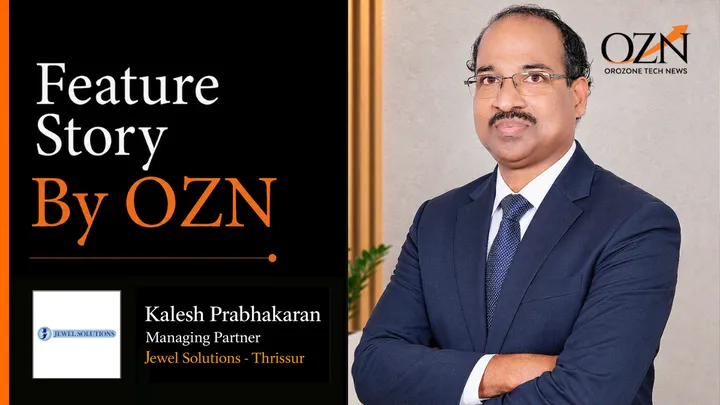
Jewellery manufacturing is becoming more complex at a time when margins are under greater pressure than ever. Gold prices remain elevated, production costs are rising, skilled manpower is becoming harder to secure and manufacturers are being expected to deliver lighter, more precise products without compromising on quality. For Kalesh Prabhakaran, Managing Partner at Jewel Solutions, Thrissur, the answer to these challenges does not begin with buying more machines. It begins with understanding what the factory is being built to achieve.
Prabhakaran believes that every new manufacturing unit should start with three decisions: the market it intends to serve, the product categories it plans to produce and the level of investment available for metal, infrastructure and machinery. A factory, in his view, cannot be designed in isolation from the customer or the market. Product selection must reflect the demand of the region being targeted, whether that means lightweight daily wear, temple jewellery, bridal pieces, diamond jewellery or another category entirely. Only after that should manufacturers determine factory size, technology investment and quality standards.
Technology, he says, is essential, but only when it has a clear purpose. Modern machinery can improve speed, consistency, quality and repeatability while reducing human error and manpower dependency. It can also make new product development possible. Yet the presence of sophisticated equipment alone does not guarantee a better factory.
For Prabhakaran, the real differentiator remains process knowledge. A team that does not understand how jewellery moves through each stage of production will struggle to control quality and loss, regardless of how advanced the machinery may be. This is where many factories, in his experience, begin to fail.
Metal loss, rejection, downtime, weak manpower and poor layout are often discussed separately, but he sees them as connected symptoms of the same underlying problem: inadequate production control. A factory without strong SOPs or technically competent people in key positions can quickly lose efficiency across the entire line. Poor layout can create unnecessary metal movement and handling. Weak manpower can increase rejection. Inadequate supervision can allow small process failures to become expensive production losses.
The most critical area, according to Prabhakaran, lies between CAD/CAM and casting. Decisions made at the design and prototyping stages have a direct impact on what happens later in setting, finishing and quality control. If the pre-casting stages are poorly managed, the factory may spend more time correcting problems that should never have reached the metal stage in the first place.
That point becomes especially important as the industry moves deeper into lightweight jewellery.
When less metal is used, there is less room for error. Strength, durability, balance, stone security and finishing all require tighter control. At a time when gold itself carries greater value, manufacturers cannot afford to focus only on metal recovery after production. They must also concentrate on reducing loss before it occurs.
Prabhakaran therefore places equal importance on what happens before casting and after casting. Better design preparation, correct process selection and stronger control upstream can reduce rejection, rework and unnecessary wastage later in the production cycle. In a high-gold-price environment, this kind of process discipline can make a meaningful difference to margins.
Automation will continue to play a larger role, but Prabhakaran does not see it eliminating traditional craftsmanship. India’s regional jewellery traditions still depend heavily on the experience and judgement of skilled artisans. What technology can do is support that craftsmanship by improving speed, precision and consistency.
He points to developments such as paper casting and extremely thin cast components as examples of this hybrid future. Designs that were once produced entirely by hand, particularly in temple and antique jewellery, can now incorporate casting technology while retaining the visual character of traditional work. The result is not a replacement of craft, but a different relationship between craft and technology.
Prabhakaran has observed this transition closely across South India for around 15 years. Tamil Nadu, Karnataka and Kerala have all become more willing to invest in modern machinery and production systems, and Thrissur is gradually developing as an important diamond manufacturing centre in the region.
Even so, he believes Kerala still has a significant distance to travel before it can compete fully with established manufacturing centres such as Mumbai, Surat, Jaipur, Delhi and Rajkot. The gap, in his view, is not simply about machinery. It is also about manufacturing knowledge, quality consciousness, skilled manpower and the economics created by very low making charges.
As factories scale, management becomes even more critical. Prabhakaran sees leadership as the spine of the manufacturing unit. Systems can only work if management is willing to implement them, bring the right people into the right roles and invest in technology with a clear understanding of the outcome expected.
Looking ahead, he sees AI, robotics, 3D printing, lasers and automation developing at different speeds. AI, in his view, is likely to make an earlier impact in design creation, concept development and marketing than in core production. Robotics remains expensive today, but shortages of skilled labour could make it more relevant in the future. 3D printing has already advanced far beyond what the industry once expected, while lasers and automation are steadily making manufacturing faster and more accurate.
Direct metal additive manufacturing remains promising, though he believes feasibility is still a limiting factor for widespread jewellery production.
If given the opportunity to build a world-class jewellery factory today, Prabhakaran says he would not replicate the model of a decade ago. His approach would centre on minimum production loss, intelligent process flow, technically justified machinery and environmental responsibility. Air, water and ground pollution control, he argues, should be treated as part of factory design rather than an optional expense.
For him, the future factory will not be defined by the number of machines installed on the floor. It will be defined by how intelligently market understanding, process knowledge, technology, management and craftsmanship work together as one system.
That is the shift he believes jewellery manufacturing now needs most.