
Metal 3D printing is no longer just for making basic plastic prototypes or visual samples in jewellery manufacturing. It is about speed, smooth surface finish, complete design freedom, and repeatable batch production. As jewellery pieces become lighter, finer, and more intricate, factories need direct metal printing systems that deliver clean results without relying heavily on traditional wax trees, investment casting molds, or endless manual grinding and polishing.
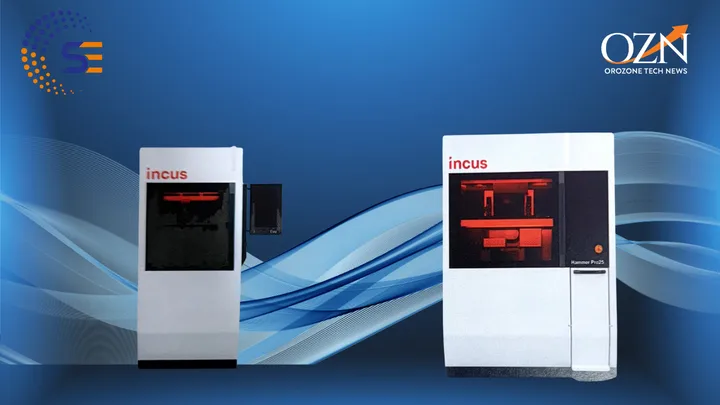
The Incus Hammer Series—featuring the laboratory-friendly Hammer Evo35 and the high-output Hammer Pro25—is designed for this exact requirement. Brought to the Indian market by Mumbai-based SARTO ELECTRO Equipments Pvt. Ltd., these machines use Lithography-based Metal Manufacturing (LMM) technology. The process combines photopolymerization, high-resolution light projection, and standard thermal debinding and sintering into a reliable manufacturing setup.
Its strongest advantage is simplicity. Operating through a clean light-curing process followed by furnace sintering, the Hammer system makes direct metal printing straightforward, safe, and repeatable. This is especially important for manufacturing houses handling intricate luxury jewellery, filigree work, micro-components, and fine-detail production, where even a tiny surface flaw adds hours of manual bench work and increases rejection rates.
Built for Fine Details and Complex Geometries
The Incus Hammer Series uses custom LED projection optics to cure metal-filled liquid feedstock layer by layer. The system offers a sharp lateral resolution of 35 microns on the Hammer Evo35 and down to 25 microns on the Hammer Pro25, allowing the light projector to define microscopic details accurately. This helps production teams create ultra-fine lattice patterns, internal channels, and delicate shapes that traditional casting or CNC milling tools struggle to produce.
For manufacturers producing specialized metal components, the process creates green parts with high strength before firing. Because the viscous feedstock naturally holds the part in place during printing, the system eliminates the need for physical metal support structures attached to the pieces. This saves substantial labor during post-processing, protects fine design details from tool damage, and leaves a clean surface before final debinding and sintering.
Multiple Production Scales in One Technology
The technology is not limited to a single output size. The platform supports smooth scaling from early R&D material testing up to industrial mass production, giving manufacturers flexibility across different growth stages.
A facility can start with the compact Hammer Evo35 to test custom metal feedstocks, refine new designs, or run short production batches. Once a process is proven, production can shift directly to the Hammer Pro25 line. Equipped with two scrolling LED light units and an automatic feedstock feeder, the Pro25 reaches build speeds up to 980 cm³ per hour. This allows businesses to scale up volume without changing their material settings or reworking component files.
Key Advantages
The Incus Hammer Series offers several practical advantages for high-precision manufacturers.
Its powder-free liquid feedstock setup provides a safe, clean workplace compared to traditional powder-bed fusion systems that require heavy air filters and protective gear. The process works with a wide range of materials, including precious metals like gold and silver, alongside titanium, copper, tungsten, and stainless steel alloys.
By doing away with support structures and printing close to final dimensions, the machine minimizes precious metal scrap and shortens finishing times. The controlled sintering cycle produces solid metal structures with mechanical strength matching standard metal injection molding.
Capacity and Application
With build volumes reaching up to 56 x 89.6 x 150 mm on the Evo35 and up to 200 x 204.55 x 140 mm on the Pro25, the system suits professional production houses that need both fine detail and steady output.
It is especially useful for businesses operating across luxury jewellery, watchmaking, medical and dental components, electronics, fine automotive parts, and specialized molding tools.
Final Takeaway
The Incus Hammer Series is not just another 3D printer. It is a practical production system for jewellers and precision engineers who want smoother surface finishes, total design freedom, and tighter control over complex metal manufacturing.
As the industry moves toward lower metal weights, finer detailing, and direct digital workflow, machines like the Incus Hammer Series help factories reduce process guesswork and improve production confidence.
For jewellery factories and engineering facilities looking to upgrade their production department, especially for delicate and complex metal parts, the Incus Hammer Series deserves serious attention.