Mumbai: Aurevia AI, a Mumbai-based jewellery technology startup founded in 2026, has introduced an AI-powered design platform aimed at shortening the journey from an initial jewellery idea to client-ready visuals and manufacturing documentation. The platform is built specifically for jewellery studios, designers and manufacturers rather than general-purpose image generation.
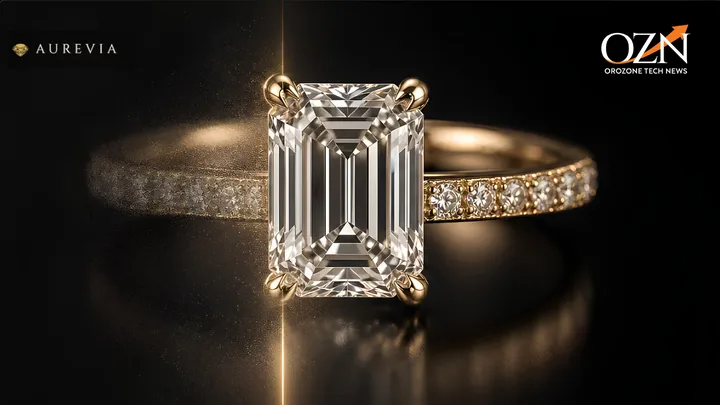
At the core of Aurevia is a seven-stage workflow that can take a text brief, reference image or voice note and turn it into moodboards, sketches, production graphics, photoreal renders and interactive 3D visualisations. The company says renders can be generated in about 60 seconds, while the workflow also supports dimensioned CAD sheets and AR-enabled client try-on.
What makes the platform more relevant to jewellery manufacturing is its attempt to address a long-standing industry bottleneck: moving from a design concept to a technically usable production brief. Aurevia provides outputs that include stone sizes, metal weight and dimensional details intended for bench use, while also allowing conversational edits such as making a band thinner or adding a hidden halo.
Founder Aadit Shah says the idea came from his experience within the jewellery and diamond trade, including training at Asian Star and exposure to end-to-end jewellery manufacturing at Jewelex. According to Aurevia, the slow and manual transition from design idea to production-ready CAD was the specific problem the platform was built to address.
The technical approach is also notable. In a recent engineering hiring brief, Aurevia said its CAD engine is designed around a principle where AI interprets design intent, but deterministic geometry code builds the actual model. The company argues that generative models can infer a design brief well, but direct AI-generated geometry can still be dimensionally unreliable for real manufacturing. Its system therefore uses rule-based computational geometry and manufacturability checks after the AI stage.
That distinction is important for jewellery, where a visually convincing render is not enough. A manufacturable design must account for real dimensions, watertight geometry, stone settings, band thickness, casting constraints and downstream lost-wax production.
Aurevia also supports interactive 3D viewing, virtual try-on and multiple export formats, with its broader platform positioned around taking jewellery concepts closer to production assets rather than stopping at visual ideation.
For jewellery manufacturers and CAD studios, the development signals a broader shift in AI adoption. The next generation of tools is moving from “generate me a beautiful jewellery image” towards “help me convert a client brief into something the workshop can actually use.”
The real breakthrough in jewellery AI will not be better renders. It will be closing the gap between creative intent and manufacturable geometry.