Global: The jewellery industry has always operated on planning. Gold procurement is timed around price movement, production is aligned with order cycles, exports are scheduled against fixed logistics timelines, and retail inventory is built around seasonality, weddings, and consumer demand. This structure works efficiently when markets are predictable. But in periods of geopolitical instability, predictability is often the first thing to disappear. For the jewellery industry, the current global environment is proving exactly that.
Rising tensions across the Middle East have created instability across shipping corridors, energy pricing, and commodity markets, pushing businesses to reassess not only short-term decisions but entire operating models. While gold price volatility and export delays are immediate outcomes, the deeper impact is structural. Jewellery businesses are now being forced to operate in an environment where disruption is no longer an exception, but an expected business condition.
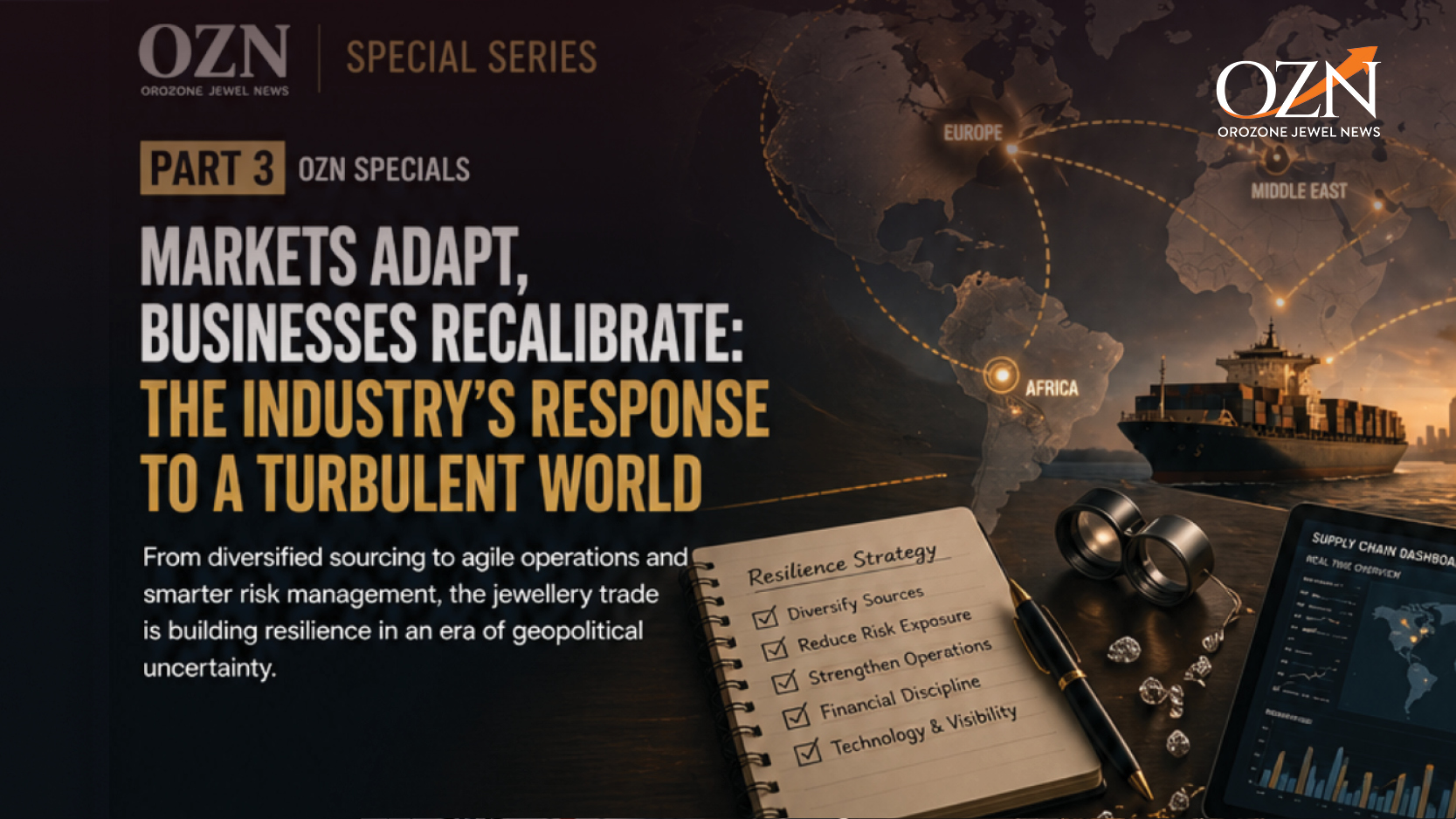
This is where resilience becomes central. Across manufacturing, export, and retail, businesses are moving away from systems built purely for efficiency and toward models designed for continuity. The traditional lean approach of tight procurement cycles and minimal inventory buffers is becoming riskier in volatile conditions. When gold prices move sharply or shipments are delayed, businesses with little operational flexibility face immediate pressure on margins, production timelines, and customer commitments.
Inventory management is therefore becoming more disciplined. Rather than carrying excessive stock across broad categories, many businesses are prioritising commercially stronger and faster-moving product lines. Lightweight gold jewellery, modular bridal pieces, everyday diamonds, and versatile high-conversion collections are gaining preference over slower-moving, capital-heavy inventory. The focus is shifting from inventory volume to inventory quality and turnover speed.
Manufacturers are also adjusting production strategy. Instead of aggressive output based on projected demand, there is a stronger shift toward demand-linked manufacturing. Confirmed orders, shorter production cycles, and tighter raw material planning are becoming increasingly important. This reduces exposure to price fluctuation and prevents excess capital from being locked into inventory during uncertain periods.
For exporters, resilience is becoming equally critical. India’s gems and jewellery sector exports over USD 30 billion annually, making the country highly dependent on predictable global movement. Delays in shipments, freight cost escalation, insurance increases, or route diversions can significantly disrupt export economics. In response, exporters are becoming more cautious with delivery commitments and are reassessing dependence on specific trade routes and destination markets. Market diversification is gaining stronger strategic importance, with increasing attention toward the Middle East, Southeast Asia, and emerging luxury consumption regions.
Retailers are experiencing a different but equally important shift. Consumer demand remains active, but buying behaviour becomes more measured during uncertainty. Purchases are more value-driven, price sensitivity increases, and buyers spend more time evaluating product relevance, gold rates, and exchange assurance. This is strengthening the role of trust-based retailing. Transparent pricing, buyback structures, exchange policies, and brand credibility are becoming stronger conversion drivers than discount-led selling.
Technology is also becoming an operational necessity. Inventory tracking systems, ERP platforms, procurement analytics, and shipment visibility tools are helping businesses respond faster to disruption. In an uncertain environment, businesses that can monitor inventory movement, supplier dependencies, and production status in real time hold a clear advantage over those operating with fragmented visibility.
The broader shift taking place is clear. The jewellery industry is no longer optimising only for growth. It is increasingly optimising for adaptability. Businesses are learning that long-term competitiveness will depend not just on design, retail scale, or manufacturing capacity, but on the ability to absorb shocks without operational breakdown.
This is what defines the current phase of the industry. Not contraction, but recalibration. Jewellery demand continues, but the businesses serving that demand are becoming more strategic, more cautious, and more operationally disciplined. In a world shaped by recurring volatility, resilience is no longer a defensive strategy. It is becoming a core business asset.
For the jewellery industry, this may be one of the most important structural lessons of the current global cycle. The strongest businesses in the years ahead will not simply be the ones that expand fastest. They will be the ones best designed to continue performing when markets become uncertain, logistics become slower, and pricing becomes harder to predict.
Because in an industry built on value, timing, and trust, resilience is no longer optional. It is infrastructure.