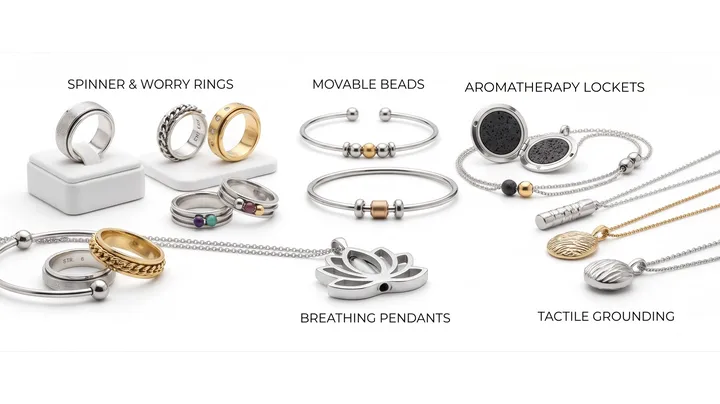
From kinetic rings and breathing pendants to aromatherapy lockets and haptic bracelets, a new generation of jewellery is being designed not simply to be seen—but to be touched, moved, felt and used.
For centuries, jewellery has carried emotion.
A wedding ring holds commitment. An heirloom carries memory. A religious pendant offers spiritual reassurance. A personalised charm can preserve the presence of a person, place or moment.
Now, another dimension is beginning to emerge.
Jewellery is becoming interactive.
A ring that rotates beneath the thumb.
A bead that moves silently along a bracelet.
A pendant that slows an exhalation.
A locket carrying a familiar scent.
A bracelet that responds through a subtle pulse against the skin.
These products are increasingly grouped under the term “anti-anxiety jewellery”—but the label only partially explains what is happening.
The more important shift is this:
Jewellery is moving from passive ornamentation towards wearable experience.
The piece no longer ends at appearance.
It begins again when the wearer touches it.
That evolution could create one of jewellery’s most interesting new product categories—at the intersection of design, personal wellbeing, behavioural ritual, precision engineering and eventually wearable technology.
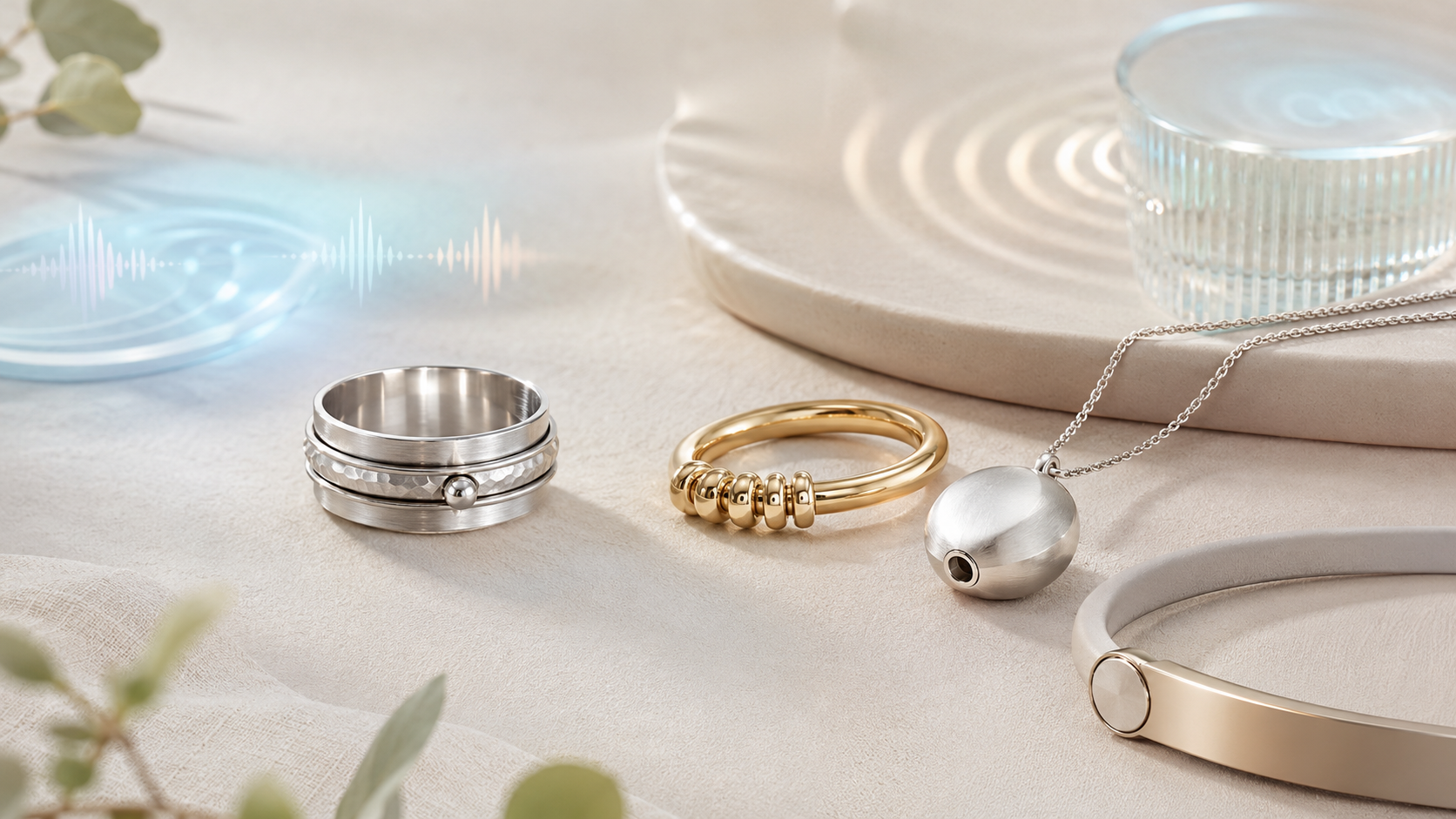
Why This Category Is Emerging Now
The timing is not accidental.
Anxiety and emotional wellbeing have become major global conversations. According to figures referenced in the original research, the World Health Organization estimated that anxiety disorders affected approximately 359 million people in 2021, or around 4.4% of the global population.
At the same time, wellness has developed into a substantial consumer economy. The Global Wellness Institute figures cited in the research place the global wellness economy at US$6.8 trillion in 2024, with projections approaching US$9.8 trillion by 2029.
Jewellery is entering this conversation because consumer expectations are changing too.
Increasingly, jewellery is asked to do more than signal wealth, status or style.
Consumers want pieces that feel:
personal, meaningful, functional, customisable and emotionally relevant.
This is particularly visible in younger markets, where identity, wellbeing, spirituality, personalisation and self-expression often intersect.
The result is an emerging product space in which the jewel becomes something a person can actively interact with during the day without carrying an obvious wellness device or conventional fidget product.
The opportunity is not to turn jewellery into medicine.
It is to turn jewellery into a beautiful personal ritual.
From Ornament to Interface
Perhaps the most important way to understand this category is through the word interface.
Conventional jewellery primarily communicates visually.
Interactive jewellery communicates physically.
The wearer may:
rotate it.
slide it.
trace it.
rub it.
count with it.
breathe through it.
smell it.
feel it vibrate.
That changes the relationship between object and wearer.
It also changes the job of the jewellery designer.
A conventional ring may succeed because its proportions, finish, stone setting and comfort are excellent.
An interactive ring must accomplish all of those things—and then deliver a predictable mechanical experience every time it is touched.
The resistance has to feel right.
Movement cannot become loose after repeated use.
The mechanism cannot pinch.
The component should not rattle unnecessarily.
Dust, cosmetics and skin oils cannot easily jam the movement.
Stone security has to survive thousands of interactions.
Even sound becomes part of the design brief.
A soft mechanical click may feel satisfying to one consumer and intrusive to another.
Future products may therefore be engineered around different sensory profiles:
- silent movement
- subtle mechanical feedback
- textured tactile feedback
- controlled resistance
- personalised sensory experiences
The design question is no longer simply:
“How does this jewellery look?”
It becomes:
“How does this jewellery feel when someone uses it?”
Inside the Emerging Product Universe
Anti-anxiety jewellery is not one invention.
It is an umbrella category containing several very different design directions.
Spinner and Worry Rings
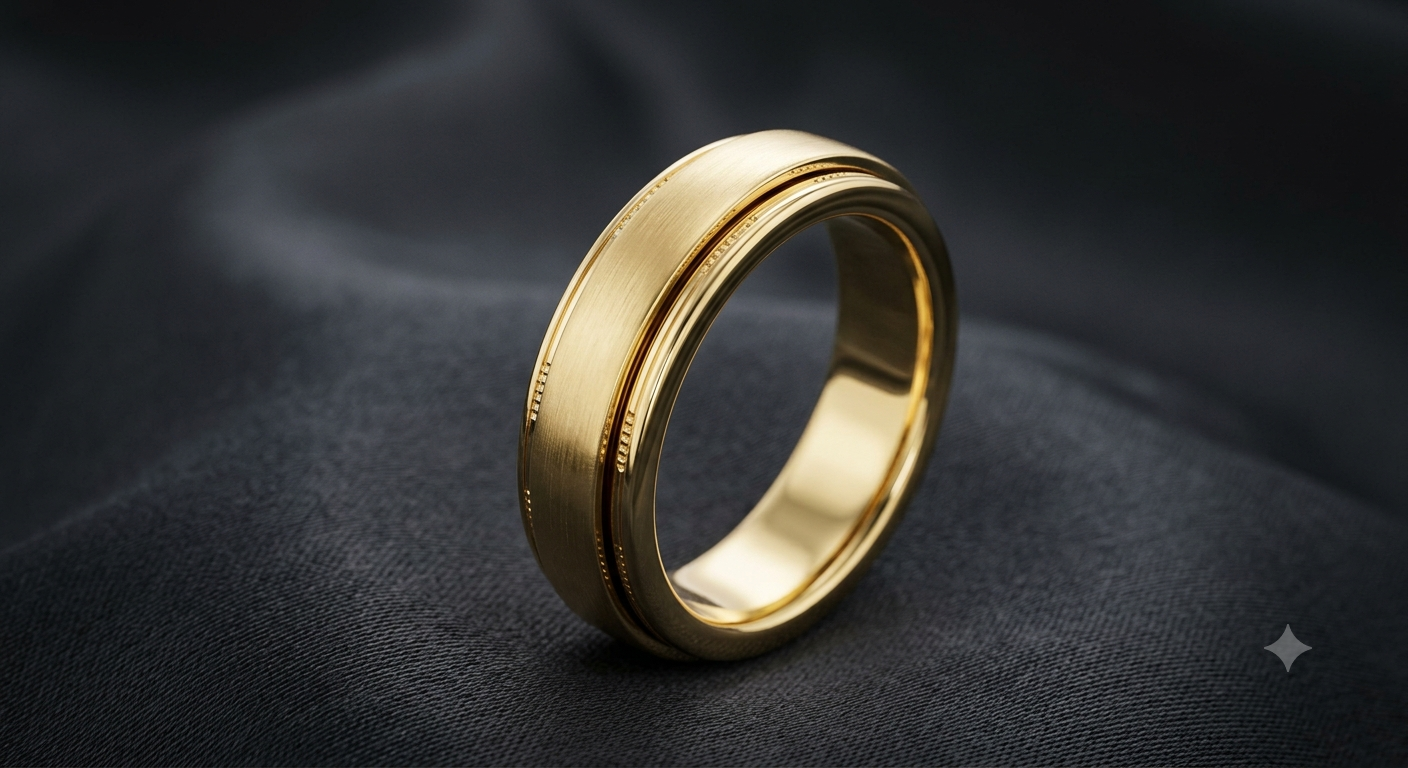
These are perhaps the most commercially accessible form.
A rotating band, chain, disc or captive component gives the wearer something controlled to manipulate with the thumb or finger.
The brilliance of the format lies in discretion.
The movement exists inside an object already socially accepted as jewellery.
There is no separate wellness gadget to carry and no obvious fidget device to remove from a pocket.
But premium execution will be critical.
A luxury spinner ring cannot feel like a toy onto which diamonds have simply been added.
Mechanism, weight, resistance, acoustics and finish must all communicate jewellery first.
Movable-Bead Jewellery
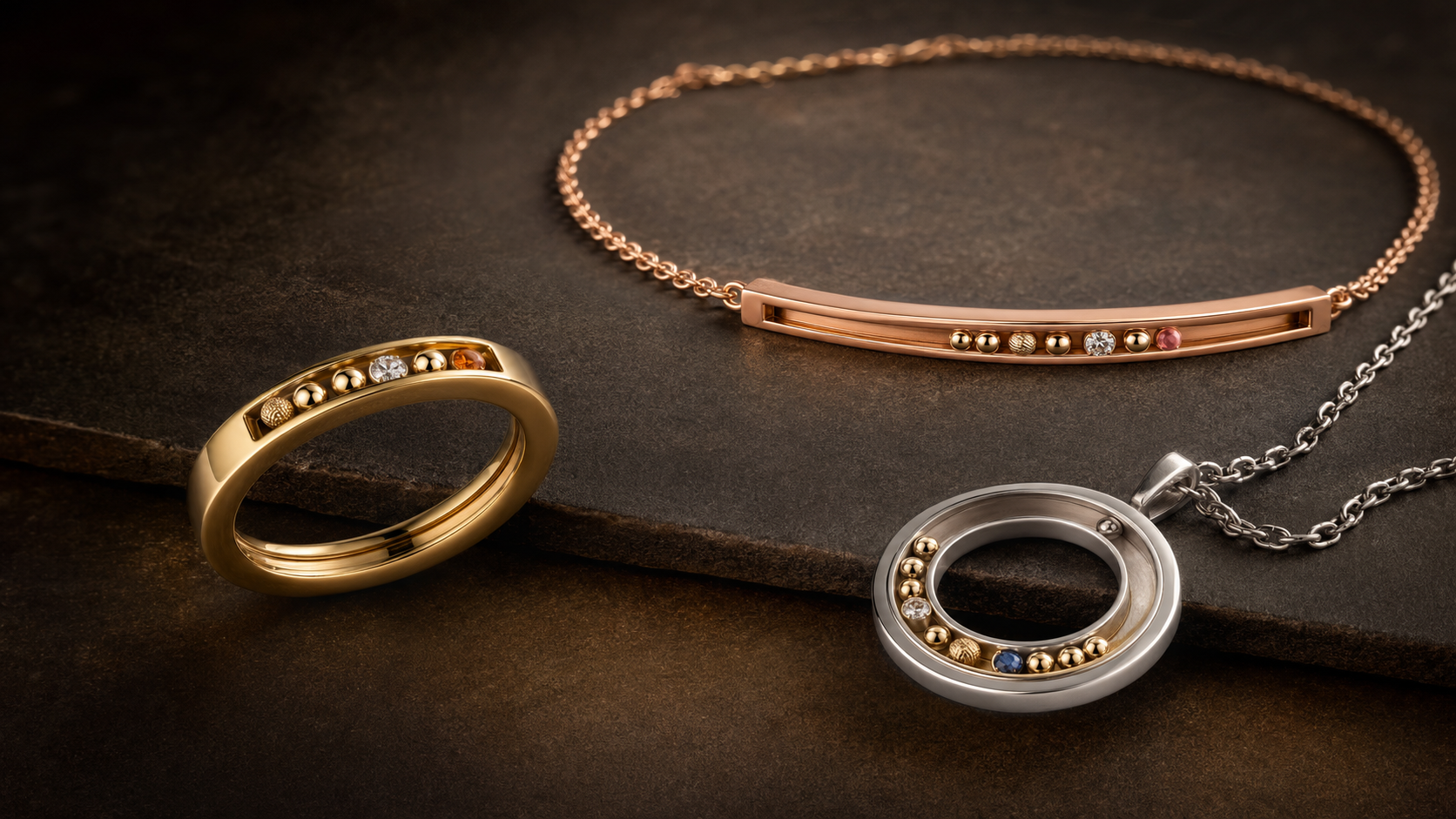
Another direction uses gemstones, beads or precious-metal elements that travel through an enclosed track.
Movement can become rhythmic.
A wearer might move one element at a time, count repetitions or associate each movement with a breath.
This concept has interesting cultural possibilities because jewellery has long intersected with prayer beads, meditation objects and repetitive counting rituals.
The commercial opportunity is to reinterpret that behavioural familiarity through contemporary fine-jewellery design.
Imagine a diamond travelling through an invisible curved track.
Or a bracelet where a sequence of gold elements can be moved individually without ever leaving the jewel.
This is where small-scale engineering begins becoming part of jewellery aesthetics.
Tactile and Grounding Jewellery
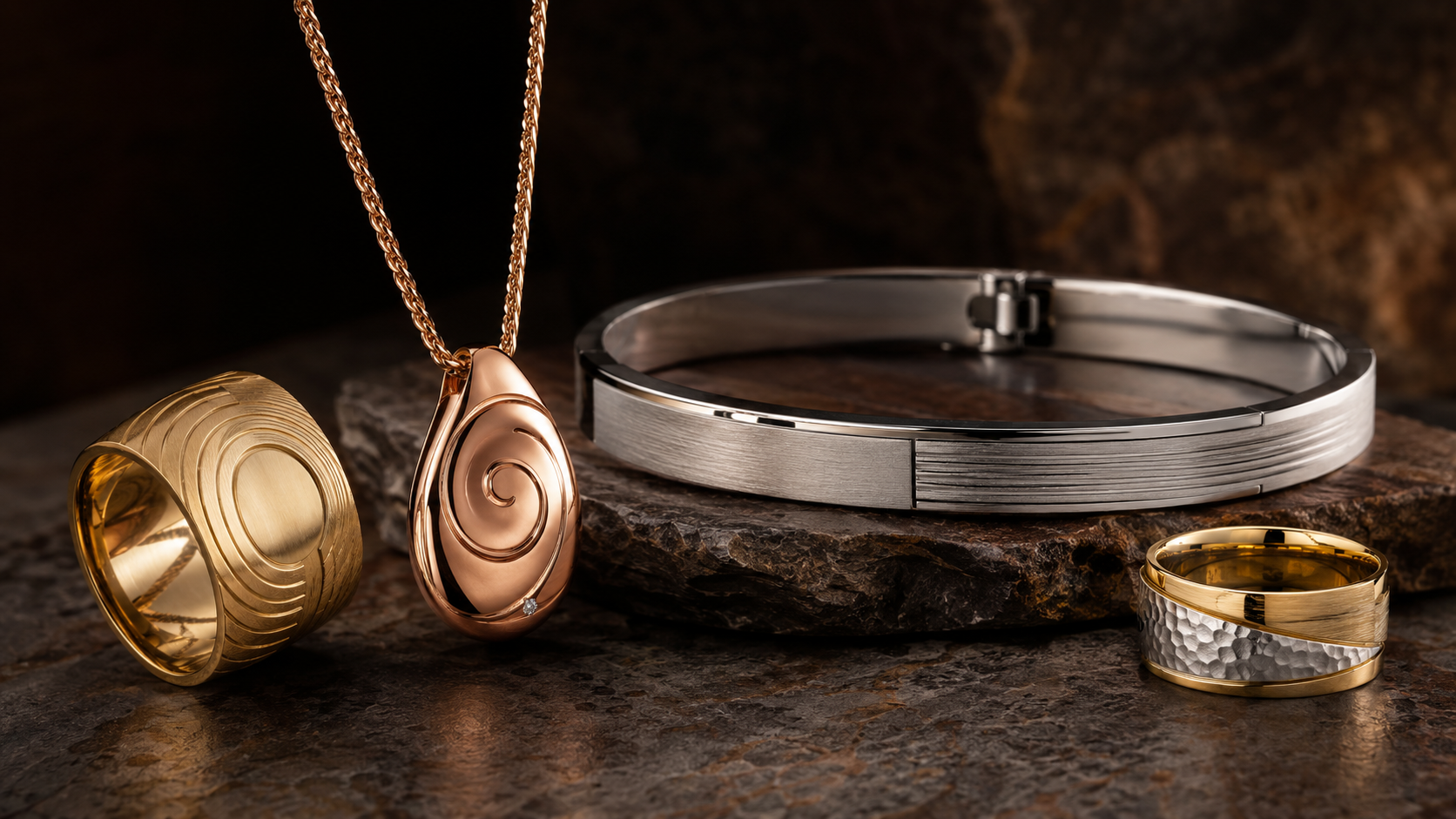
Not all interactive jewellery needs moving components.
A surface can itself become the interaction.
Engraved paths, polished depressions, ridges, contrasting textures and sculptural stone-like forms can give the wearer something to repeatedly trace or touch.
This could become particularly interesting for high jewellery because tactile functionality can remain almost completely invisible to another observer.
The piece looks like jewellery.
Only the wearer knows what part of it is designed to be touched.
Breathing Pendants: Jewellery as a Pacing Device
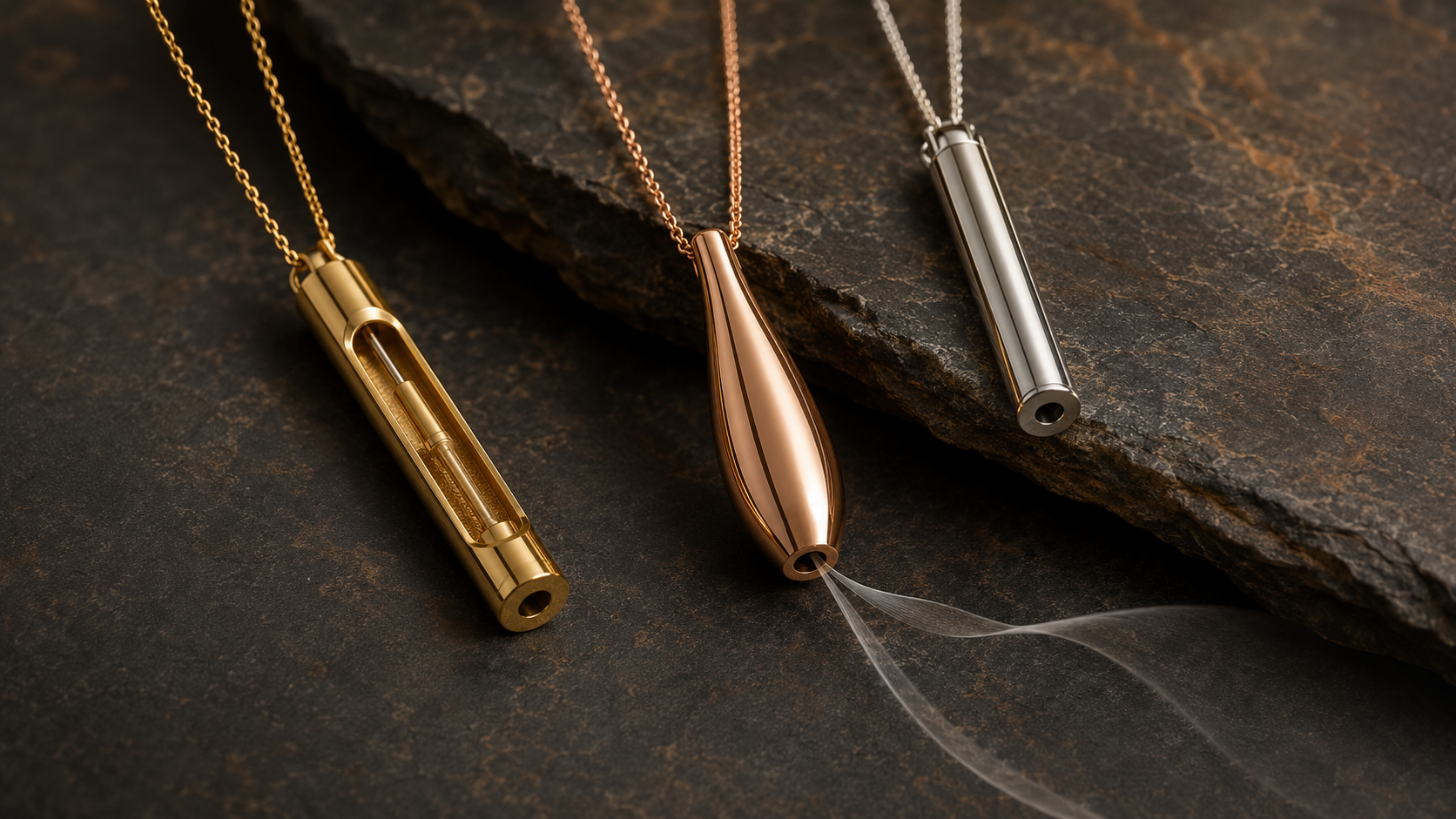
Breathing pendants operate differently.
Instead of supplying mechanical movement, they generally use a controlled internal passage through which the wearer slowly exhales.
The pendant does not create calm by itself.
Its role is more subtle:
it gives a physical structure to a breathing ritual.
The research underpinning the original feature notes that slow breathing is recognised as a relaxation technique and that broader evidence supports structured breathing practices more strongly than it supports any particular commercial breathing necklace.
That distinction matters commercially.
Brands should not sell the jewel as a treatment.
They can instead design it as a beautiful behavioural prompt:
a tactile reminder to stop,
slow the breath,
and momentarily redirect attention.
For Indian designers, the visual opportunity is particularly strong.
A breathing pendant does not need to resemble the generic tubular products already available internationally.
Its airflow architecture could potentially be integrated into forms inspired by:
the lotus, conch, temple geometry, sacred patterns, architectural jaalis or abstract interpretations of airflow.
That is where functional jewellery begins acquiring cultural authorship.
Aromatherapy Lockets: Scent Becomes Part of the Jewel
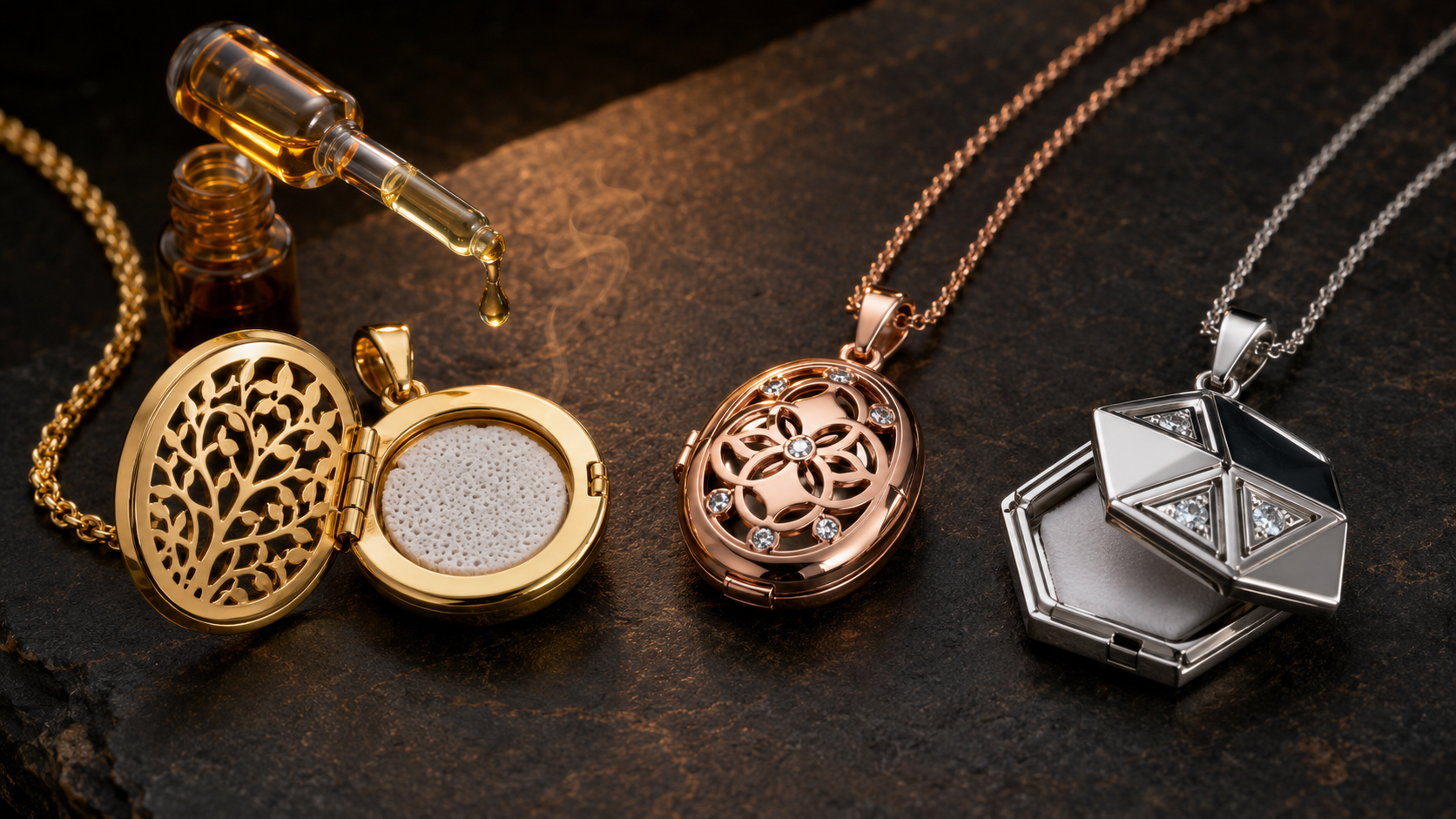
Aromatherapy lockets add another sensory layer: smell.
A porous insert, pad or protected internal chamber can hold fragrance or essential oil, allowing the wearer to associate a familiar scent with a personal pause or relaxation ritual.
This category needs careful communication.
The underlying research referenced in the source notes that some studies have reported anxiety-reducing effects from inhaled lavender, while reviews also point to variations in evidence quality and methodology.
There are also practical considerations involving:
skin sensitivity, allergies, concentrated oils and material compatibility.
For jewellery manufacturers, however, the design possibilities are compelling.
The insert itself could be hidden.
It could be replaceable.
It could sit behind intricate openwork.
A pendant might carry scent without visually revealing that it performs any wellness-related function.
Again, the strongest product is likely to be the one that remains jewellery first and wellness object second.
The Next Frontier: Haptic Jewellery
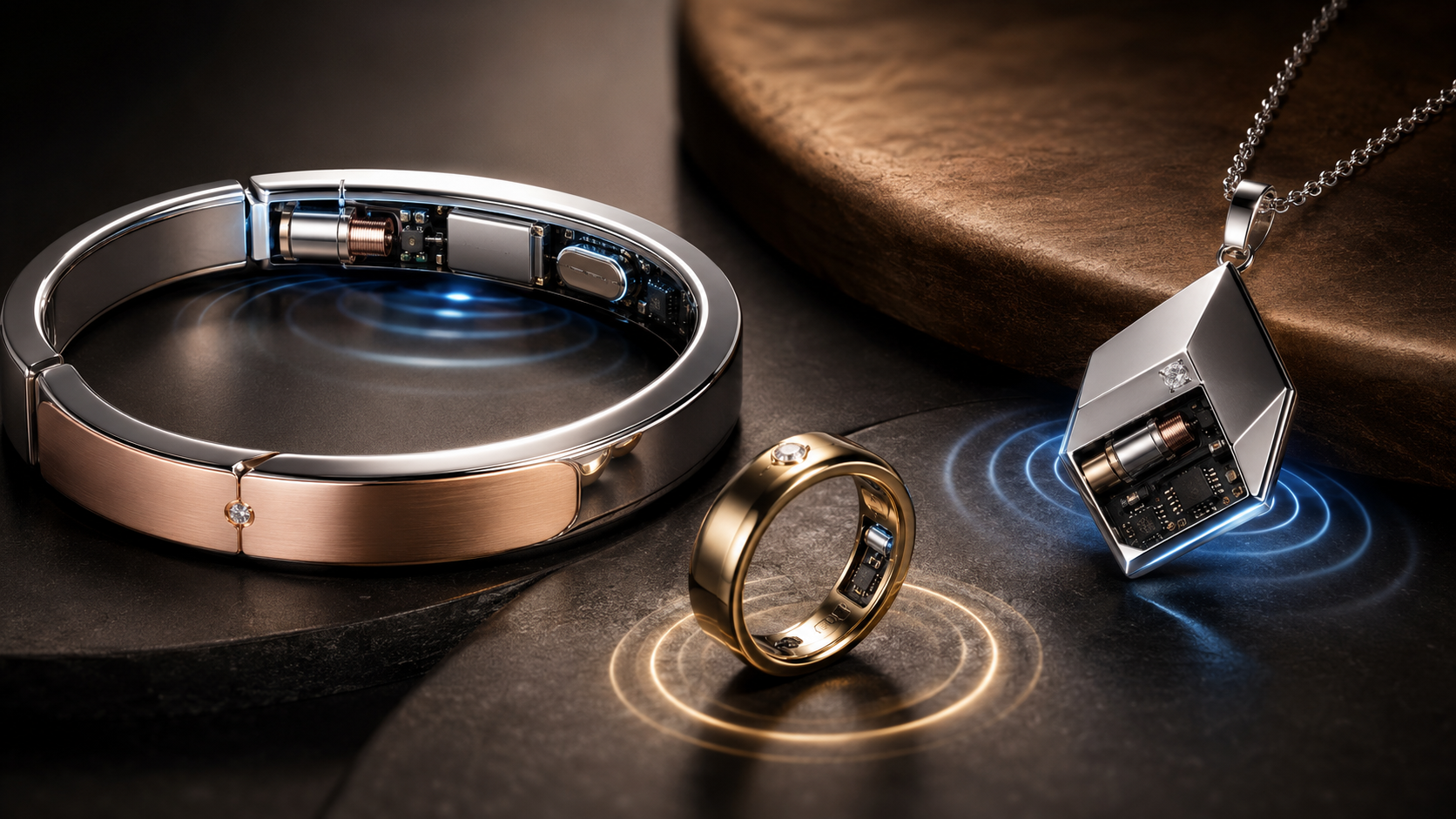
Beyond passive mechanisms lies a substantially more advanced category.
Haptic jewellery.
Here, the jewel can communicate through vibration or rhythmic pulses.
A ring or bracelet might deliver a slow tactile rhythm intended to prompt measured breathing.
A discreet pulse might encourage the wearer to redirect attention before a meeting or stressful event.
The source research references a 2017 study in which slow heartbeat-like vibration delivered through a wrist-worn device was associated with lower increases in physiological arousal and reported anxiety during a stressful task.
But research into stress-management wearables remains developing, with different technologies, relatively small studies and limited long-term evidence.
This distinction is important.
Haptic jewellery may become the most technologically exciting part of the category.
It is also likely to be the most difficult to execute properly.
Because the moment electronics enter precious jewellery, manufacturers inherit an entirely new design problem:
How do you make technology age as gracefully as gold?
Does Anti-Anxiety Jewellery Actually Work?
This is where responsible editorial positioning becomes critical.
The most accurate answer is:
some interactive jewellery may help some people engage in behaviours they personally find calming, but evidence specifically supporting “anti-anxiety jewellery” remains limited.
The source material references a small 2023 University of North Carolina honours study comparing an interactive fidget ring with a similar non-fidget ring.
Participants using the fidget ring reported a moderate reduction in anxiety relative to the control group, while significant improvements were not observed for stress or attention.
The study itself was limited: it involved a small non-clinical population, ran for only one week and included feedback around discomfort, noise and individual differences in fidgeting preferences.
This may actually reveal the category's most important design lesson.
The possible value is unlikely to reside in the gold, silver, gemstone or pendant itself.
It lies in the behaviour the object facilitates:
repetitive movement
tactile focus
deliberate breathing
counting
rhythm
momentary redirection
personal ritual
That reframes anti-anxiety jewellery completely.
It is not a pharmaceutical product.
It is not therapy.
It is not a medical device simply because a brand gives it a therapeutic-sounding name.
At its most credible, it is a wearable behavioural prompt.
The Manufacturing Challenge Is Bigger Than It Looks
For jewellery manufacturers, this may be where the trend becomes particularly interesting.
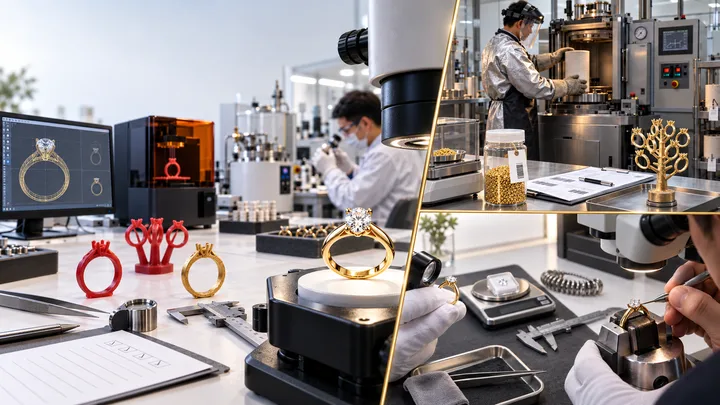
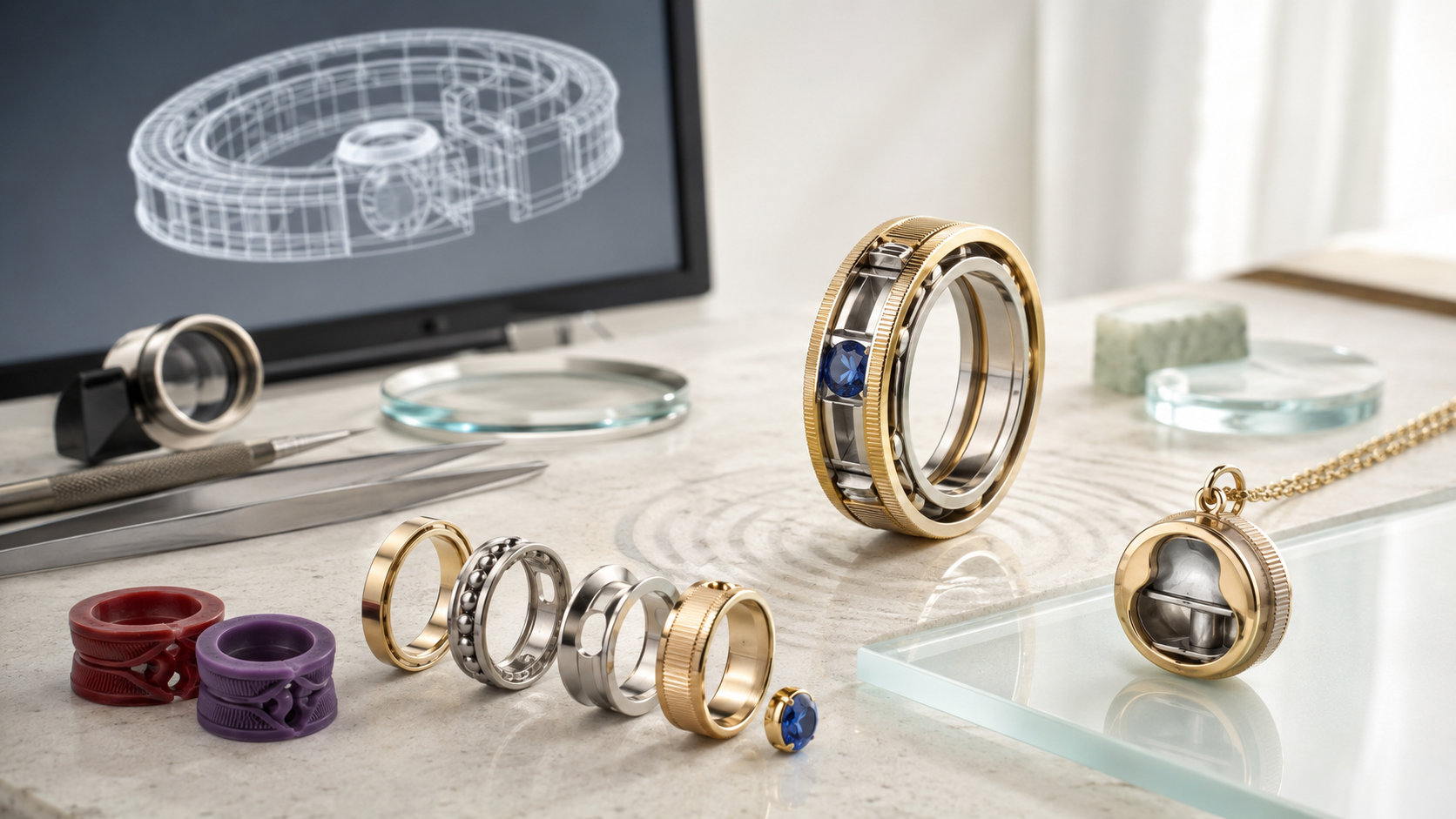
Interactive jewellery introduces a discipline that sits between jewellery manufacturing and micro-mechanical engineering.
CAD becomes critical.
Designers may need to develop:
- captive moving components
- interlocking mechanisms
- rotating channels
- internal airflow passages
- enclosed gemstone tracks
- concealed hinges
- haptic modules
- removable electronic cores
And tolerances become unforgiving.
A fraction of a millimetre could determine whether a ring rotates elegantly or rattles.
Whether a bead moves freely or jams after polishing.
Whether a mechanism feels premium or inexpensive.
Whether the jewel survives thousands of repeated interactions.
High-resolution prototyping and real-wax 3D printing could therefore become particularly valuable for developing and testing multiple clearances before final production.
The New Jewellery QC Checklist
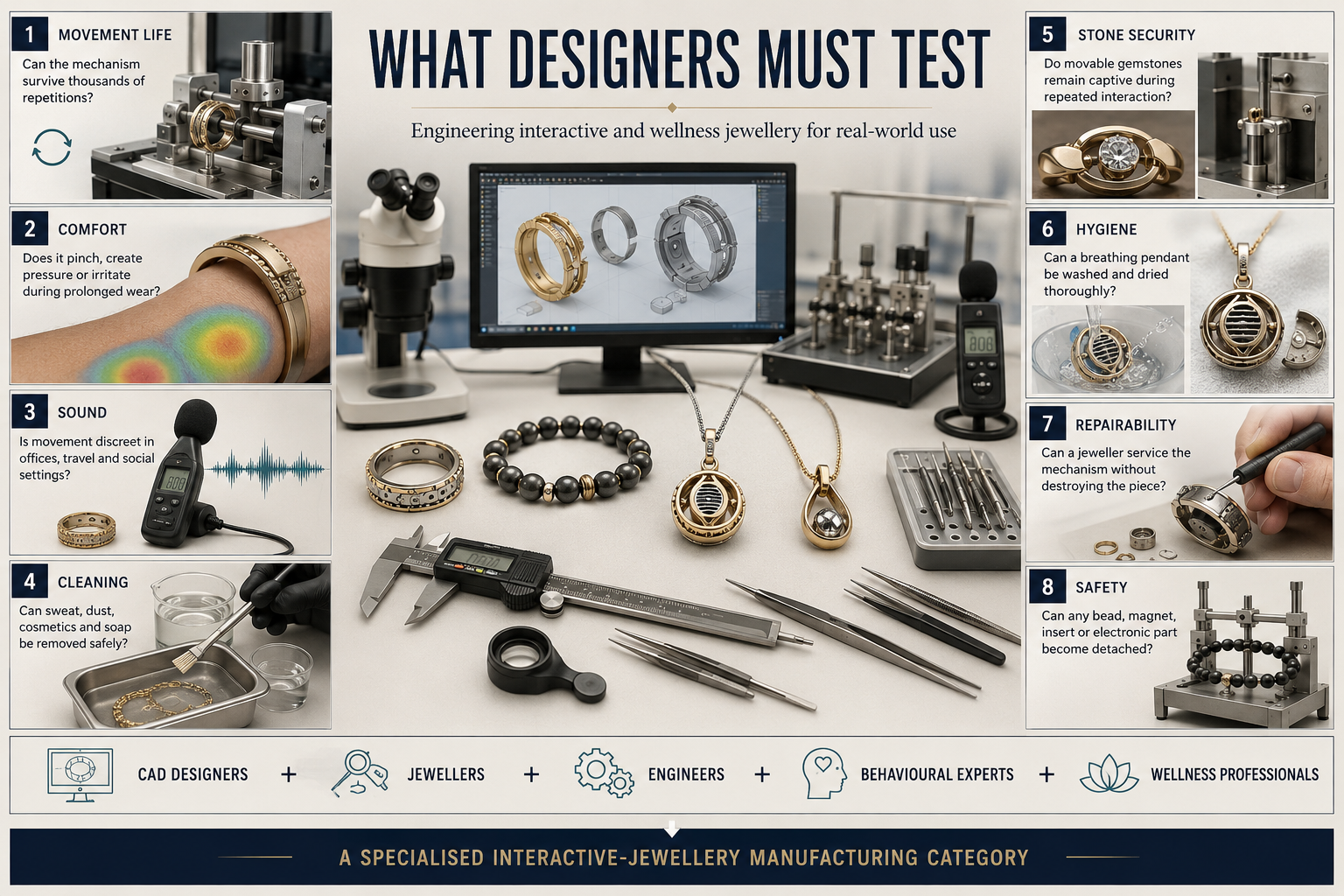
Interactive jewellery will need to pass tests that conventional jewellery may never face.
Movement Life
Will the mechanism continue working after thousands—or potentially tens of thousands—of repetitions?
Comfort
Can it be manipulated repeatedly without pinching, creating pressure points or irritating the skin?
Acoustics
Does it make unwanted noise?
Contamination
What happens when lotion, dust, soap, cosmetics or perspiration enter the mechanism?
Stone Security
Can gemstones remain captive despite repeated movement?
Hygiene
Can components such as breathing pendants be properly cleaned and dried?
Repairability
Can the mechanism be serviced without destroying the precious-metal structure?
Safety
Could a bead, magnet, insert or electronic component become detached?
This is no longer jewellery design alone.
It is design-for-interaction.
And that may eventually create an entirely new speciality involving CAD designers, goldsmiths, engineers, behavioural specialists and wearable-technology developers.
Where India Could Play
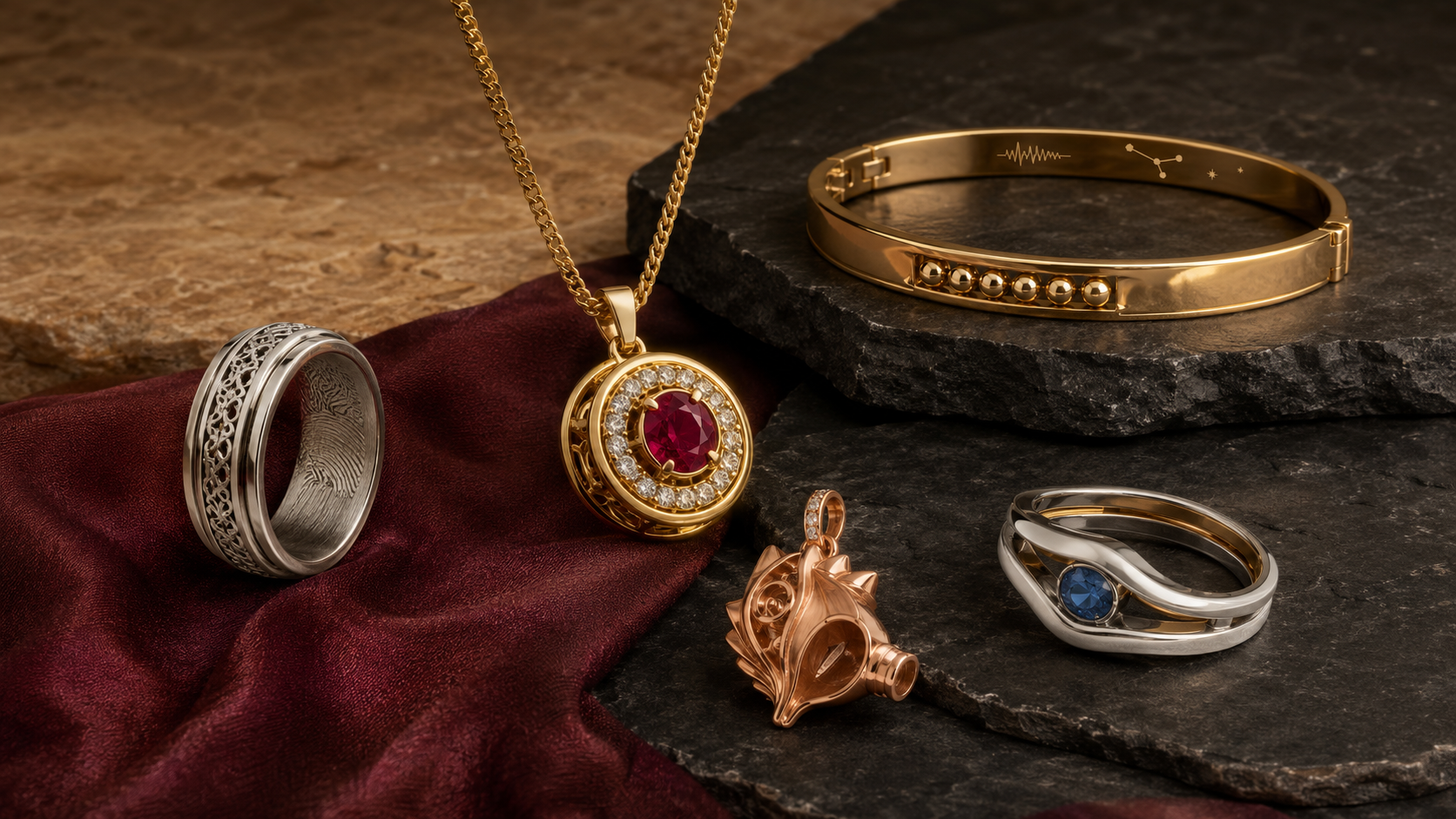
For Indian jewellery manufacturers, the smartest first move may not be electronics.
It may be passive interactive jewellery executed exceptionally well.
A sterling-silver spinner ring provides an accessible entry point.
The same principle can then migrate upwards into:
14-karat daily wear
18-karat fine jewellery
platinum jewellery
diamond jewellery
coloured-stone jewellery
personalised gifting
spiritual jewellery
luxury kinetic pieces
A rotating halo could surround a central diamond.
A captive gemstone could move within a sculpted track.
A bracelet could translate counting beads into minimalist fine jewellery.
A pendant could hide a breathing passage inside an architecturally inspired form.
Personalisation could add another layer through:
names, dates, mantras, zodiac signs, fingerprints, spiritual motifs, sound-wave patterns and hidden messages.
The strongest commercial opportunity may ultimately emerge where function and emotion become inseparable.
The consumer should want the jewel even before understanding what it does.
That is the benchmark.
From Wellness Jewellery to Emotional Luxury
There may also be a larger strategic opportunity here.
For decades, jewellery has been marketed around familiar emotional territories:
love.
celebration.
commitment.
status.
memory.
achievement.
Interactive wellness jewellery adds another possibility:
self-regulation.
Not as medicine.
Not as therapy.
But as a private ritual.
That territory could become particularly relevant to the future of daily-wear jewellery because it gives consumers another reason to remain physically connected to a piece throughout the day.
The jewel is no longer something worn only because it complements the wearer.
It becomes something the wearer uses.
And usage creates behavioural attachment.
That is commercially powerful.
Responsible Branding Will Separate Serious Brands from Gimmicks
The category also carries an obvious danger.
The term “anti-anxiety jewellery” can easily imply that a product treats a medical condition.
That is precisely where brands must exercise restraint.
The original research notes that the Advertising Standards Council of India requires factual advertising claims to be capable of substantiation and prohibits misleading communication through exaggeration, implication, omission or ambiguity.
Claims such as:
“Cures anxiety.”
“Stops panic attacks.”
“Clinically proven to treat stress.”
“Replaces medication or therapy.”
should therefore be avoided unless the extraordinary evidence required to substantiate them actually exists.
Far more credible positioning would be:
“Designed to encourage slow, mindful breathing.”
“Offers discreet tactile movement during moments of everyday stress.”
“A wearable reminder to pause, breathe and refocus.”
“Designed to support a personal grounding routine.”
Even the category itself may evolve.
Future premium brands may prefer terms such as:
Mindful Jewellery
Sensory Jewellery
Grounding Jewellery
Kinetic Wellness Jewellery
Interactive Jewellery
Emotional-Wellness Jewellery
Language will matter because the category's credibility may ultimately depend as much on what brands do not claim as on what they do.
What Happens When Jewellery Starts Sensing the Wearer?
The next stage could be considerably more ambitious.
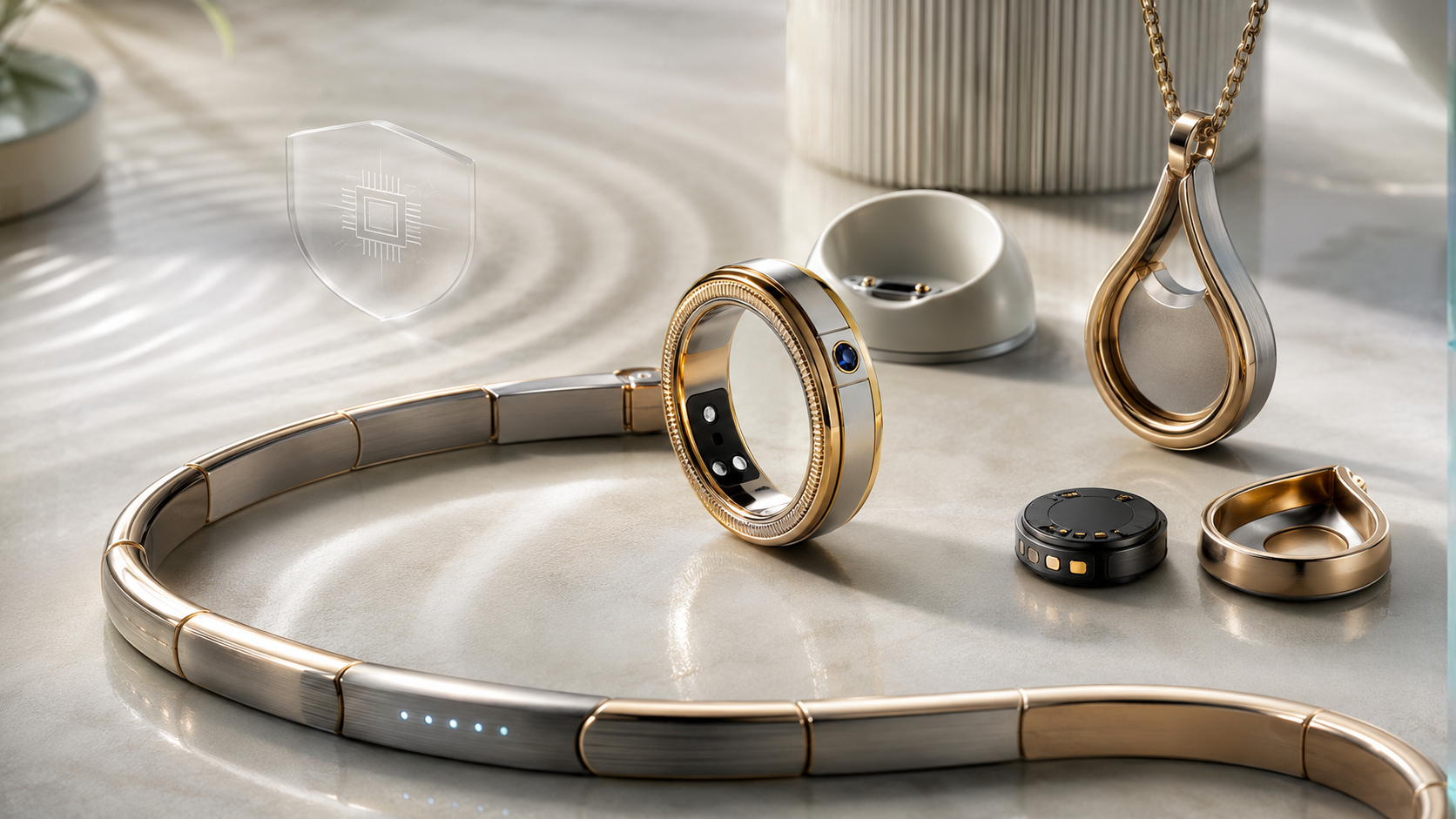
Imagine a ring capable of recognising changes in physiological signals and delivering a discreet tactile prompt.
A bracelet that responds with a slow rhythm before a presentation.
A pendant that produces a personalised haptic pattern without requiring the wearer to look at a smartphone.
Artificial intelligence could eventually identify behavioural patterns and recommend brief breathing or grounding routines.
But this is where jewellery would enter another world entirely.
The questions would no longer concern only stones, metal and mechanisms.
They would concern:
biometric data
privacy
battery life
software longevity
cybersecurity
electronic repairability
upgradeability
product obsolescence
A gold jewel may survive for generations.
A sensor may not.
A bracelet may be inherited.
Its operating system almost certainly will not be.
That creates one of the most important design questions for the future of smart luxury:
Can technology be made replaceable while the jewel remains permanent?
The strongest future smart-jewellery architecture may therefore separate the two.
Permanent precious body.
Upgradeable technological core.
That could allow luxury jewellery to retain what makes it valuable—durability, emotion and longevity—without becoming obsolete every time the electronics change.
TECH RADAR VERDICT
Anti-anxiety jewellery should not be mistaken for a medical revolution.
Its real significance is more interesting.
It represents a shift in jewellery from passive ornament to interactive experience.
For designers, it introduces new disciplines: ergonomics, sensory design, movement, acoustics and behavioural interaction.
For CAD teams, it creates demand for tighter tolerances, hidden channels, captive elements and complex micro-mechanisms.
For manufacturers, it opens opportunities in kinetic jewellery, breathing tools, sensory products, personalised rituals and eventually haptic wearables.
For brands, it creates a new emotional territory beyond love, status and celebration.
And for consumers, the proposition can remain remarkably simple:
a beautiful object that quietly reminds them to pause.
The winners in this category are unlikely to be the brands making the loudest wellness claims.
They will be the ones capable of creating products that look unmistakably like fine jewellery, function with mechanical precision and communicate their purpose with credibility.
The future of jewellery may therefore not be defined only by what a piece looks like.
Increasingly, it may also be defined by what happens when the wearer touches it.
And that could be the beginning of an entirely new relationship between the jewel and the human body.