
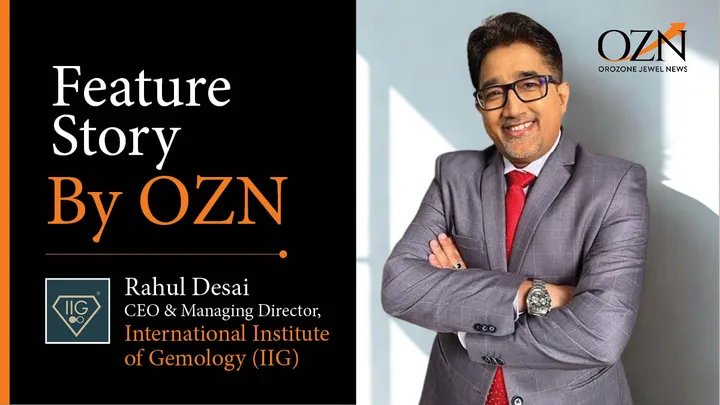
With a legacy dating back to 1965, IIG has established itself as a specialised institution dedicated to gem and jewellery education. Under Rahul Desai’s leadership, the institute is focusing on building a stronger connection between classrooms and industry requirements, ensuring that students gain not only technical knowledge but also practical understanding of how the jewellery ecosystem functions.
According to Desai, the vision is to make IIG a future-next institute — one that prepares students not only for the industry that exists today but also for the opportunities and challenges of tomorrow. “A certificate can be framed, but industry-readiness is what helps you walk through doors with confidence,” says Desai.
From Traditional Craftsmanship To Future-Ready Skills
India’s jewellery industry has always been powered by three major strengths — craftsmanship, manufacturing capability and entrepreneurial energy. However, according to Desai, the next chapter will require smarter systems, stronger skills and professionals who can adapt to rapid changes.
Jewellery manufacturing is moving towards greater precision, flexibility and technology adoption. CAD, artificial intelligence, digital tools, advanced gemological instruments and data-driven processes are changing how jewellery is designed, manufactured and marketed.
However, Desai believes technology should not replace human expertise. “A machine may identify a pattern, but a trained professional must understand what that pattern means. Human intelligence will remain at the wheel, while AI becomes a very capable co-pilot,” he explains. For the future workforce, the ability to combine craftsmanship with technology will become one of the most important skills.
Bridging The Gap Between Education And Industry
One of the biggest challenges facing the jewellery sector is the gap between industry requirements and available talent. IIG’s approach focuses on ensuring that education remains connected with real-world applications.
The institute’s curriculum covers multiple aspects of the jewellery ecosystem, including gemology, diamond grading, jewellery design, CAD, manufacturing, retail management and merchandising. For Desai, the relationship between education and industry must remain continuous.
“What changes in the trade must find its way into the classroom, and what is taught in the classroom must work in the trade,” he says. Through practical learning, industry exposure and skill development, IIG aims to prepare professionals who can contribute effectively across manufacturing, retail and design environments.
AI, Technology And The New Learning Ecosystem
Technology has become an important part of the jewellery industry, and Desai believes educational institutions must actively integrate these changes into their learning models. Artificial intelligence, according to him, presents a major opportunity for both education and jewellery businesses. AI can support design exploration, personalised learning, business analysis and operational efficiency.
However, the true value of AI will come when it works together with human understanding. Desai believes jewellery businesses already possess valuable information related to customers, inventory and market behaviour, but the opportunity lies in converting this information into meaningful insights. “Start with one genuine problem and one measurable use case. One useful pilot is worth more than ten impressive tools,” he explains.
Creating A Lifelong Learning Ecosystem
For Rahul Desai, the role of an educational institution does not end when a student completes a course. The future requires continuous learning as technology, consumer behaviour and business models continue to evolve. IIG’s journey over six decades reflects this philosophy of constant adaptation.
“Legacy alone does not guarantee relevance. Our strength is not simply that we have been teaching for sixty years, but that we have never stopped learning during those sixty years,” says Desai. As the jewellery industry moves towards a more technology-driven and globally competitive future, the importance of skilled professionals will continue to grow.
Through practical education, industry collaboration and future-focused learning, Rahul Desai’s vision is to build a stronger talent ecosystem that enables the jewellery industry to innovate, adapt and lead the next era of growth.