In 1805, an Italian chemist hooked an early battery up to a silver coin sitting in a jar of liquid gold. Without realising it, he proved that making jewellery did not always have to be about cutting away metal.
While traditional shop floors rely on carving wax, filing edges, and grinding down rough castings, modern electrodeposition works in reverse. Inside quiet chemical tanks, factories build solid metal shapes and mirror-smooth finishes atom by atom. The process turns invisible metal floating in a liquid bath into light, highly profitable jewellery pieces that no cutting tool or casting mould could ever make.
Mastering these liquid tanks—whether you are putting down micro-thin rhodium coats or building hollow gold shapes from scratch—is essential for keeping factory profits healthy. It is the difference between making sturdy, high-end jewellery and dealing with costly floor errors.
The entire process works through simple physics and direct electrical current. You submerge the jewellery piece, which acts as a negatively charged cathode, into a water bath packed with dissolved metal salts. Opposite it sits an anode—a positive electrode made of pure silver, pure gold, or an inert metal like platinised titanium. As electricity flows through the tank, positive metal ions in the liquid attach themselves to the jewellery surface, turning into solid metal.
Faraday’s laws of electrolysis govern how fast and thick this layer grows. The exact weight of metal you deposit depends on the electrical current, how long the piece stays in the bath, and the chemical nature of the metal itself. But in a real factory, electricity does not always behave perfectly. If you run the current too high, the electricity breaks down water molecules into hydrogen gas bubbles. Getting a smooth, mirror finish instead of a rough, dark crust comes down to controlling the exact amount of electrical current spread across the surface of your pieces.
While standard plating and electroforming rely on the same chemical principles, they do completely different jobs on the shop floor. Standard electroplating is used for surface finishing, putting down tiny coatings that range from fractions of a micron up to five microns thick to protect the metal or change its colour.
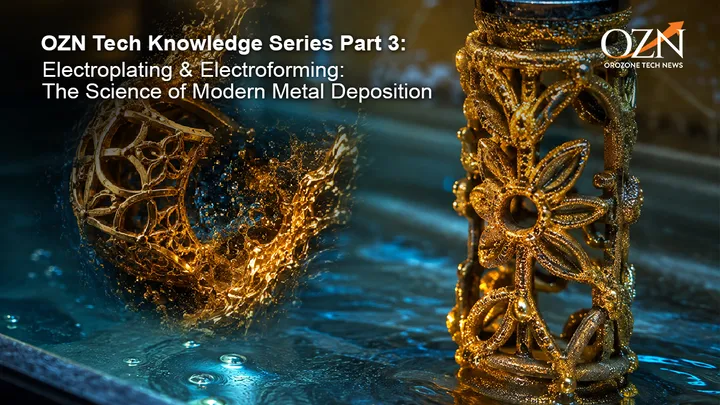
Electroforming, on the other hand, is a structural process. It builds thick, hollow gold pieces from scratch—often around one hundred to two hundred and fifty microns thick—by depositing metal onto a temporary core. This lets factories craft huge, bold 14K, 18K, or 24K gold earrings and bangles that look heavy and solid but feel feather-light and stay affordable to produce.
To electroform a piece, workers start by moulding or 3D-printing a temporary shape out of special wax. Because wax does not conduct electricity, they spray or dip it in an ultra-thin layer of conductive silver or graphite paint. Next, these prepared wax shapes hang inside a low-temperature gold bath for ten to fourteen hours.
The bath deposits a thick, solid gold skin over the painted wax. Once the gold shell reaches the right thickness, workers pull the piece out, drill a tiny hole into it, and heat it up. The inner wax melts and drains out through the hole, leaving behind a hollow, seamless gold structure that gets washed out with solvent and sent off for final polishing.
The secret to getting a flawless finish lies in the chemical mix inside the tank. A basic plating bath needs metal salts like gold potassium cyanide or rhodium sulfate to supply raw metal, along with organic additives that fine-tune the result. Without these additives, metal would build up in rough, uneven crystals. Special organic brighteners and levellers travel straight to high points on the jewellery surface, slowing down metal build-up on the peaks and forcing it into tiny scratches and valleys. This self-levelling action is what gives the metal its liquid-smooth shine.
At the same time, hydrogen gas bubbles naturally cling to the metal as it plates. Left alone, these bubbles block fresh metal from sticking, leaving tiny, pitted holes all over the finished piece. Factories solve this by adding surfactants, which lower the liquid's surface tension so gas bubbles pop off the surface instantly. For high-end white jewellery, plants run concentrated rhodium sulphate baths that leave an intensely white, scratch-resistant barrier over white gold or silver. Newer hybrid baths combine rhodium with platinum, giving shop floors a bright white look while keeping raw metal costs lower.
Even in well-run factories, plating lines run into trouble. When problems show up, shop managers turn to a diagnostic tool called a Hull Cell—a small, angled test tank that lets them see how a bath behaves across different electrical strengths all at once. Dark, rough, or "burnt" edges on the corners of a piece usually mean the electrical voltage is set too high or the metal content in the bath has dropped too low. Turning down the power or using thin guard wires to pull excess current away from sharp corners fixes the issue.
When plated layers start peeling or flaking off, the bath itself is rarely to blame. Peeling almost always traces back to poor cleaning before the piece ever touched the plating bath. Leftover polishing grease or invisible oxide films block the new metal from locking on. The best defence is a strict, multi-step wash line on the floor: workers run parts through ultrasonic grease removers, warm water rinses, an electrical deep clean, an acid dip to strip oxides, and a final deionised water wash before anything goes into the plating tank.
If small pitted craters keep showing up on the surface, workers need to turn up the liquid pumps or air lines in the tank, or add fresh surfactants to keep gas bubbles from sticking. And when rhodium or gold tanks turn cloudy and start giving off dull, discoloured finishes, it usually means copper or iron has dragged into the tank on dirty plating racks. Floor techs clean the bath using a trick called "dummying"—running a weak electrical current through a wavy scrap metal sheet to draw out base metal impurities without wasting precious gold or rhodium.
Looking ahead, surface finishing is changing fast to meet tighter environmental laws and rising metal prices. Traditional gold electroforming tanks relied on toxic cyanide compounds, but factories are rapidly moving toward safer, non-cyanide formulations that eliminate hazardous fumes without sacrificing metal strength or brightness.
At the same time, plants are adopting high-frequency pulse plating, which sends rapid bursts of electrical current back and forth through the tank instead of a steady flow. The brief reverse pulses knock off rough spots as they start to form, yielding a much harder, denser metal layer with less raw material. Many plants are also pairing traditional wet chemistry with vacuum-chamber PVD coatings, applying ultra-hard base layers before adding a precious metal topcoat.
Ultimately, keeping a plating line profitable comes back to basics: keep pre-cleaning cycles strict, track electrical current based on surface area rather than guessing voltage, and test bath health regularly to catch contamination before it ruins a whole batch of inventory.
References
https://knowledge.electrochem.org/encycl/art-e01-electroplat.htm
https://www.finishing.com/books/the-canning-handbook-surface-finishing-technology/
https://www.ganoksin.com/article/recent-electroforming-developments/
https://www.ganoksin.com/article/electroplating-jewellery/
https://www.ganoksin.com/article/electroforming-step-by-step/
https://www.cooksongold.com/blog/learn/gold-plating-jewellery/
https://www.riogrande.com/knowledge-hub/articles/guide-to-jewelry-plating/
https://legor.com/en/prodotto/rhodium/
https://legor.com/en/prodotto/rhodiens/
https://www.pschemitech.com/goldelectroforming