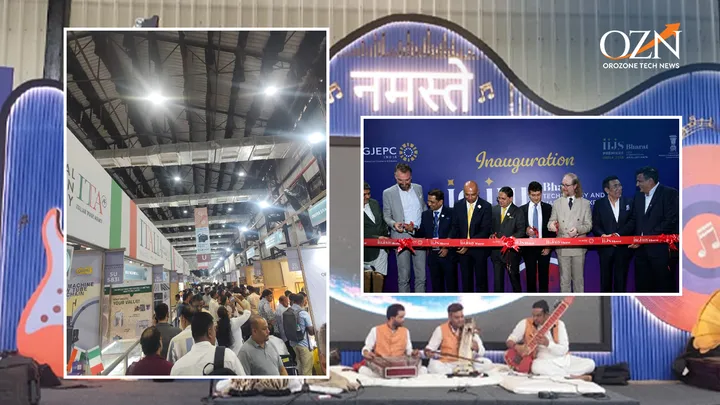
Mumbai: While thousands of buyers moved through the jewellery halls of IIJS Bharat Premiere 2026 searching for the next commercially successful collection, another equally important conversation was taking place inside the machinery section at the Bombay Exhibition Centre in Goregaon.
The India Gem & Jewellery Machinery Expo — IGJME Bharat Premiere 2026, held alongside IIJS Bharat Premiere, brought machinery manufacturers, technology suppliers, process-chemistry companies, equipment specialists and jewellery manufacturers together to examine one fundamental question: how can jewellery be produced faster, more accurately and with lower material loss?
The machinery exhibition ran from 6th–10th August 2026 at BEC, Mumbai, giving manufacturers an opportunity to evaluate technologies across jewellery production, casting, laser processing, surface finishing, electroplating, chain manufacturing, cleaning, metallurgy and factory automation.
Interest in the machinery exhibition was substantial ahead of the event, with GJEPC reporting applications from more than 280 machinery and allied companies seeking over 410 booths.
The exhibition was accommodated primarily across Hall 5 and Aurum Hall, creating a concentrated technology sourcing destination within the wider IIJS ecosystem.
But the importance of IGJME 2026 went beyond exhibitor numbers.
The exhibition demonstrated how jewellery manufacturing is rapidly changing from an industry built largely around skilled manual processes into one increasingly supported by digital control, automation, process monitoring and precision engineering.
Jewellery Machinery Is No Longer Only About Production Capacity
For many years, machinery purchasing decisions in the jewellery industry were primarily based on output.
Manufacturers wanted to know how many chains, rings, bangles or components a machine could produce during a shift.
That calculation is becoming considerably more sophisticated.
Today, manufacturers are increasingly examining factors such as metal recovery, production consistency, cycle time, rejection rates, labour dependency, energy consumption, maintenance requirements, repeatability and return on investment before purchasing equipment.
The machine therefore has to contribute not only to production volume but also to profitability.
This shift has become particularly significant as gold prices remain elevated.
When the raw material being processed is one of the most expensive commodities in the world, even fractional improvements in metal utilisation can translate into substantial savings.
A production technology capable of reducing excess metal by only a small percentage can generate significant financial benefits when multiplied across thousands of pieces produced every month.
This is changing the definition of productivity inside jewellery factories.
Laser Technology Expands Across the Jewellery Factory
Laser technology remained one of the most visible technology categories at the exhibition.
Jewellery manufacturers are increasingly using laser systems across multiple operations, including cutting, welding, engraving, marking, texturing and hallmarking.
The advantage lies in precision and repeatability.
Traditional processes often require considerable operator experience, whereas digitally controlled laser systems allow manufacturers to reproduce complex operations with greater consistency.
Laser welding, for example, allows jewellery manufacturers to perform highly localised repairs or joining operations while minimising heat exposure to surrounding areas.
Similarly, laser cutting and engraving technologies enable extremely detailed patterns that would be difficult or time-consuming to reproduce manually.
As jewellery designs become lighter and more intricate, this level of control is becoming increasingly valuable.
The next stage of development is likely to involve deeper integration between CAD design, digital production files and laser processing, creating a more connected manufacturing workflow from design to finished component.
Casting Technology Continues to Evolve
Casting remains one of the foundations of jewellery manufacturing, but the technology surrounding casting is becoming increasingly sophisticated.
Manufacturers are paying greater attention to parameters such as temperature control, vacuum quality, pressure, metal flow, porosity reduction and repeatable casting cycles.
Inconsistent casting can lead to porosity, incomplete filling, surface defects and rework.
Each of these problems ultimately represents lost time, additional labour and precious-metal handling.
Modern casting systems therefore increasingly focus on creating repeatable process conditions rather than relying entirely on operator judgement.
For large manufacturers running hundreds of casting cycles, this consistency can have a direct impact on rejection percentages and overall factory efficiency.
Metallurgy Becomes Part of the Technology Conversation
Another significant aspect of modern jewellery manufacturing is metallurgy.
Companies supplying alloys, master alloys and casting-related technical solutions have become increasingly important within machinery exhibitions because the performance of a production system depends heavily on the material being processed.
The correct alloy can influence casting fluidity, hardness, colour stability, polishing behaviour, deformation resistance and production consistency.
Manufacturers are therefore looking beyond equipment specifications and examining complete process combinations involving the machine, alloy, temperature settings and post-casting treatment.
This represents an important evolution within the jewellery manufacturing ecosystem.
Technology is no longer simply a machine sitting on the factory floor.
It is becoming a combination of equipment, material science, software and process knowledge.
Surface Finishing Moves Towards Greater Control
Finishing has traditionally been one of the most labour-intensive areas of jewellery manufacturing.
Polishing, cleaning, electroplating and surface treatment require considerable skill, particularly when dealing with delicate or highly detailed pieces.
At IGJME, technologies related to electroplating, ultrasonic cleaning, enamelling and finishing processes reflected growing demand for better process control.
Modern plating systems increasingly incorporate temperature regulation, rectification control, solution management and standardised process parameters.
The objective is consistency.
For jewellery manufacturers producing thousands of identical pieces, even small variations in plating thickness or surface finish can create quality-control problems.
More controlled systems allow manufacturers to achieve greater repeatability while reducing dependence on individual operator judgement.
UV enamelling and related surface-decoration technologies are also becoming increasingly relevant as jewellery brands experiment with colour and mixed-material aesthetics.
Chain and Component Manufacturing Remain Highly Specialised
While digital manufacturing attracts significant attention, traditional high-volume jewellery manufacturing technologies continue to evolve.
Specialised machinery for chain production, rope-chain manufacturing, lobster clasps, spring rings, wire processing and jewellery components remains extremely important for large production houses.
These systems are designed around speed, consistency and high-volume output.
For manufacturers supplying domestic and export markets, automated component-production machinery can significantly reduce manual handling while maintaining tight dimensional tolerances.
This segment also demonstrates that automation in jewellery manufacturing is not new.
What is changing is the level of sophistication.
Modern machinery increasingly incorporates digital settings, electronic monitoring and higher levels of process control.
Automation Is Moving From Large Factories to Mid-Sized Manufacturers
One of the broader trends visible around the jewellery machinery market is the gradual democratisation of automation.
Previously, advanced production systems were largely affordable only to major jewellery factories.
That gap is narrowing.
Compact machinery, desktop technologies and modular production systems are allowing smaller manufacturers to introduce automation without completely redesigning their production facilities.
For mid-sized jewellery manufacturers, this presents an opportunity to gradually automate individual bottlenecks.
A factory may begin with laser welding, automated polishing or improved casting control before moving towards more connected production systems.
This incremental approach could become particularly important in India, where thousands of jewellery manufacturing businesses operate at small and medium scale.
Buyers Are Asking More Technical Questions
The machinery exhibition also reflects a noticeable change in buyer behaviour.
Machine purchasers are increasingly asking manufacturers about service support, spare-parts availability, training, software compatibility and long-term maintenance.
Purchasing a jewellery machine is no longer viewed simply as buying hardware.
Manufacturers want to understand the complete life cycle of the equipment.
How easily can the machine be serviced?
Are spare parts available locally?
Can technicians provide remote diagnostics?
How much operator training is required?
Can production settings be stored and repeated?
How quickly will the machine generate a return on investment?
These questions are becoming particularly important as jewellery factories adopt increasingly sophisticated systems.
A highly advanced machine delivers limited value if production stops because technical support is unavailable.
Data Could Become the Next Competitive Advantage
Another development gradually entering jewellery manufacturing is data.
As machinery becomes more digitally controlled, factories can begin measuring production performance more accurately.
Cycle times, machine utilisation, maintenance intervals, rejection rates and production output can increasingly be recorded rather than estimated.
This data can help manufacturers identify bottlenecks and understand where money is being lost inside the production process.
In the future, jewellery factories may increasingly operate using digital dashboards similar to those already common in automotive and precision-engineering industries.
Production managers could potentially monitor machine utilisation, metal movement and quality performance in real time.
For an industry handling extremely high-value raw materials, that level of visibility could become a major competitive advantage.
Technology Investment Becomes a Strategic Decision
Perhaps the strongest message from IGJME Bharat Premiere 2026 was that machinery investment is becoming more strategic.
The jewellery manufacturer of tomorrow will not necessarily be the company with the largest factory.
It may be the company that understands its manufacturing economics most precisely.
A manufacturer capable of reducing rejection, recovering more precious metal, shortening production cycles and improving repeatability may achieve significantly stronger margins even without dramatically increasing production volume.
Technology therefore becomes a tool for protecting profitability.
IGJME Develops Its Own Identity
IGJME is also increasingly developing an identity beyond being merely a machinery section attached to a jewellery exhibition.
The presence of hundreds of machinery and allied companies illustrates the growing scale of India's jewellery-manufacturing technology ecosystem.
For equipment suppliers, IIJS week provides access to a highly concentrated audience of manufacturers, exporters and jewellery business owners.
For manufacturers, the advantage is equally significant.
A company considering an investment in casting, lasers, finishing, chain production or automation can compare multiple technologies within a single exhibition.
That competitive environment can accelerate technology adoption.
The Factory Floor Is Becoming the New Competitive Battlefield
The wider conclusion from the machinery exhibition is clear.
Competition in jewellery manufacturing is increasingly moving onto the factory floor.
Design will remain essential.
Craftsmanship will remain essential.
But the manufacturers capable of combining craftsmanship with automation, metallurgy, digital manufacturing, precision machinery and process control are likely to gain an increasingly important advantage.
The objective is not necessarily to replace skilled craftsmen.
Instead, technology is increasingly being used to remove repetitive operations, improve consistency and allow skilled workers to concentrate on areas where human judgement and craftsmanship continue to add value.
IGJME Bharat Premiere 2026 therefore offered more than a showcase of machines.
It provided a glimpse of how the Indian jewellery factory itself is evolving.
From the casting room to the laser workstation and from plating tanks to automated chain lines, manufacturing decisions are becoming more measurable, more connected and increasingly technology driven.
And as jewellery manufacturers face pressure from rising metal costs, shorter product cycles and increasingly demanding customers, that transformation is likely to accelerate.