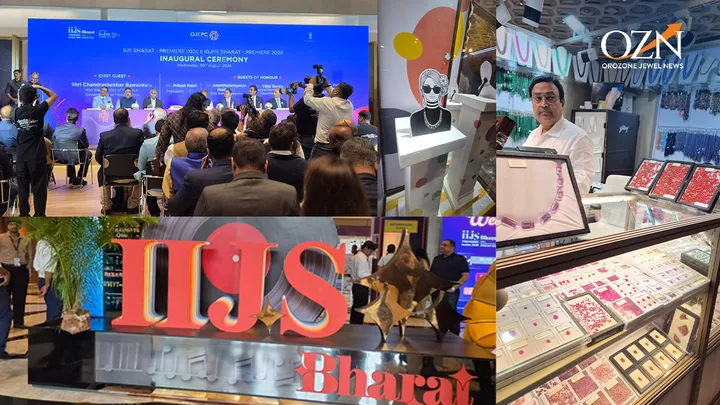
Mumbai: IIJS Bharat Premiere 2026 concluded in Mumbai on 10th August after six days of trade activity spread across the Jio World Convention Centre (JWCC) in Bandra Kurla Complex and the Bombay Exhibition Centre (BEC) in Goregaon. The JWCC leg ran from 5th–9th August, while BEC continued through 10th August. The 42nd edition also marked 25 years of IIJS operating in its B2B trade-show format.
With more than 2,100 exhibitors, 3,600 stalls and 1.35 lakh sq. metres of exhibition space, the scale remained formidable. GJEPC, which positions IIJS Bharat Premiere as the world’s second-largest B2B gem and jewellery show, created dedicated sourcing environments spanning gold, diamond and gemstone jewellery, silver, loose natural and lab-grown diamonds, coloured stones, high jewellery and international participants.
But the more significant story from IIJS 2026 is not simply how large the exhibition was. It is how the jewellery trade is changing the way it buys.
Premiere arrived at a difficult point for the gold jewellery market. World Gold Council data published through GJEPC showed India's gold jewellery demand falling 19% year-on-year to 66.1 tonnes during Q1 2026, as record prices affected affordability. Yet the value of jewellery demand climbed 47% to ₹99,920 crore. Consumers have responded by looking towards lighter pieces, lower caratages and studded jewellery — forcing manufacturers and retailers to generate more visual impact from less metal.
That makes weight engineering, pricing architecture and inventory rotation increasingly important. The question for retailers is no longer simply, “Which design will sell?” It is increasingly, “At what weight, caratage and ticket size can this design sell repeatedly?”
India’s export numbers reinforce that shift. Gem and jewellery exports stood at US$4.27 billion during April–May 2026, down 6.03% in dollar terms year-on-year. Plain gold jewellery exports fell 40.11%, while studded gold jewellery exports grew 6.71% to US$964.02 million, highlighting the growing importance of design and value addition when metal costs remain elevated.
Technology Moves Closer to the Centre
The concurrent IGJME Bharat Premiere 2026 provided the other half of the story. Jewellery manufacturing technology is becoming increasingly connected to commercial competitiveness rather than being treated merely as a production department.
Ahead of the exhibition, GJEPC reported applications from 280+ machinery and allied companies seeking more than 410 booths for IGJME. The show brought machinery, automation, software, tools and manufacturing solutions into the same sourcing ecosystem as finished jewellery.
For manufacturers facing expensive raw materials, even small reductions in metal weight, rejection, labour dependency, rework or production time can materially change margins. CAD-CAM, casting technology, laser systems, digital production management and automated finishing therefore have a much more direct connection with what eventually reaches the retailer's counter.
A Major Venue Reshuffle Tested IIJS
The 2026 edition was also logistically significant. Renovation at BEC meant the dismantling of Hall 1, removing space equivalent to 897 standard stalls used during the previous Premiere. GJEPC reworked the exhibition plan by adding capacity across Hall 6, Imperial Hall and Lotus Hall and relocating several major product categories between BEC and JWCC.
That restructuring could have disrupted an exhibition of this scale. Instead, it demonstrated how IIJS is evolving into a more deliberately segmented sourcing platform, with buyers increasingly planning visits by product category rather than simply walking the show floor.
What IIJS 2026 Leaves Behind
The conclusion of IIJS Bharat Premiere 2026 therefore leaves the industry with a clearer message than any single attendance or turnover figure could provide.
India's jewellery trade is moving towards higher design value per gram, commercially viable price points, faster inventory rotation, smarter manufacturing and broader product diversification. At the premium end, craftsmanship and exclusivity remain powerful; at the volume end, affordability and engineering are becoming inseparable from design.
IIJS remains a showcase of jewellery, but Premiere 2026 showed that it is increasingly becoming something larger — a real-time reading of how India's manufacturers, exporters and retailers are preparing themselves for the next cycle of festive, wedding and international demand.