
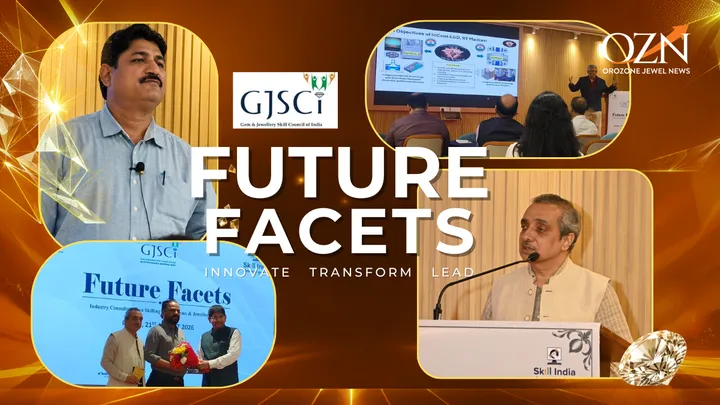
Mumbai: From the future of the karigar to lab-grown diamond technology, apprenticeship, ESG readiness and the demands of global trade, Future Facets 2026, organised by the Gem & Jewellery Skill Council of India (GJSCI) on 21st August 2026, brought several of the jewellery industry’s most pressing workforce questions onto one platform.
The discussions reflected an industry in transition. Traditional craftsmanship remains one of India’s greatest strengths, but manufacturing, retail and trade are becoming more technology-intensive, data-driven and globally accountable. Across the event, the focus repeatedly returned to how the sector can preserve its inherited skills while preparing people for changing production systems, customer expectations and business models.
Rajeev Garg, Executive Director & CEO, GJSCI, highlighted capability gaps across jewellery manufacturing, retail, wholesale, gemstone processing and traditional craft. Drawing on interactions with industry stakeholders, Garg underlined the need for continuous upskilling and reskilling as roles evolve. Skilled setters, casters and CAD professionals remain critical to manufacturing, while retail increasingly demands digital clienteling, CRM and stronger advisory capabilities. For artisans, the challenge is to introduce technology, technical understanding and process discipline without diluting the craftsmanship at the heart of Indian jewellery.
Government-led skilling initiatives were brought into focus by Hemant D. Ganjare, Regional Director/HoD, RDSDE Maharashtra, who highlighted apprenticeship opportunities and the wider transformation underway in vocational education. Among the initiatives discussed was PM-SETU, the ₹60,000-crore programme envisaging the upgradation of 1,000 government ITIs through 200 hub and 800 spoke institutions, with industry participation built into the training ecosystem. For jewellery MSMEs, the discussion reinforced the potential of structured apprenticeship and workplace learning in developing production-ready talent.
The event also looked well beyond conventional jewellery skills. Prof. M.S. Ramachandra Rao, Professor, Department of Physics, IIT Madras, and Principal Investigator for the India Centre for Lab Grown Diamonds (InCent-LGD) initiative, introduced the industry to the expanding technological possibilities of diamond. Through the idea of “Diamondtronics”, he explored applications spanning thermal management, advanced electronics, quantum technologies and traceability—placing laboratory-grown diamond within a much broader advanced-materials conversation.
Global competitiveness formed another important thread. A panel on “Impact of Global Trade, Geopolitics & ESG Readiness: Is the Jewellery Industry Ready?” brought together Ashish Shah, Managing Director, Gold Star Jewellery; Mittal Purani, Chief Operating Officer, Diatrends Jewellery; Nitin Pandya, Managing Partner, Padmakala Management Services LLP; Nasar Damani, DGM – Production, Renaissance Global; and Sanjay Dhakan, Founder & Managing Director, Bansi Jewellers.
Their conversation showed how ESG is moving from policy to proof. International buyers are increasingly seeking measurable evidence behind sustainability and social-impact claims, while technology and ERP systems are becoming important tools for traceability. At the same time, the panel stressed that future readiness must include people—whether through attracting younger talent, reskilling workers as traditional roles move towards CAD and digital processes, or improving facilities, health support and local skilling to sustain India’s handcrafted jewellery traditions.
Across the sessions, a common direction emerged: the jewellery industry cannot future-proof its businesses without future-proofing its workforce. Technology, sustainability and global compliance are no longer separate conversations from skills; they are increasingly becoming part of what being skilled in the jewellery industry means.
Future Facets 2026 ultimately positioned skilling not simply as a training function, but as an industry imperative—one that will influence how India manufactures, sells, innovates and competes in the years ahead.