
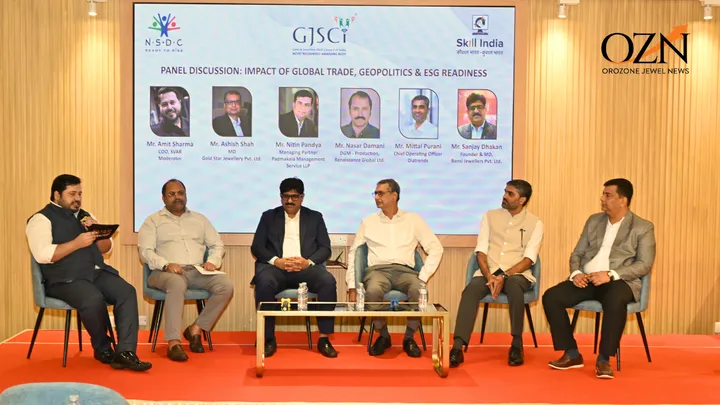
Mumbai: The next test of competitiveness for Indian jewellery may go well beyond design, price and delivery. Increasingly, businesses are being asked to show where materials came from, how responsibly they were produced, how workers are supported—and whether every claim can be substantiated.
That shift shaped the discussion on “Impact of Global Trade, Geopolitics & ESG Readiness: Is the Jewellery Industry Ready?” at GJSCI’s Future Facets 2026, bringing together Ashish Shah, Managing Director, Gold Star Jewellery; Mittal Purani, Chief Operating Officer, Diatrends Jewellery; Nitin Pandya, Managing Partner, Padmakala Management Services LLP; Nasar Damani, DGM – Production, Renaissance Global; and Sanjay Dhakan, Founder & Managing Director, Bansi Jewellers.
For Purani, the change is already visible in conversations with international clients. Where buyers once asked whether an ESG policy existed, they are increasingly asking companies to prove it. He cited customers seeking measurable records of employee participation in community service and even wanting to verify those initiatives on the ground. ESG, he underlined, is moving towards physical validation, leaving far less room for greenwashing or broad claims unsupported by evidence.
That demand for proof also places technology at the heart of readiness. Pandya highlighted how ERP systems can strengthen day-to-day compliance and traceability, including following a gold purchase from its source through to the final customer—an increasingly difficult task without a connected digital backbone.
Yet systems alone will not future-proof the sector. Shah widened the lens to talent, outlining an ecosystem where craftsmanship must increasingly connect with technology, quality, ESG and digitalisation. Attracting younger professionals, he indicated, will depend on showing them credible careers within this expanded jewellery economy, supported by structured training and opportunities to grow.
Damani’s reflection on the journey from traditional model-making to CAD illustrated how quickly those careers can change. Skills that once took shape entirely at the bench have migrated into digital environments, reinforcing the need for continuous reskilling and better use of available training infrastructure.
Dhakan, however, brought the conversation back to what must not be lost in that transition. Preserving handcrafted jewellery, he stressed, will require local skilling, better facilities for artisans and greater attention to their health and welfare, so that traditional expertise remains viable for the next generation rather than becoming a fading inheritance.
Together, the five perspectives revealed a broader definition of readiness. India’s jewellery industry will need to digitise without losing craft, meet ESG expectations with evidence rather than declarations, and build careers capable of carrying both traditions forward. In the emerging global trade order, credibility may prove as valuable as capability.