Current Scenario
Mehul Shah Elected WFDB President: Decoding the Election, the Leader and India’s Global Opportunity
The Indian diamantaire secured the world diamond industry’s highest representative office through a rare three-way international contest involving Mumbai, Dubai and Shanghai.
A Global Mandate for an Indian Diamantaire
Mehul Shah’s election as President of the World Federation of Diamond Bourses is more than another senior industry appointment.
It places an Indian diamantaire at the head of the international federation representing diamond bourses across the world at a time when the sector is confronting weak natural-diamond demand, changing trade routes, financing pressure, laboratory-grown competition and rapid technological transformation.
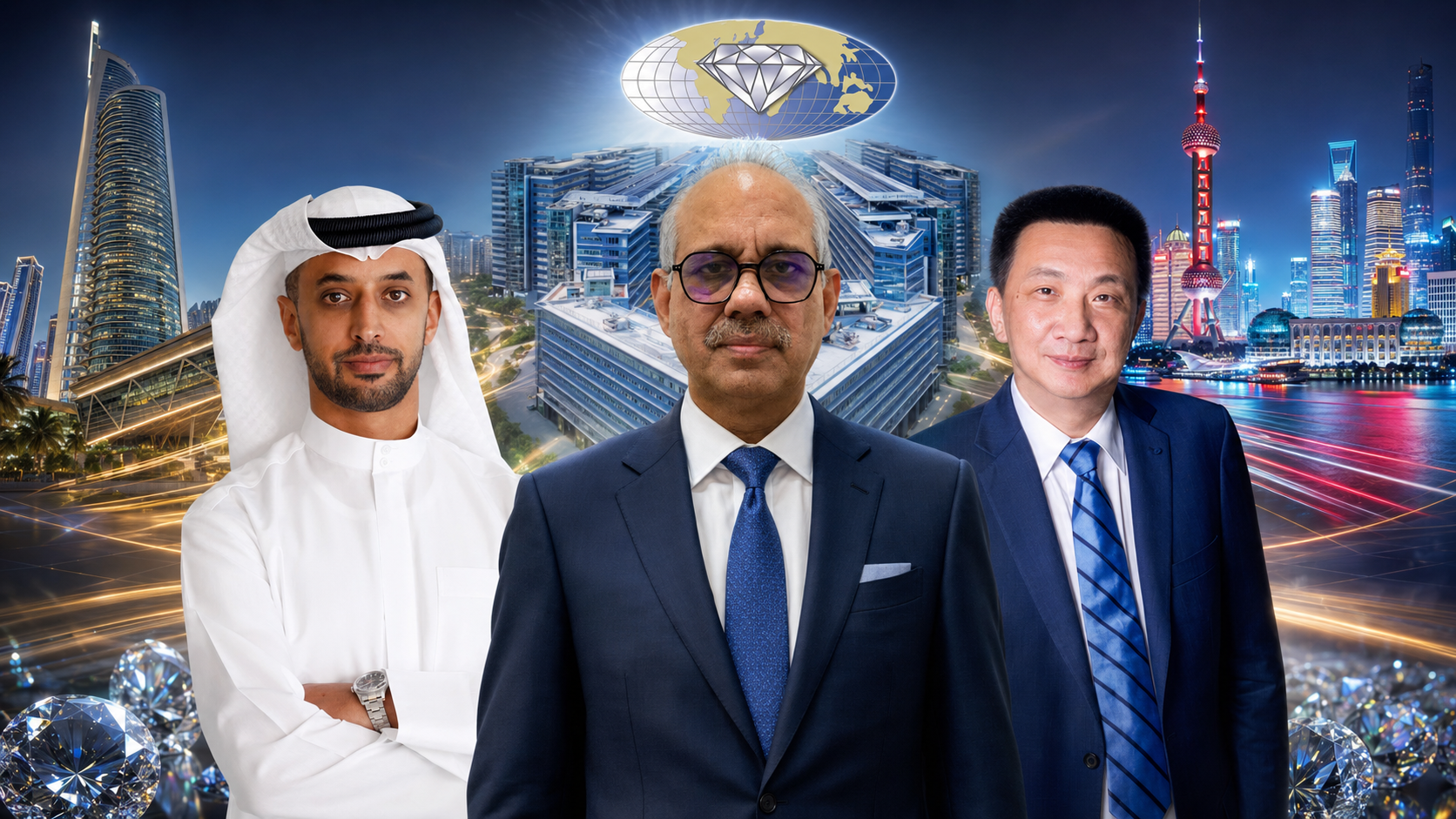
Shah won the presidency during the World Diamond Congress in Singapore, defeating:
Ahmed Bin Sulayem, Chairman of the Dubai Diamond Exchange
Lin Qiang, President of the Shanghai Diamond Exchange
He succeeds Yoram Dvash, who stepped down after completing the maximum two consecutive three-year terms.
This was not an automatic succession. It was a genuine international election involving three influential diamond centres competing for the direction of the WFDB.
Why This Election Was Particularly Difficult
1. India’s Diamond Scale Did Not Guarantee Extra Votes
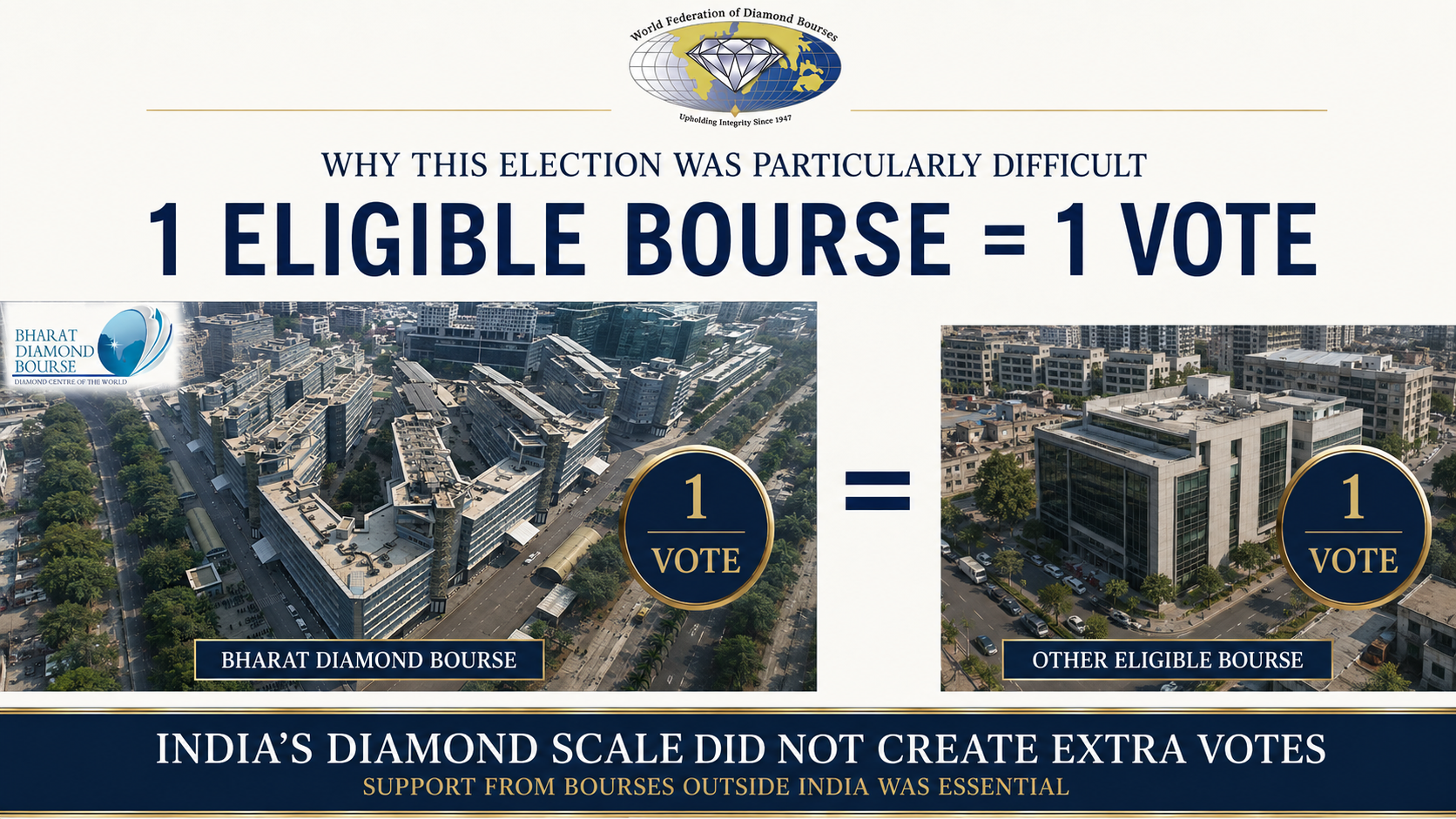
India cuts and polishes the majority of the world’s diamonds, but the WFDB does not allocate votes according to manufacturing volume, turnover or bourse size.
Under WFDB rules, each eligible affiliated bourse present at Congress receives one vote.
Bharat Diamond Bourse therefore had one vote, just like a considerably smaller exchange. Shah could not depend on India’s manufacturing dominance; he needed support from bourses outside India.
2. He Faced Two Powerful Rivals\
Dubai has developed into one of the world’s most commercially aggressive rough and polished-diamond trading centres.
Shanghai represents China, one of the industry’s most important consumer markets.
The election therefore presented three different propositions:
Dubai: speed, commercial expansion and disruption
Shanghai: consumer-market influence and Asian growth
Mumbai: manufacturing depth, experience and institutional continuity
Shah had to demonstrate that his leadership would serve the entire federation—not simply Indian interests.
3. A Majority Was Required

WFDB elections require a simple majority.
Where more than two candidates contest and no candidate secures a majority in the first round, the two leading candidates move into another round. Elections are ordinarily conducted by secret ballot unless the authorised members decide otherwise.
This meant that visible endorsements alone were insufficient. Shah needed the private confidence of international bourse leaders.
The detailed vote count has not been publicly released, so the scale of the margin should not be speculated upon. What is clear is that he built the cross-border coalition required to defeat two formidable candidates.
The Experience Behind the Victory
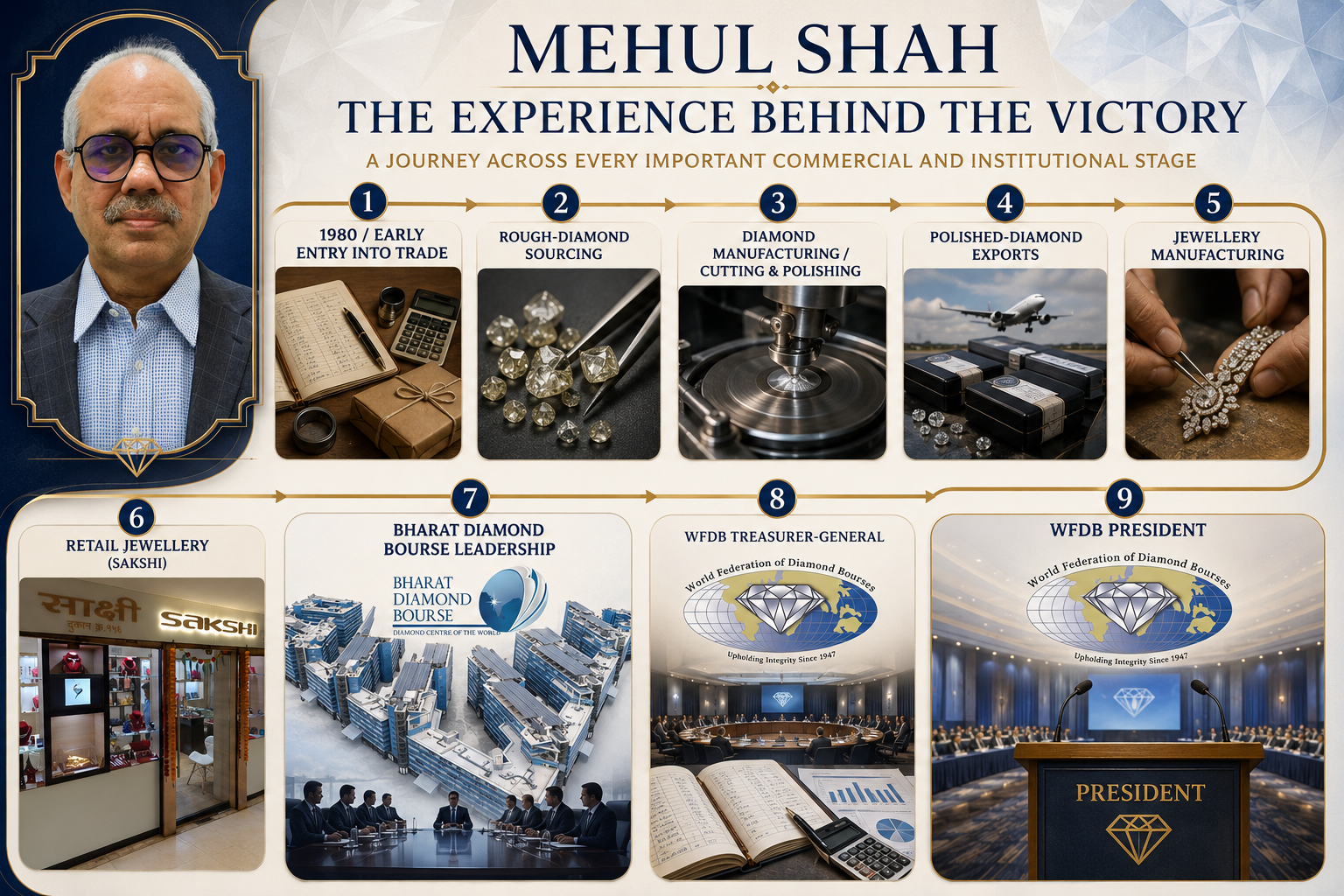
Mehul Shah entered the diamond trade in 1980 at the age of 19 as a first-generation entrepreneur.
He came to Mumbai from Kolkata, where his father was involved in the tea business. At 20, he travelled to Antwerp to purchase rough diamonds, while also helping other manufacturers source suitable material.
His first office was established in Mumbai’s Opera House diamond district, before the Bharat Diamond Bourse complex became operational.
His journey subsequently moved across almost every important commercial stage:
1.Rough-diamond sourcing
2.Diamond cutting and polishing
3.Polished-diamond exports
4.Jewellery manufacturing
5.Retail jewellery
6.Bourse administration
7.International industry governance
This breadth matters because the WFDB President must understand the consequences of international policy at the factory, trading desk and retail counter.
The Companies and Brands Behind His Business Journey
Shah is Chairman and Managing Director of the Star Brilliant Group, which operates in diamonds and jewellery with manufacturing facilities in Mumbai and Navsari.
The business cuts and polishes rough diamonds and manufactures jewellery. The company describes Star Brillian as having been founded by Navinchandra Shah together with his sons Mehul and Nikhil Shah.
Principal Business Platform
· Star Brillian Group
· Star Brillian Pvt. Ltd.
· Star Brillian Jewellery Ltd.
These should be described as businesses, partnerships or directorships associated with Shah.
A directorship record alone does not establish that he personally founded every entity.
Retail Brand
Shah developed the group’s consumer-facing presence through Sakshi, its retail jewellery brand and showroom at Atria Mall in Mumbai.
The retail operation offers natural-diamond jewellery and enabled the group to extend from rough and polished diamonds into finished jewellery and direct consumer retail.
His business history therefore reflects more than diamond trading. It represents a vertically connected journey from rough procurement to consumer jewellery.
From Businessman to Institution-Builder
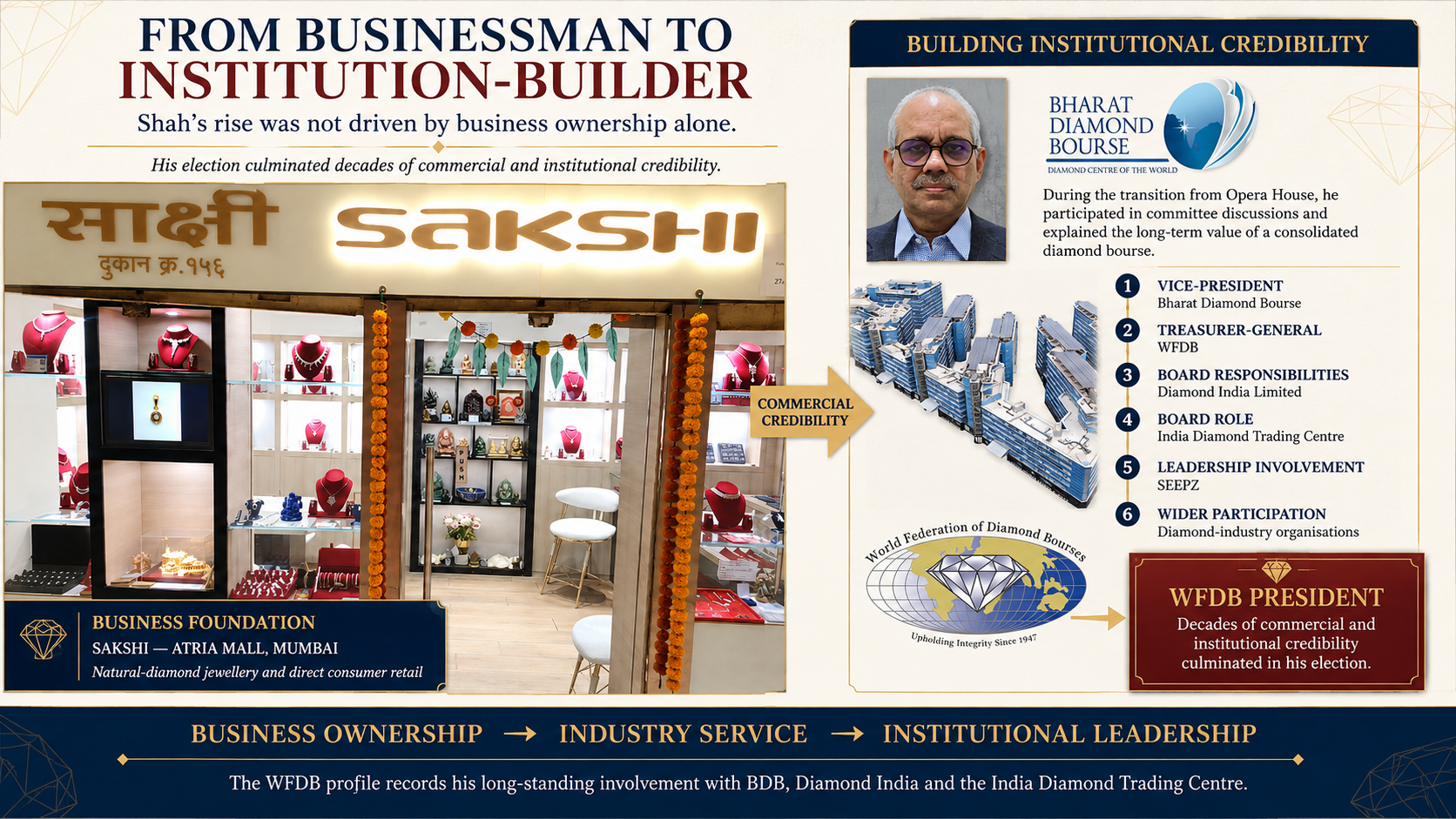
Shah’s rise was not driven by business ownership alone.
He became involved in Bharat Diamond Bourse during a period when many businesses were reluctant to relocate from Opera House to the new complex. He participated in committee discussions and worked to explain the long-term value of a consolidated diamond bourse.
His institutional career subsequently included:
·Vice-President of Bharat Diamond Bourse
·Treasurer-General of the WFDB
·Board responsibilities at Diamond India Limited
·Board role at the India Diamond Trading Centre
·Leadership involvement with SEEPZ
·Wider participation in diamond-industry organisations
The WFDB’s own profile records his long-standing involvement in BDB, Diamond India and the India Diamond Trading Centre. His election was therefore the culmination of decades spent building both commercial and institutional credibility.
What His Leadership Style Reveals
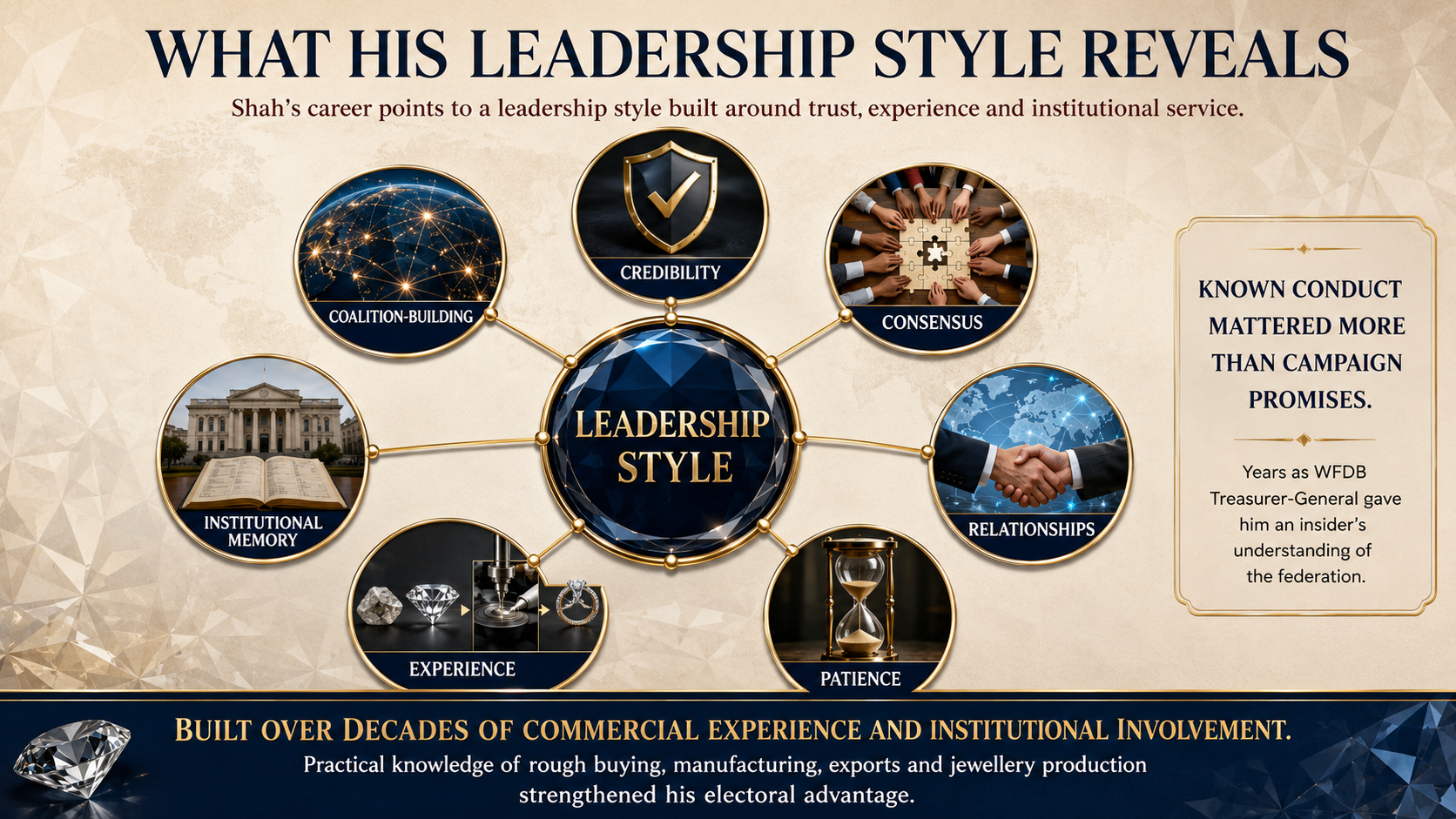
Shah’s career points to a leadership style built around:
· Personal credibility
· Institutional memory
· Consensus
· Relationship management
· Patience
· Commercial experience
· Gradual coalition-building
He is not entering the presidency as an outsider proposing sudden change. He understands the federation from within, having served for years as its Treasurer-General. He also understands the practical realities of rough buying, manufacturing, exports and jewellery production.
This combination likely became his strongest electoral advantage. International bourse leaders were not voting merely on campaign promises. They were assessing decades of known conduct.
Why the Presidency Matters for India
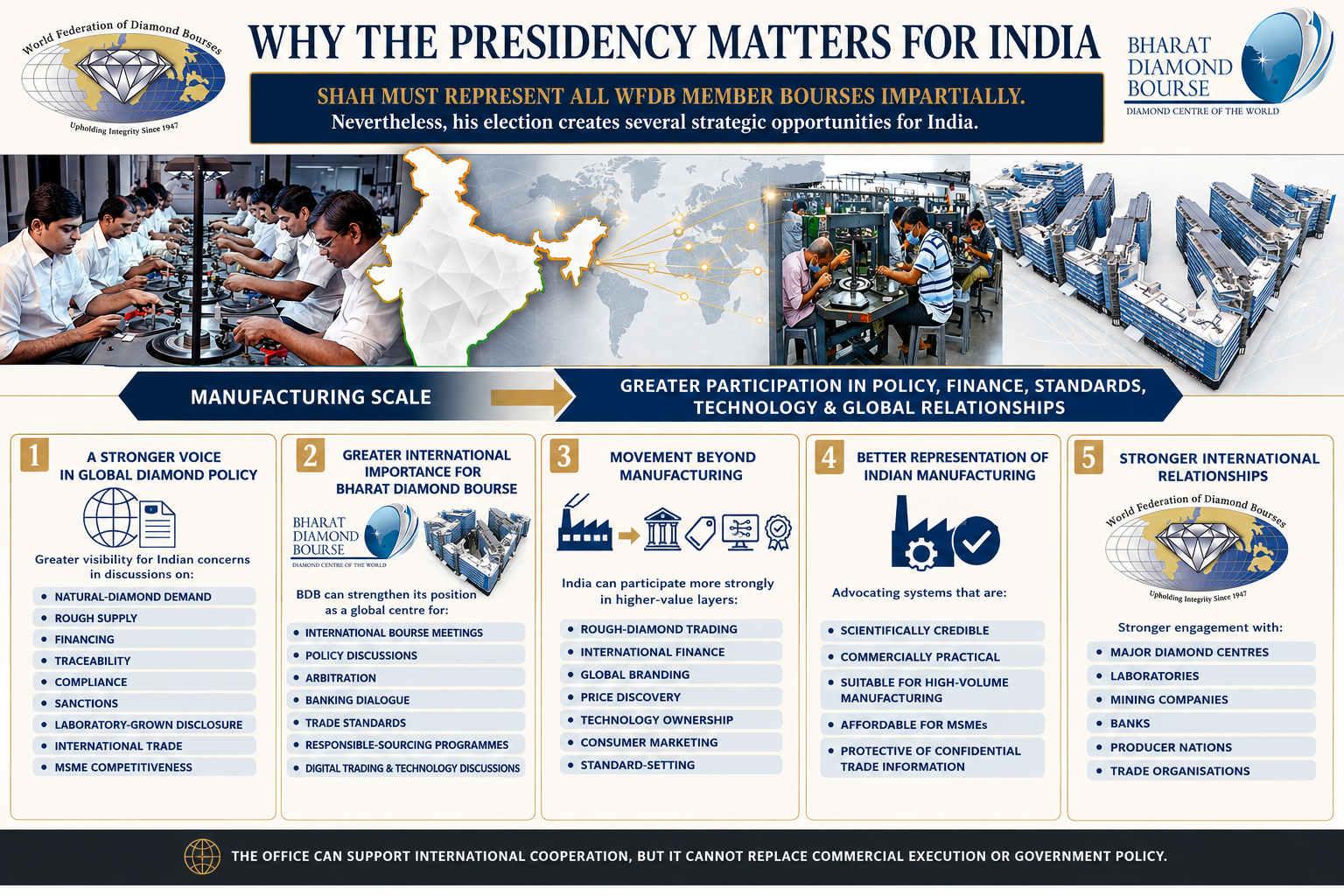
Shah must represent all WFDB member bourses impartially. Nevertheless, his election creates several strategic opportunities for India.
1. A Stronger Voice in Global Diamond Policy
Indian concerns can receive greater visibility in discussions concerning:
· Natural-diamond demand
· Rough supply
· Financing
· Traceability
· Compliance
· Sanctions
· Laboratory-grown disclosure
· International trade
· MSME competitiveness
2. Greater International Importance for Bharat Diamond Bourse
BDB can strengthen its position as a global centre for:
·International bourse meetings
·Policy discussions
·Arbitration
·Banking dialogue
·Trade standards
·Responsible-sourcing programmes
·Digital trading and technology discussions
3. Movement Beyond Manufacturing
India processes enormous diamond volumes but does not exercise the same degree of influence over:
· Rough-diamond trading
· International finance
· Global branding
· Price discovery
· Technology ownership
· Consumer marketing
· Standard-setting
The presidency creates an opportunity for India to participate more strongly in these higher-value layers.
4. Better Representation of Indian Manufacturing
International policies are not always designed with the operational realities of India’s large manufacturing ecosystem in mind.
Indian leadership can help advocate systems that are:
· Scientifically credible
· Commercially practical
· Suitable for high-volume manufacturing
· Affordable for MSMEs
· Protective of confidential trade information
5. Stronger International Relationships
The office strengthens India’s engagement with major diamond centres, laboratories, mining companies, banks, producer nations and trade organisations.
It can support international cooperation, but it cannot replace commercial execution or government policy.
The Presidency Has Limits
Shah cannot independently:
· Raise diamond prices
· Restore global consumer demand
· Change Indian taxation
· Force mining companies to sell rough in India
· Direct laboratories to adopt specific standards
· Resolve every financing problem
· Compel independent bourses to follow an Indian proposal
WFDB authority is exercised through its Congress, Presidents’ Meetings and Executive Committee. Individual bourses also retain autonomy over their domestic affairs.
The presidency provides influence, agenda-setting capacity and convening power. Converting those advantages into results will require cooperation between WFDB, BDB, GJEPC, governments, manufacturers, retailers, banks and producers.
The Harder Assignment Begins Now
Winning the election was difficult.
Leading the federation may be harder.
Shah takes office when the diamond industry is divided over:
·How to restore natural-diamond demand
·How to address laboratory-grown diamonds
·How bourses remain relevant in digital trading
·How to protect smaller businesses
·How to respond to geopolitical restrictions
·How to rebuild banking confidence
·How to engage younger diamantaires
·How to modernise without weakening established trade discipline
His presidency will be judged not only by the meetings he chairs, but by whether the WFDB becomes more commercially relevant to its members.
Final Assessment
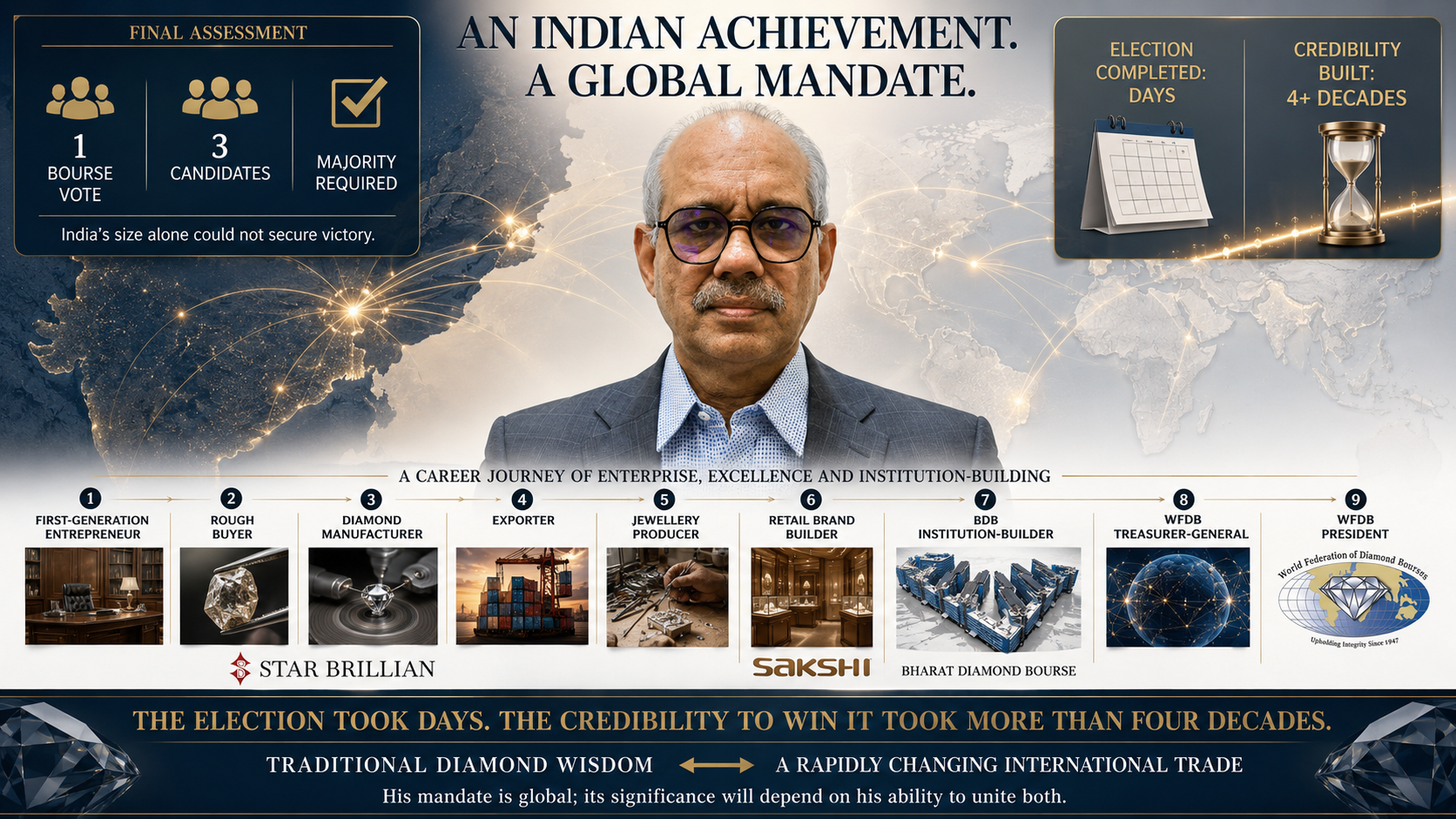
Mehul Shah’s victory cannot be explained simply by India’s size. India had one bourse vote. Shah still had to defeat candidates representing Dubai and Shanghai and earn the confidence of international leaders through a majority-based electoral process.
His progression can be summarised as:
First-generation entrepreneur → Rough buyer → Diamond manufacturer → Exporter → Jewellery producer → Retail brand builder → BDB institution-builder → WFDB Treasurer-General → WFDB President
The election was completed in a matter of days.
The credibility required to win it was built over more than four decades.
Mehul Shah’s election is an Indian achievement, but his mandate is global. Its real significance will be determined by whether he can unite traditional diamond wisdom with the demands of a rapidly changing international trade.
Future Trends
Anti-Anxiety Jewellery
When Jewellery Becomes a Wearable Tool for Calm
From spinner rings and movable beads to breathing pendants and haptic bracelets, a new category of jewellery is emerging—designed not only to decorate the body, but also to encourage touch, movement, mindful breathing and moments of emotional pause.
For centuries, jewellery has carried emotions. A wedding ring represents commitment, a religious pendant offers spiritual reassurance, an heirloom keeps memories alive and a personalised charm connects the wearer to a person, place or meaningful moment.
Now, jewellery is taking on another possible role: becoming an interactive object that may help the wearer pause, redirect restless energy and practise simple calming behaviours during moments of everyday stress.
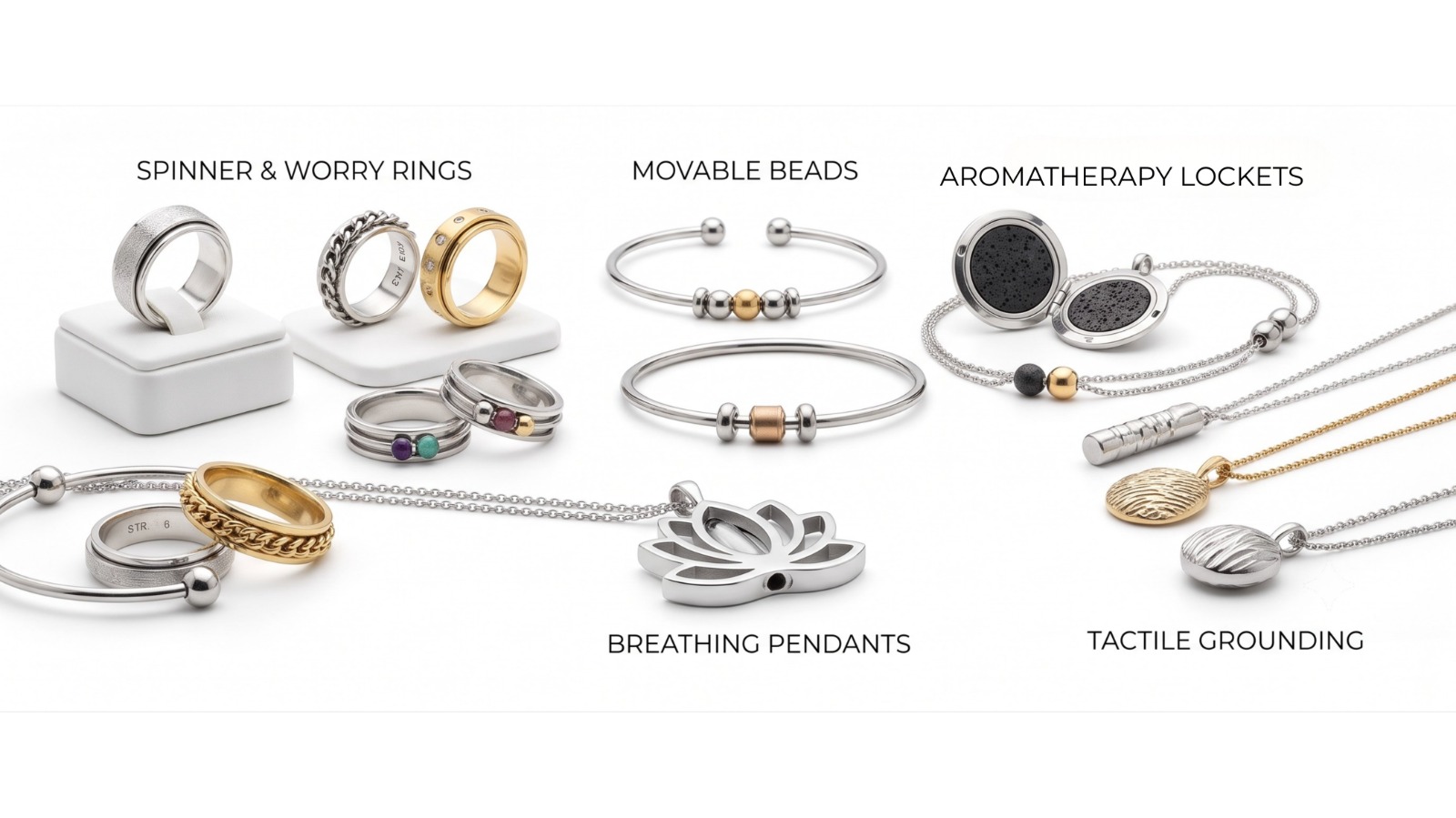
Commonly described online as “anti-anxiety jewellery,” this growing category includes spinner rings, worry rings, bracelets with movable beads, textured pendants, breathing necklaces, aromatherapy lockets and electronically powered haptic wearables.
The jewellery does not remove the source of anxiety. Nor should it be presented as a substitute for therapy, medication or professional mental-health care. Its attraction lies elsewhere: it turns familiar self-regulation behaviours into something discreet, attractive and constantly available.
The future opportunity is therefore not jewellery that promises to cure anxiety. It is jewellery that helps create a small, accessible ritual of touch, breathing, focus or movement.
Why Is This Trend Emerging Now?
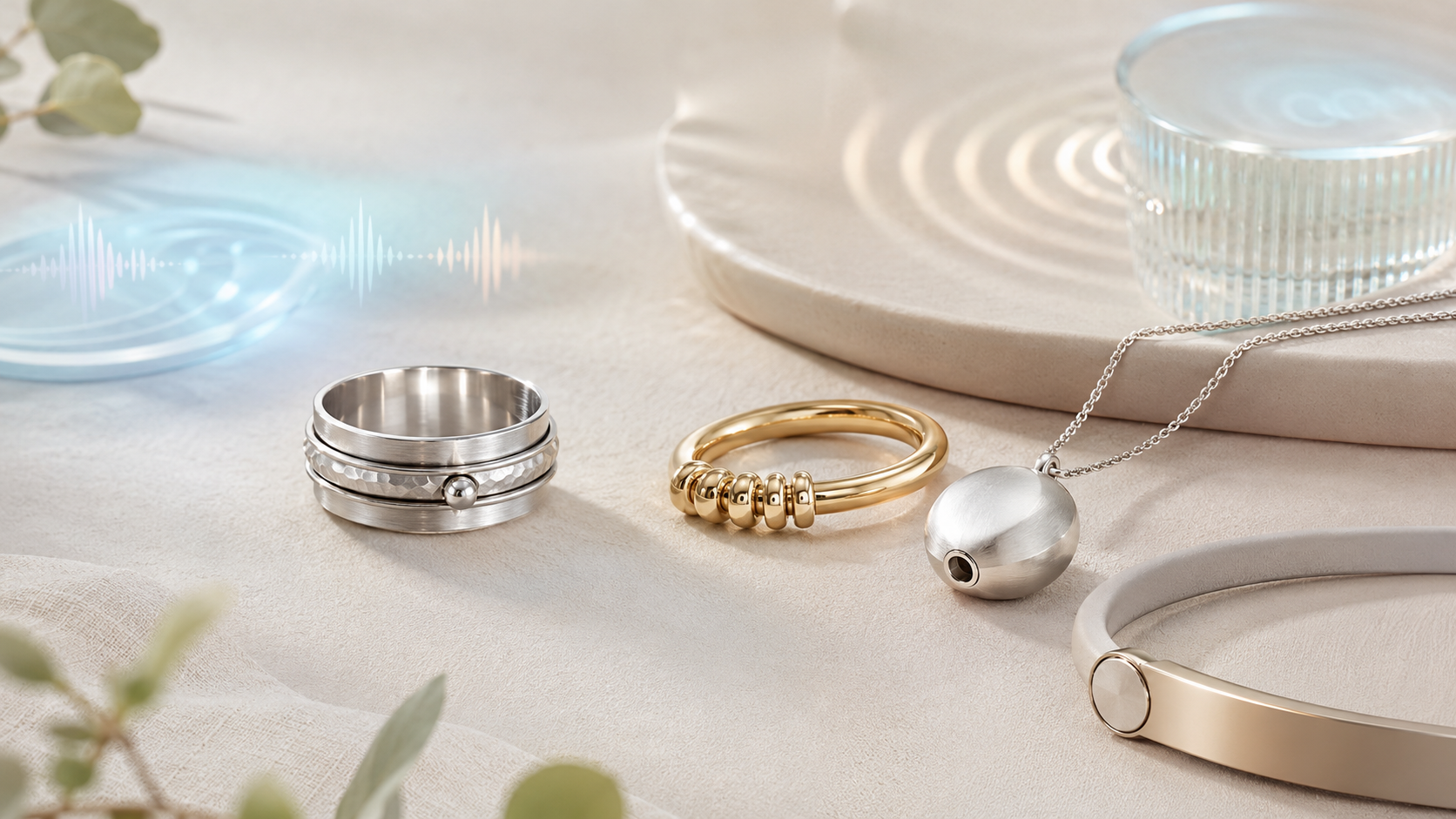
Anxiety is not a niche concern. The World Health Organization estimates that anxiety disorders affected approximately 359 million people in 2021, or about 4.4% of the global population. WHO also distinguishes occasional feelings of anxiety from anxiety disorders, which involve intense or excessive fear and worry that can interfere with daily functioning.
At the same time, wellness has become a major consumer industry. The Global Wellness Institute reports that the global wellness economy reached US$6.8 trillion in 2024 and projects it to approach US$9.8 trillion by 2029. Mental wellness was among its fastest-growing sectors between 2019 and 2024.
This changing consumer environment is influencing jewellery.
Customers—particularly younger buyers—are increasingly attracted to products that provide personal meaning, emotional relevance, customisation and everyday utility. Jewellery is no longer expected only to communicate status or complete an outfit. It may also communicate identity, beliefs, memories, moods and personal values.
In July 2026, anti-anxiety jewellery entered mainstream Indian lifestyle discussion, with products such as spinner rings, movable-bead bands and breathing pendants being presented as discreet accessories for consumers seeking calming routines without carrying an obvious fidget toy or wellness device.
The trend belongs to a wider movement in which fashion, personal wellbeing and technology are beginning to overlap.
What Is Anti-Anxiety Jewellery?
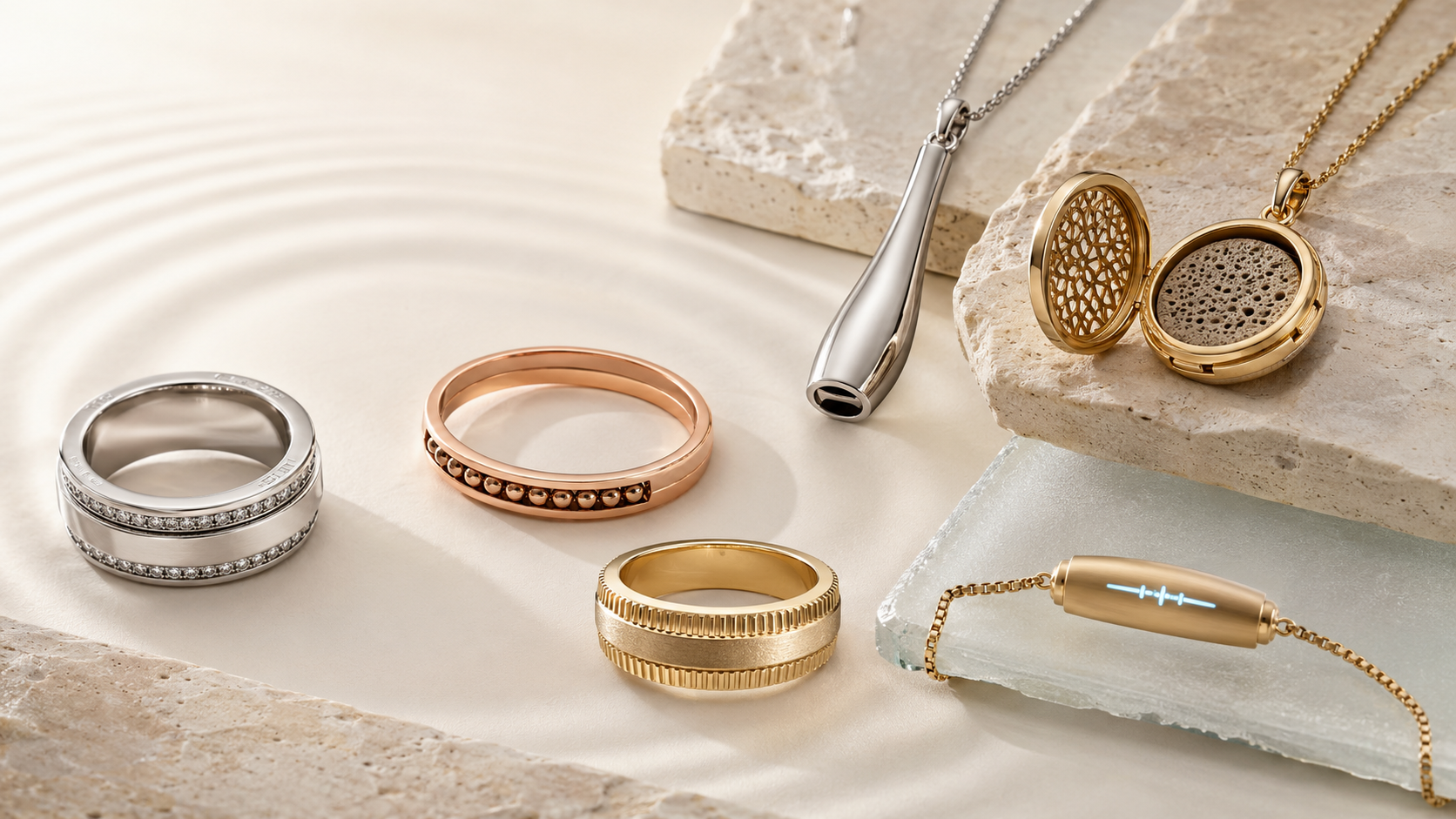
Anti-anxiety jewellery is not a single product or technology. It is a broad consumer label covering several types of interactive jewellery.
Spinner and Worry Rings
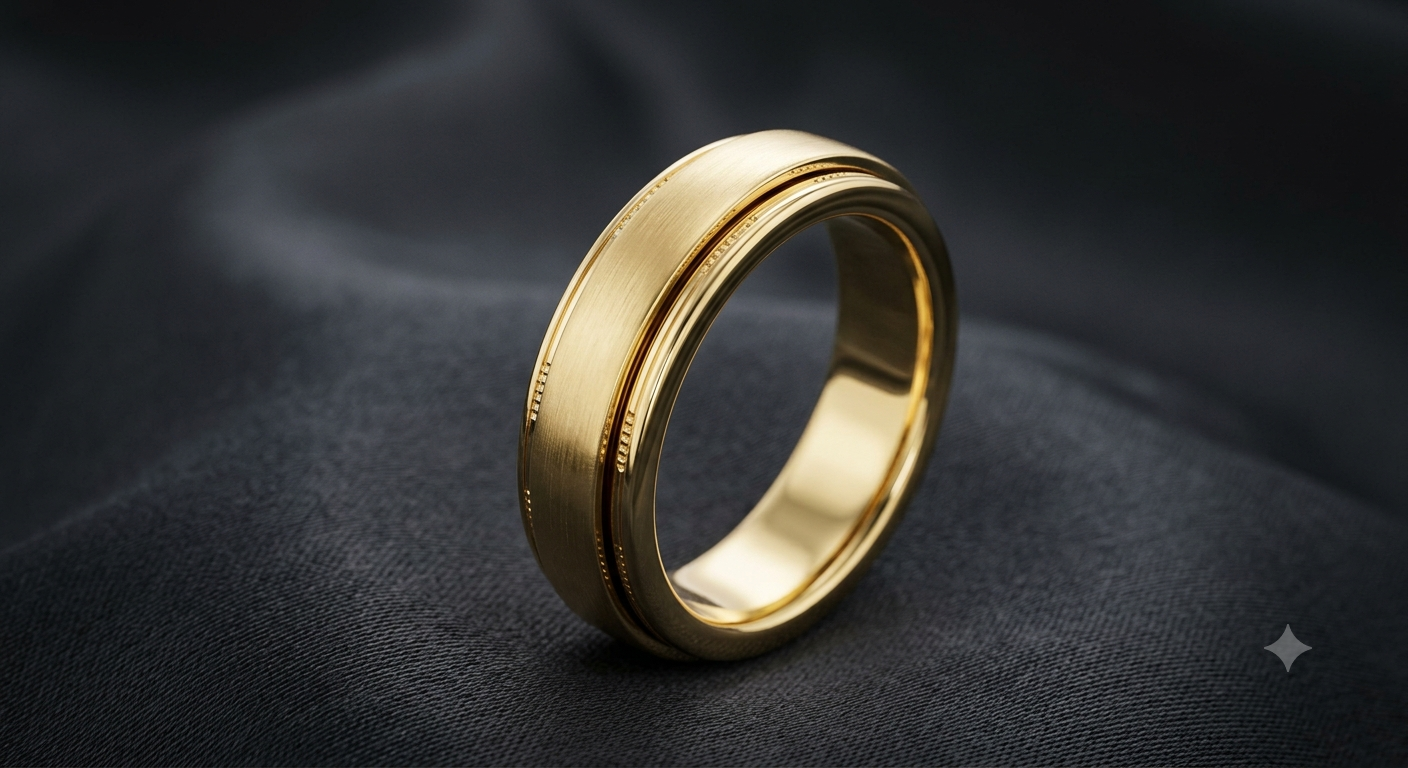
These rings contain an outer band, movable section, chain, disc or small element that can be rotated using the thumb or another finger.
The repeated action gives restless hands a controlled movement. Unlike a conventional fidget spinner, the mechanism remains part of a wearable and socially familiar object.
A successful spinner ring must feel like jewellery first. Its movement should be smooth, quiet and satisfying without looking like a toy.
Movable-Bead Jewellery
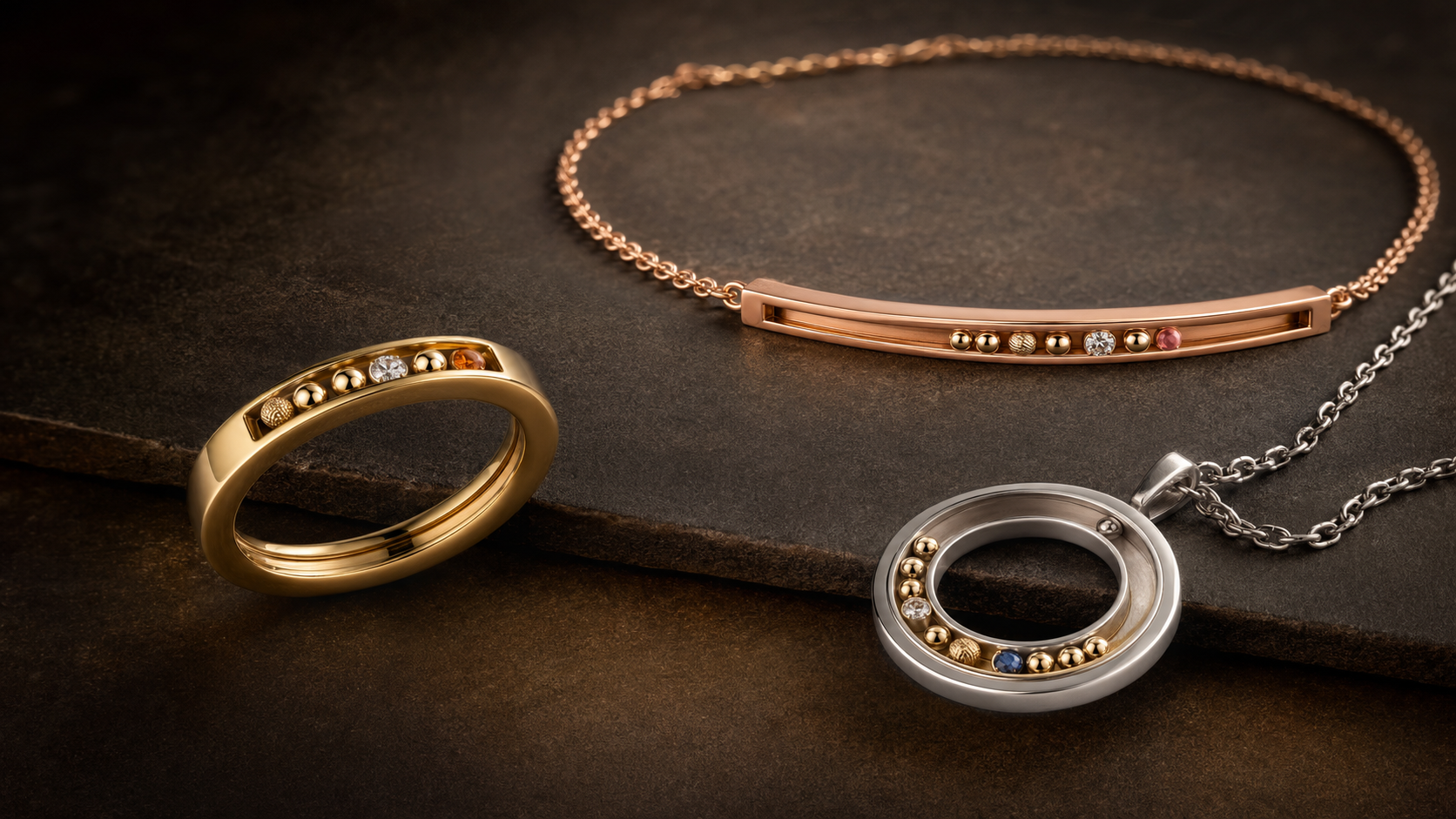
Small beads, gemstones or metal components can travel along a securely enclosed channel in a ring, bracelet or pendant.
The wearer may move the beads one by one, use them to count breaths or simply focus on their texture. The design can be inspired by prayer beads or traditional meditation tools while adopting a contemporary fine-jewellery appearance.
Tactile and Grounding Jewellery
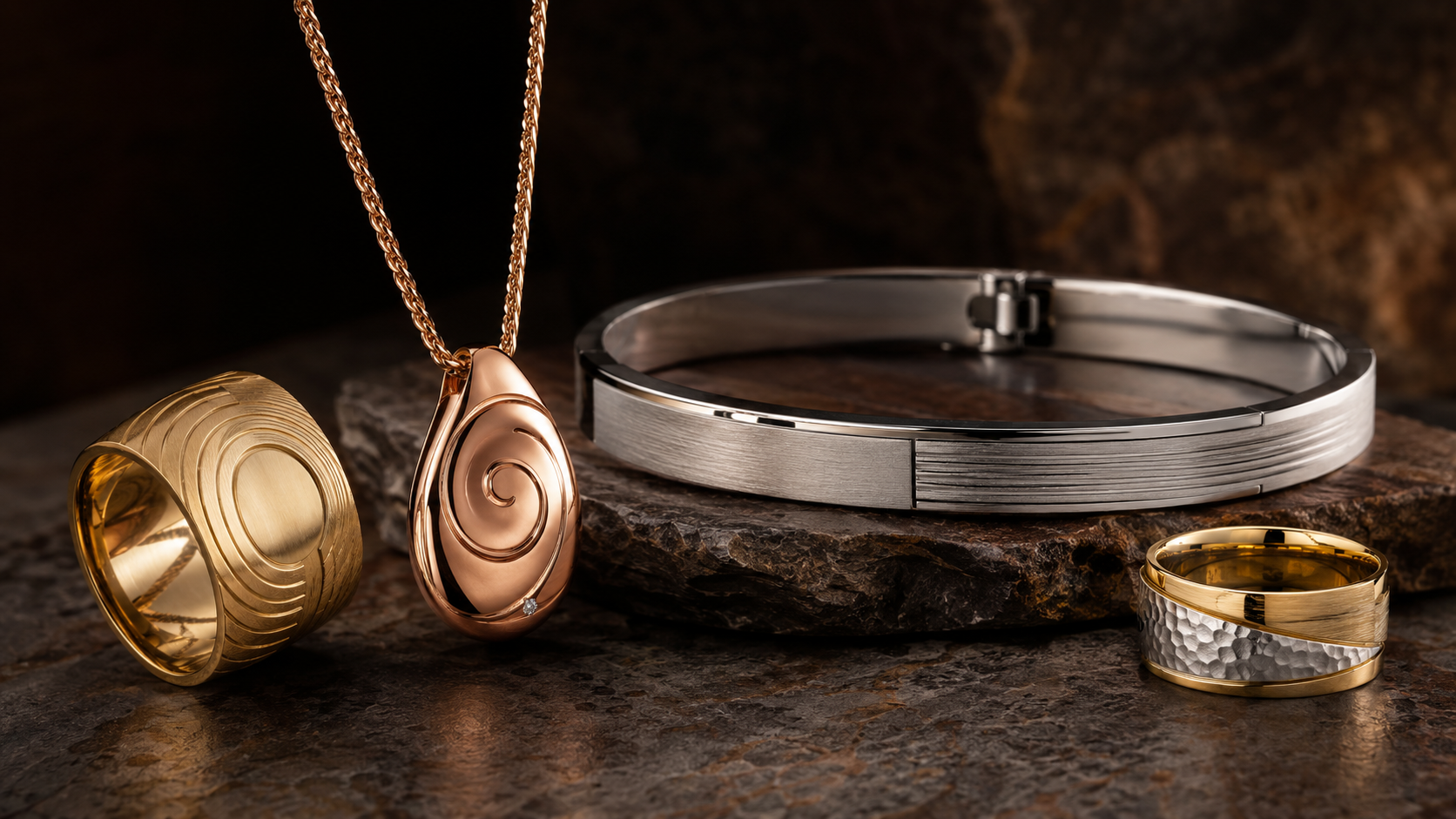
These products use ridges, grooves, engraved patterns, contrasting surfaces or smooth stone-like forms.
The wearer can trace a repeated path with a fingertip, rub a polished surface or concentrate on the contrast between textures. The intention is to bring attention back to a physical sensation in the present moment.
Breathing Pendants
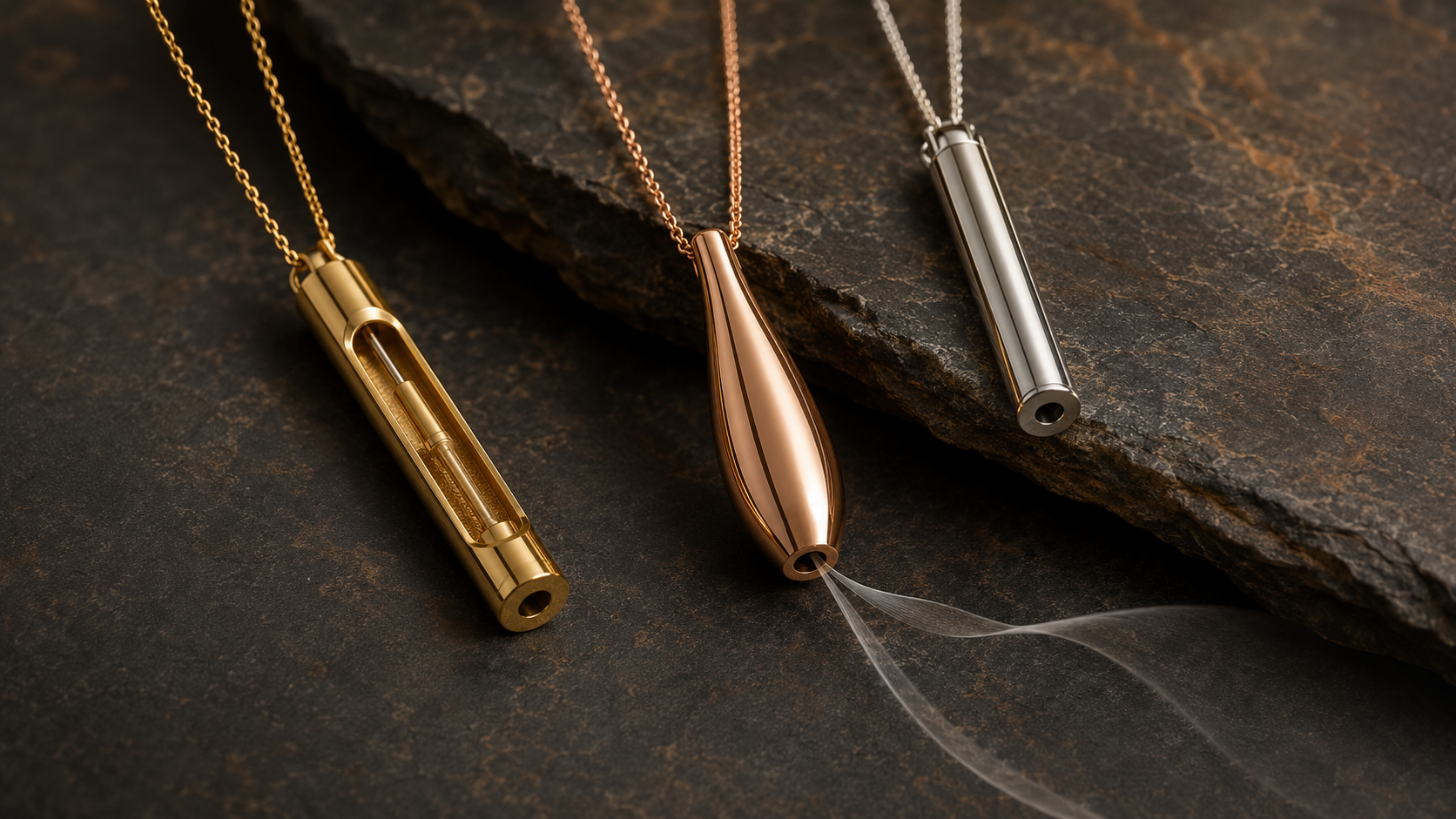
A breathing pendant normally contains a narrow internal passage. The wearer inhales normally and exhales slowly through the pendant.
The necklace does not produce calm by itself. It acts as a physical reminder and pacing tool for controlled breathing.
Slow breathing is recognised by WHO as a relaxation technique that may support anxiety management, while broader research suggests that structured breathing practices can help reduce stress and anxiety in some populations. However, evidence supports the breathing practice more strongly than it supports any specific commercial necklace.
Aromatherapy Lockets
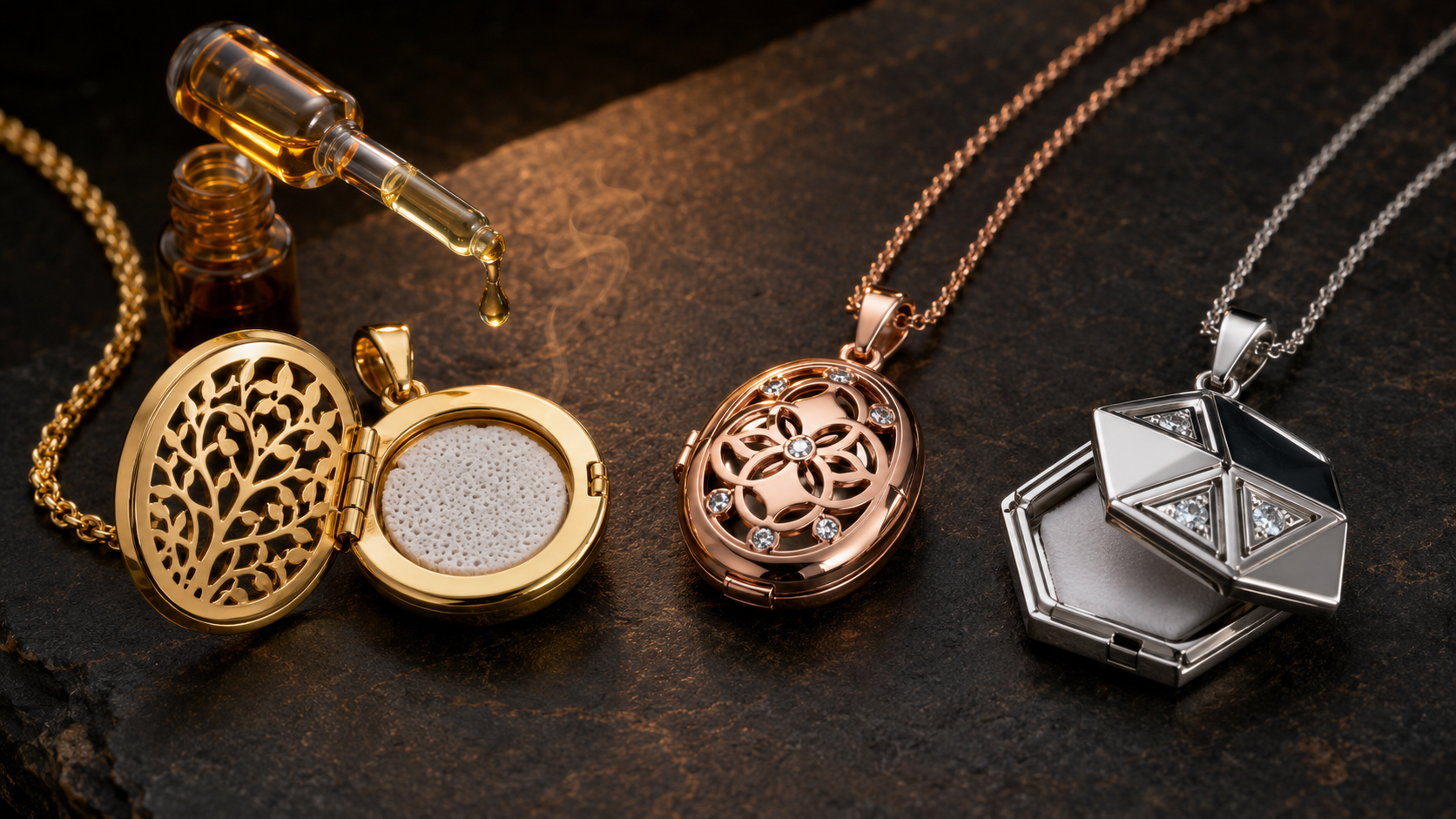
These lockets contain a porous insert, absorbent pad or enclosed component that carries a fragrance or essential oil.
The wearer may associate a familiar scent with relaxation or a personal ritual. Some research has reported anxiety-reducing effects from inhaled lavender, but reviews also highlight differences in study design and the need for stronger evidence. Aromatherapy jewellery should therefore be positioned cautiously, with attention to allergies, skin sensitivity and safe use of concentrated oils.
Haptic Smart Jewellery
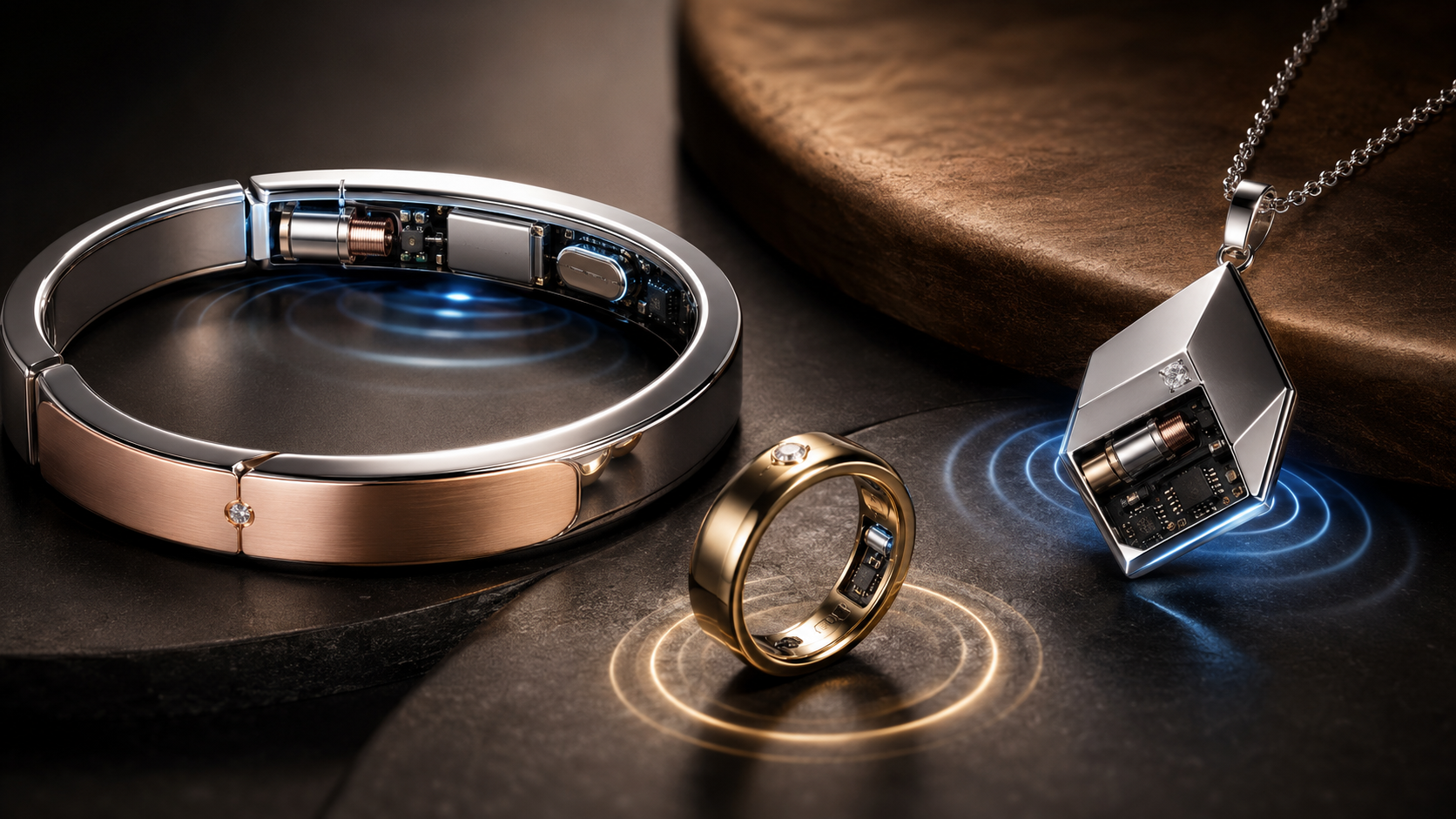
Haptic jewellery uses gentle vibration or rhythmic pulses. A bracelet, ring or pendant could provide a slow pattern intended to encourage the wearer to match their breathing or shift attention away from a stressful thought.
A 2017 study found that participants receiving slow heartbeat-like vibration through a wrist-worn device showed lower increases in physiological arousal and reported anxiety during a stressful task. Wider reviews, however, show that stress-management wearables remain a developing field with varying technologies, small studies and limited evidence about long-term outcomes.
This may become the most technologically advanced part of the category—but also the most complex.
Can Jewellery Really Reduce Anxiety?
The most honest answer is: it may help some people with particular calming behaviours, but evidence specifically supporting “anti-anxiety jewellery” remains limited.
A 2023 University of North Carolina honours study randomly assigned adults to wear either an interactive fidget ring or a similar non-fidget ring for one week. Of 51 participants enrolled, 44 completed the study and were included in the analysis.
The fidget-ring group reported a moderate reduction in anxiety compared with the control group, but the product did not produce significant improvements in stress or attention.
The study is interesting, but it should not be treated as final proof. It involved a small, non-clinical group, lasted only one week and did not provide long-term follow-up. Some participants also reported discomfort, self-consciousness caused by sound or confusion about the ring’s design. The researchers concluded that fidgeting is highly individual and that the same mechanism may not benefit everyone.
This is an important lesson for jewellery designers.
The possible benefit may not come from the metal, gemstone or jewellery category itself. It may come from the behaviour that the product encourages:
Repetitive movement
Focused tactile sensation
Deliberate breathing
Counting or rhythm
Momentary distraction
A personal grounding ritual
That makes anti-anxiety jewellery closer to a wearable behavioural prompt than to a medical treatment.
The Real Innovation: Jewellery as an Interface
Most jewellery is visually experienced. Anti-anxiety jewellery is physically interacted with.
The customer does not only see the piece. The customer rotates it, slides it, rubs it, breathes through it, listens to it or feels its vibration.
This changes the designer’s responsibility.
A conventional ring can succeed primarily through appearance, comfort and durability. An interactive ring must also deliver a predictable mechanical experience.
The resistance must feel correct. The component should not rattle excessively. Movement should not become jammed by dust, lotion or regular wear. Stones must remain secure despite repeated handling. The mechanism should not pinch the skin, catch on clothing or loosen after thousands of movements.
The sound of the jewellery is also important. One customer may find a soft click satisfying, while another may become uncomfortable using an audible mechanism in a meeting, classroom or public place.
Future designs may therefore need a choice between:
Silent movement
Soft mechanical feedback
Textured tactile feedback
Adjustable resistance
Customised sensory experiences
The product must be designed around the wearer’s emotional comfort—not only the designer’s visual concept.
A New Opportunity for CAD and Jewellery Manufacturing
Anti-anxiety jewellery is particularly relevant to the technology sector because it combines jewellery design with small-scale mechanical engineering.
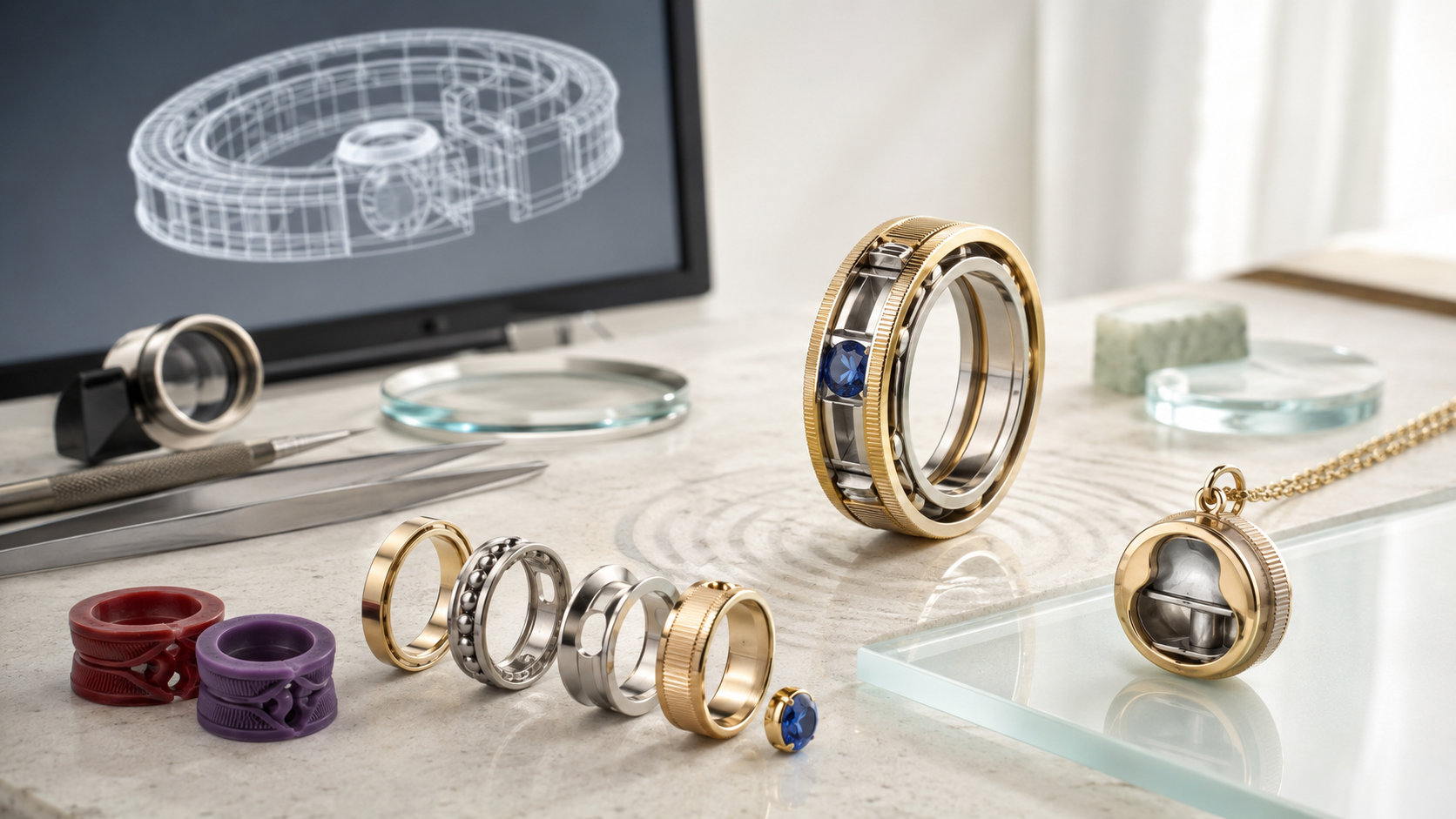
CAD can be used to develop interlocking components, captive gemstones, rotating channels, internal breathing passages and hidden movement systems. High-resolution prototyping and
real-wax 3D printing can help manufacturers test multiple clearances and mechanisms before moving into final production.
A fraction of a millimetre may determine whether a spinner ring moves smoothly, becomes loose, creates noise or stops functioning after polishing.
Designers should test:
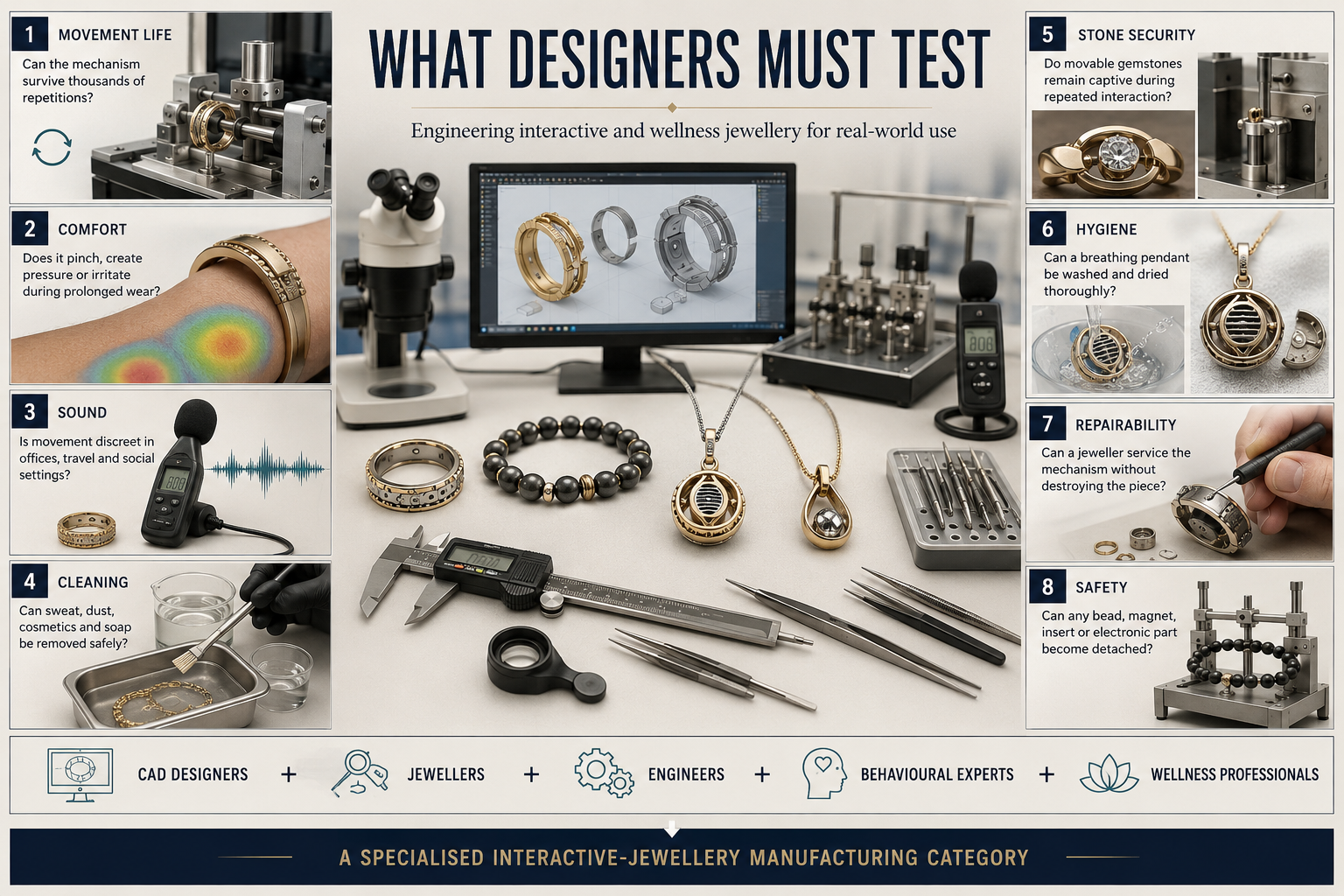
Movement life: Can the mechanism survive thousands of repetitions?
Comfort: Does it pinch, create pressure or become irritating during prolonged use?
Sound: Is the movement discreet enough for offices, travel and social settings?
Cleaning: Can sweat, dust, cosmetics and soap be removed without damaging the
mechanism?
Stone security: Can decorative or movable gemstones remain captive during repeated
interaction?
Hygiene: Can a breathing pendant be washed and dried thoroughly?
Repairability: Can a jeweller service the mechanism without destroying the entire piece?
Safety: Can any bead, magnet, insert or electronic component become detached?
These requirements could create a specialised manufacturing category combining CAD designers, jewellers, engineers, behavioural experts and wellness professionals.
Product Directions for Indian Jewellers
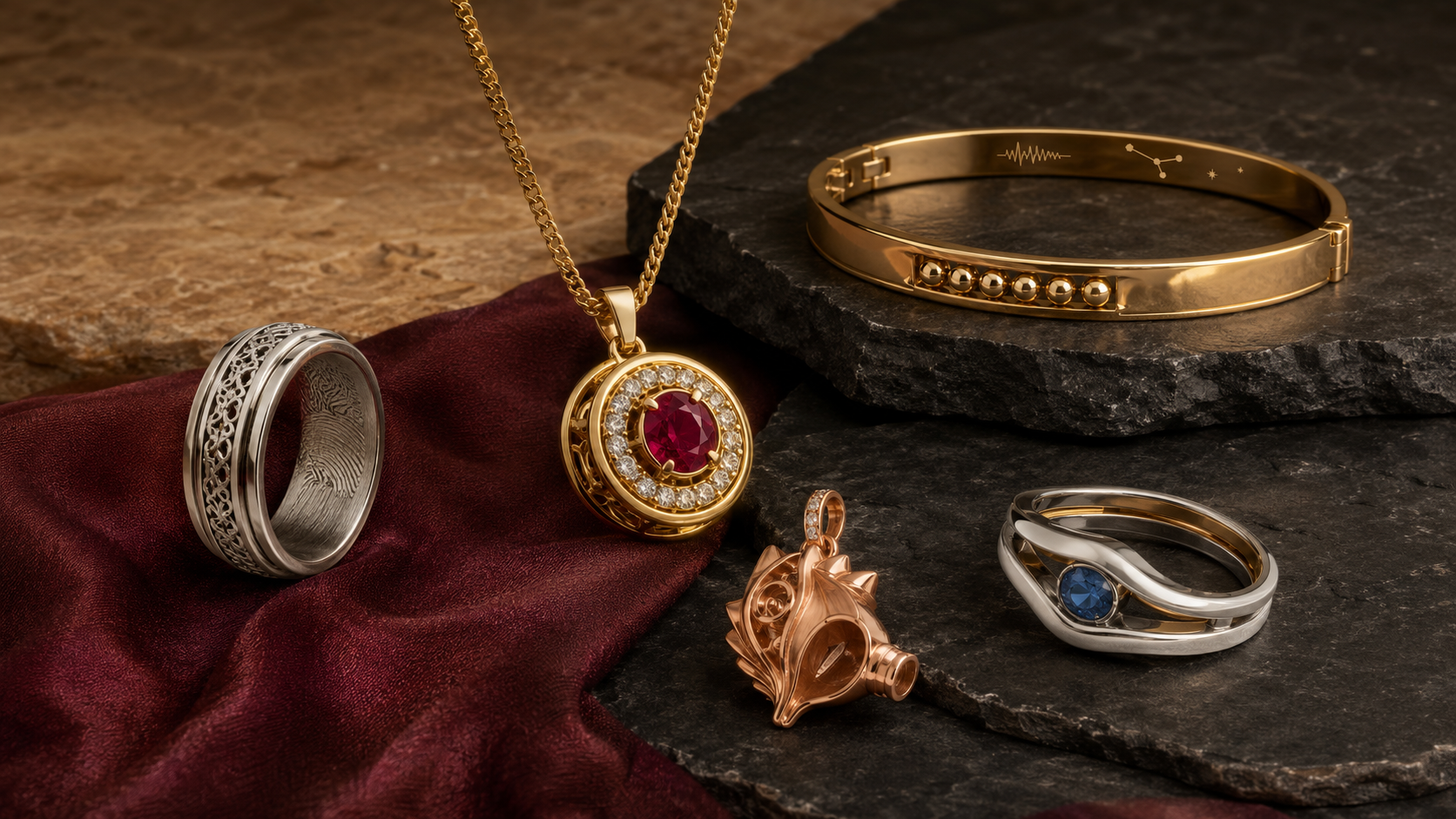
The strongest entry point for Indian manufacturers may be passive interactive jewellery rather than immediately moving into electronics.
A sterling-silver spinner ring can provide an accessible starting product. Gold, platinum, diamonds and coloured gemstones can then elevate the same concept into fine jewellery.
A rotating halo pendant could surround a central diamond, birthstone, spiritual symbol or personalised initial. A bracelet could combine movable counting beads with contemporary minimal design. A ring could include a captive gemstone that travels along a curved channel without being removable.
Personalisation can deepen the emotional connection through names, meaningful dates, mantras, fingerprints, zodiac signs, religious motifs, sound-wave patterns or hidden messages.
Breathing pendants could be designed with Indian visual influences rather than copying generic tube-like international products. Inspiration could come from temple geometry, the lotus, the conch, sacred patterns, architectural jaalis or abstract interpretations of airflow.
The commercial opportunity can extend across several markets:
Silver and fashion jewellery
Accessible 14-karat and 18-karat daily-wear jewellery
Fine kinetic jewellery
Personalised gifting
Spiritual and meditation jewellery
Corporate wellness gifts
Technology-enabled premium wearables
The winning product will not necessarily be the most complicated. It will be the product that combines credible function, emotional storytelling, effortless movement and desirable design.
Responsible Branding Will Decide the Category’s Future
The term anti-anxiety jewellery is useful as a trend name because customers immediately understand the intended category. But it can also create the impression that the product medically treats anxiety.
That impression must be handled carefully.
The Advertising Standards Council of India requires factual advertising claims to be capable of substantiation and states that advertisements should not mislead consumers through exaggeration, implication, omission or ambiguity.
Jewellery brands should therefore avoid claims such as:
“Cures anxiety.”
“Stops panic attacks.”
“Clinically proven to treat stress.”
“Replaces medication or therapy.”
“Heals the nervous system.”
More responsible descriptions would be:
“Designed to encourage slow, mindful breathing.”
“Offers discreet tactile movement during moments of everyday stress.”
“A wearable reminder to pause, breathe and refocus.”
“Designed to support a personal grounding routine.”
Brands may also consider category names such as calming jewellery, mindful jewellery, sensory jewellery, grounding jewellery or interactive wellness jewellery.
A clear disclaimer should state that the product is a personal wellness accessory and is not intended to diagnose, treat, cure or prevent a medical condition.
Persistent, severe or disabling anxiety requires evidence-based professional care. WHO identifies psychological treatments—particularly approaches based on cognitive behavioural therapy—along with appropriate medical care as established treatments for anxiety disorders.
What Comes Next?
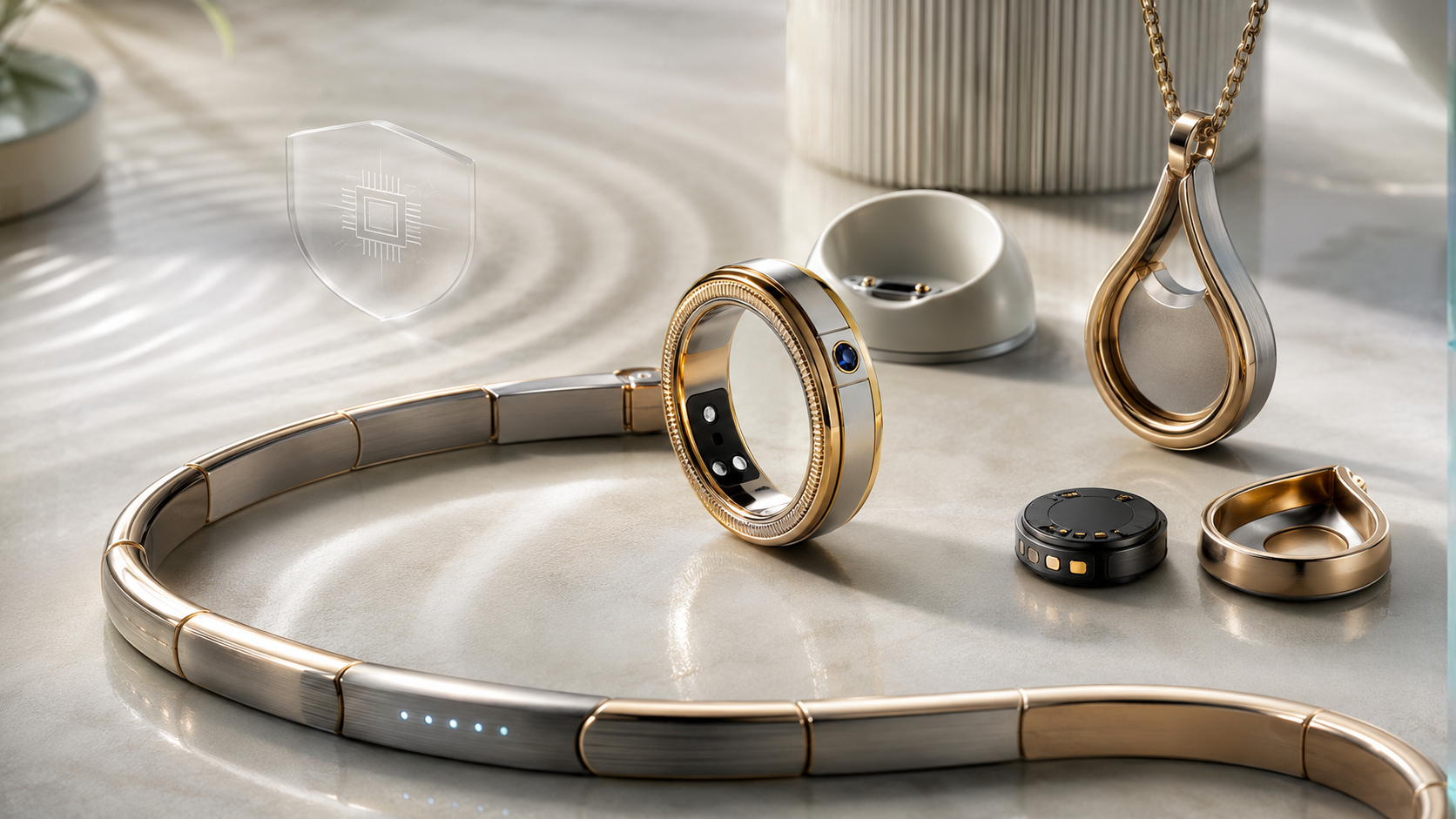
The next generation of wellness jewellery could move beyond manually operated rings and pendants.
A future smart ring might recognise changes in heart rate or skin conductance and respond with a discreet breathing prompt. A bracelet could provide a slow rhythm before a presentation or important meeting. A pendant could deliver personalised haptic patterns without requiring the wearer to look at a phone.
Artificial intelligence may eventually help identify patterns associated with stressful situations and recommend a short calming routine.
But this future also raises questions.
Who controls the user’s emotional and biometric data? Can a jewellery company protect such sensitive information? How long will batteries and electronic modules remain serviceable? Will the product still function after the software platform is discontinued? Can the electronic core be upgraded without discarding the precious-metal body?
Successful smart jewellery will need to be designed as both a durable jewel and a responsible technology product.
Tech Radar Verdict
Anti-anxiety jewellery is not a medical revolution—but it is a genuine design and consumer trend.
Its strongest future is not based on exaggerated healing promises. It lies in creating beautiful, discreet objects that encourage credible calming behaviours such as slow breathing, repetitive movement, sensory focus and personal ritual.
For the jewellery industry, this represents a shift from passive ornamentation to interactive experience.
For designers, it introduces a new discipline combining aesthetics, ergonomics, psychology and precision engineering.
For manufacturers, it opens opportunities in kinetic mechanisms, customised sensory products, breathing tools and future haptic wearables.
For consumers, it offers something simple but meaningful: jewellery that can become a quiet reminder to pause.
The most successful anti-anxiety jewellery will not announce itself as a therapeutic device. It will look refined enough to be worn anywhere, function smoothly enough to be used repeatedly and communicate its purpose responsibly.
The future of jewellery may not only be about how a piece looks—it may also be about how it makes the wearer pause, breathe and feel.
New Product
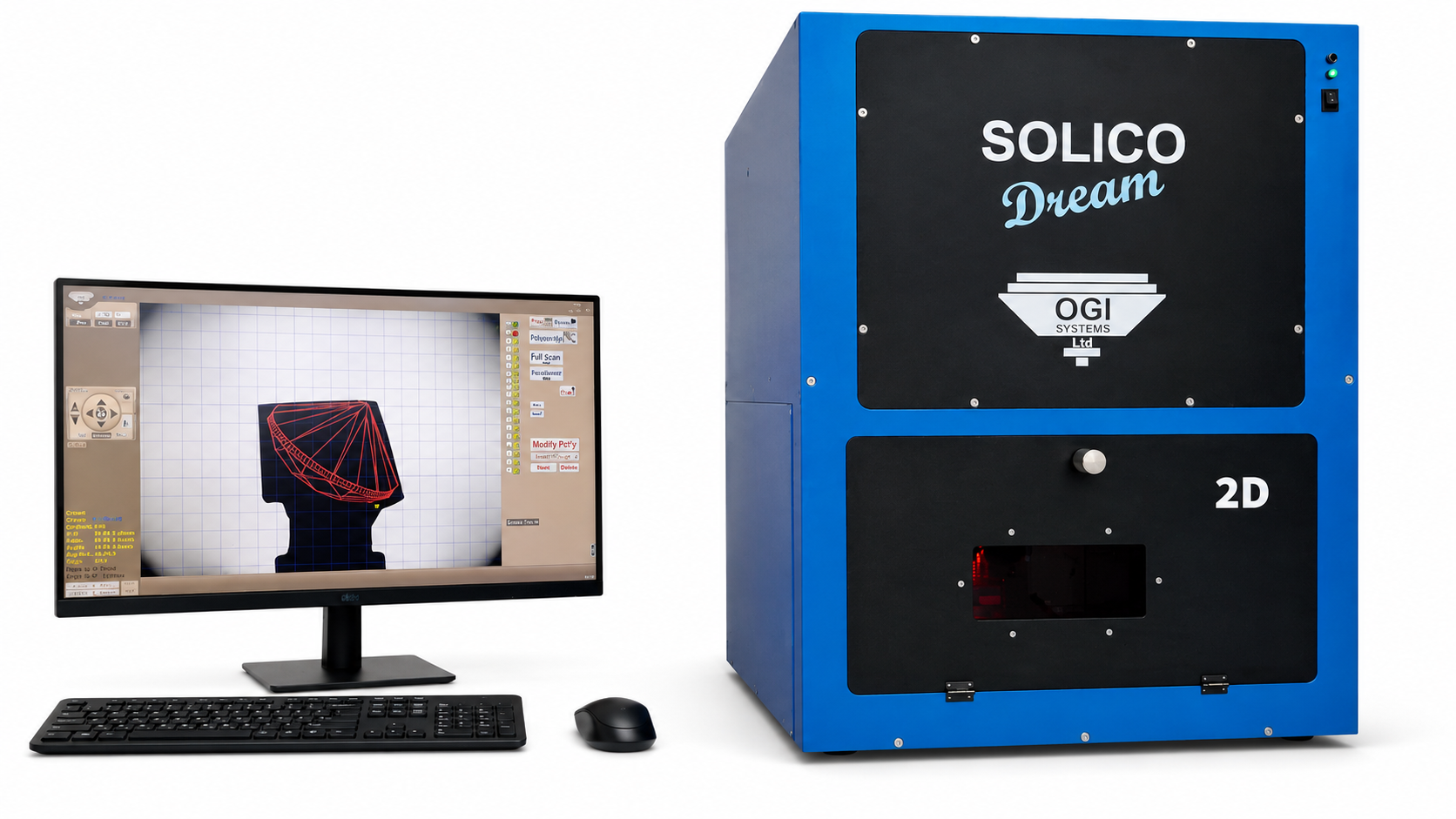
SOLICO DREAM: Desktop Laser Technology Bringing 3D Diamond
Manufacturing Into the Office
OGI Systems combines internal diamond planning, 3D laser sawing, 2D creative cutting and engraving in a compact platform aimed at moving advanced diamond processing beyond the conventional factory floor.
|
PRODUCT |
MAKER |
CATEGORY |
OROZONE RATING |
|
SOLICO DREAM |
OGI Systems Ltd., Israel |
Desktop Diamond Laser |
8.5 / 10 |
Ramat Gan: What if sophisticated diamond manufacturing no longer required a large industrial laser department? Israel-based OGI Systems is pursuing exactly that idea with SOLICO DREAM, a compact multifunctional desktop laser developed for professional offices, laboratories, jewellery manufacturers and specialised diamond-production environments.
Introduced by OGI Systems in 2024, DREAM is positioned by the company as the "world's first office laser cutting machine" capable of combining 3D diamond cutting, 2D diamond cutting and marking. The "world's first" designation is a manufacturer claim, but the underlying concept is noteworthy: multiple advanced diamond-processing functions are being brought into one compact workstation.
More Than a Desktop Laser
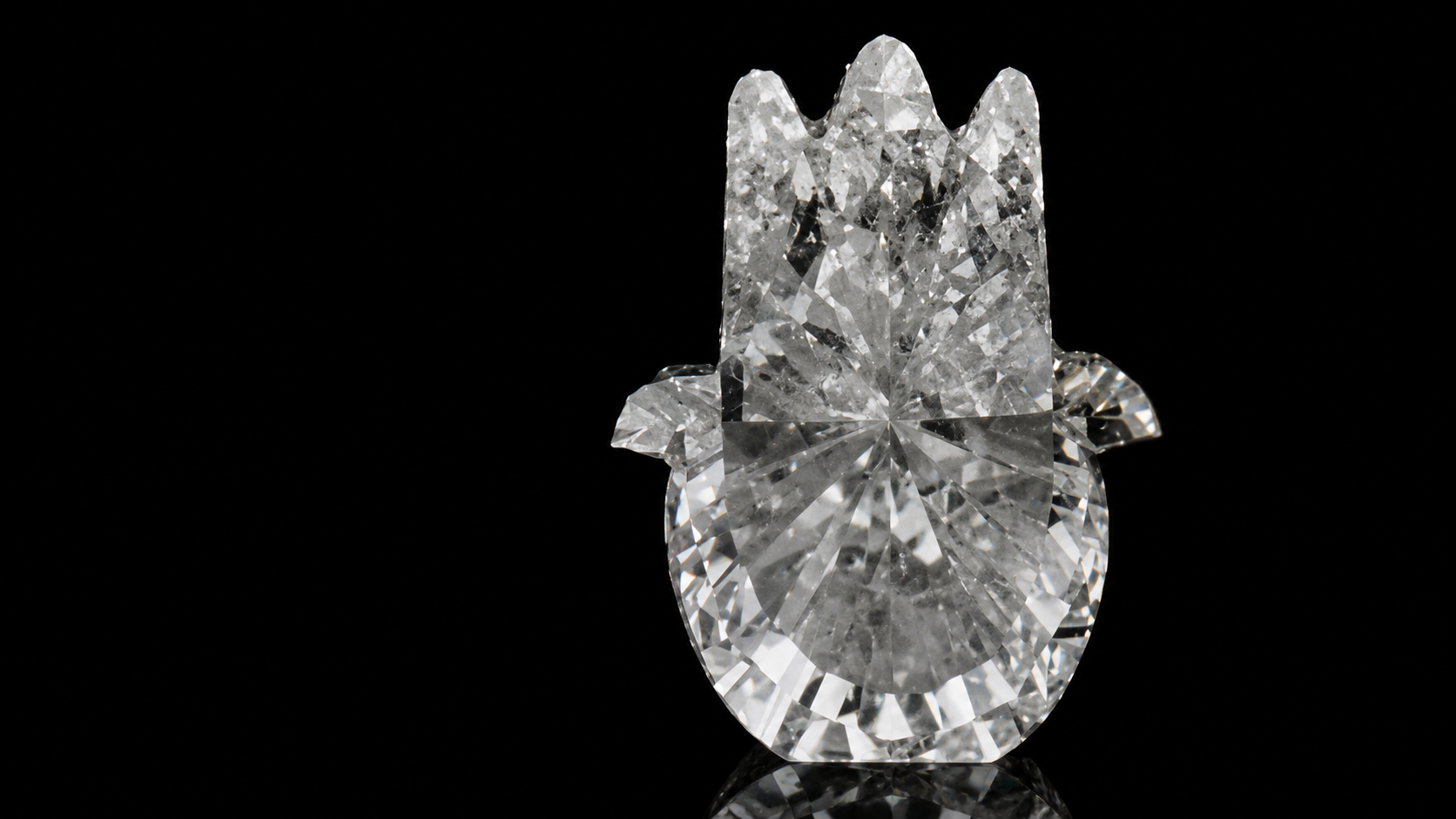
SOLICO DREAM is not simply a diamond inscription or marking machine. According to OGI, the system plans the stone internally and performs high-precision 3D and 2D laser sawing, enabling complex diamond geometries to be created in a compact platform.
Its applications extend beyond conventional rough-diamond sawing. OGI lists 3D laser sawing of complex shapes, cutting small stones for watch and jewellery inlays, two-dimensional cutting of letters, logos and portraits, and marking or engraving designs on larger lab-grown diamonds for pendant applications.
That opens an interesting manufacturing direction. Instead of treating a diamond only as a gemstone that must eventually become a conventional round or fancy cut, DREAM allows designers and manufacturers to approach diamond more like a digitally machinable luxury material. This could be especially relevant to custom jewellery, luxury watches, branded diamonds, personalised lab-grown diamond products and limited-production collections.
What Makes SOLICO DREAM Advanced?
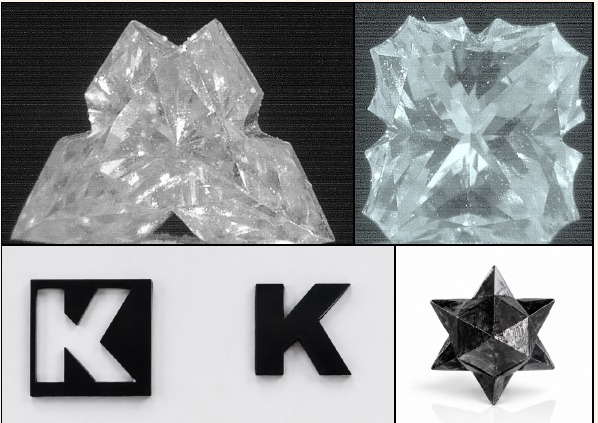
3D laser sawing: Intended for complex diamond shapes rather than only straight or simple sawing operations.
2D creative cutting: OGI specifically highlights letters, logos and portrait-type shapes.
Internal planning: Planning and laser processing are brought closer together within the same workflow.
Watch and jewellery inlays: Small diamonds can be shaped as precision components for high-value decorative applications.
Lab-grown diamond personalisation: Larger LGDs can be marked or engraved for customised pendant and branding applications.
Office-oriented architecture: OGI describes the machine as compact, quiet, energy-efficient, low-maintenance and user-friendly for offices and laboratories.
From SOLICO to SOLICO DREAM
SOLICO
SOLICO DREAM
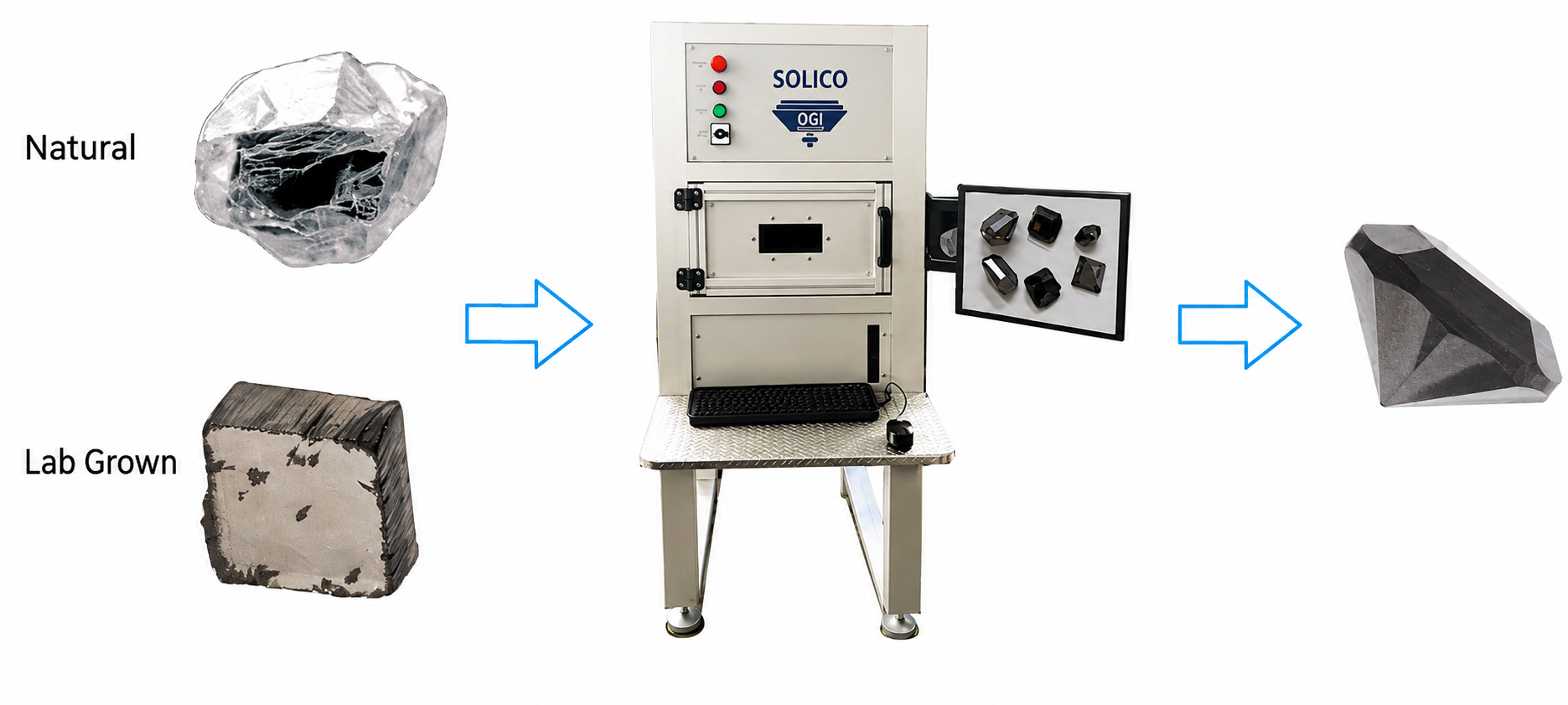
DREAM builds on OGI's established SOLICO concept. SOLICO is an acronym for Scanner, Optimizer and Laser Integrated Compact OGI. OGI describes the standard SOLICO as a five-axis system using X, Y and Z movement plus two rotational axes, with rough-diamond mapping, optimisation and laser processing integrated in one platform.
The standard SOLICO can perform operations including sawing, table cutting, blocking, bruting, facet processing and customised 3D shapes. OGI publicly lists an IR fibre laser, 150 kg machine weight, 220 V single-phase electrical supply, air-pump cooling and an indicative processing time of around one hour to obtain one-carat round blocking.
DREAM takes the concept in a different direction: smaller and deliberately positioned for desktop and office use. Its value proposition is therefore not simply higher throughput, but accessibility, creative flexibility and the possibility of installing sophisticated diamond-processing capability closer to designers, laboratories and specialised production teams.
Commercial Positioning
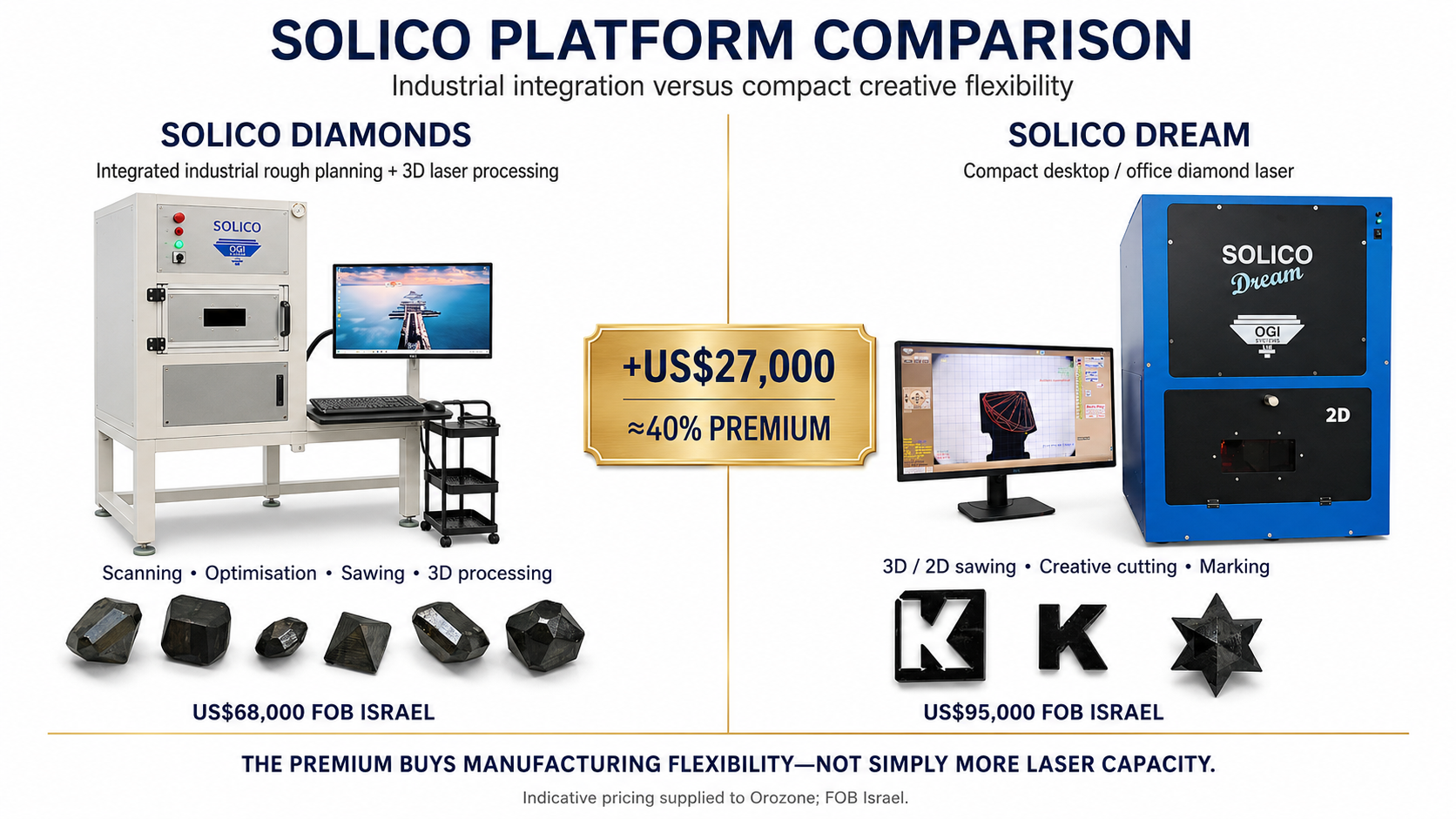
Commercial pricing for the SOLICO DREAM is set at US$95,000 FOB Israel
The additional investment is best viewed as a purchase of manufacturing flexibility rather than simply laser capacity. DREAM appears most compelling for high-value, low-volume and highly customised production where unusual shapes, logos, watch components, diamond lettering or personalised lab-grown diamond products can command a premium.
SOLICO PLATFORM COMPARISON
|
Factor |
SOLICO Diamonds |
SOLICO DREAM |
|
Positioning |
Integrated industrial rough planning and 3D laser processing |
Compact desktop/office diamond-laser platform |
|
Core emphasis |
Scanning, optimisation, sawing and 3D processing |
3D/2D laser sawing, creative cutting, marking and engraving |
|
Published laser detail |
IR fibre laser listed by OGI |
Laser-source details not publicly specified on the current DREAM page |
|
Published motion detail |
5 axes: X, Y, Z + 2 rotations |
Not publicly specified on the current DREAM page |
|
Indicative price* |
US$68,000 FOB Israel |
US$95,000 FOB Israel |
Why DREAM Is Technically Interesting
The most significant aspect of SOLICO DREAM may not be the laser itself. Laser sawing and shaping are already established technologies in advanced diamond factories. The innovation lies in miniaturising and integrating the workflow.
Planning, three-dimensional shaping, two-dimensional design cutting and marking are being brought closer to the designer, jeweller, laboratory or specialised manufacturer instead of remaining confined to a dedicated industrial laser department. This points toward a more decentralised production model: smaller digital manufacturing cells capable of moving from an idea or customised design to a laser-processed diamond within the same environment.
Why It Could Matter for Lab-Grown Diamonds
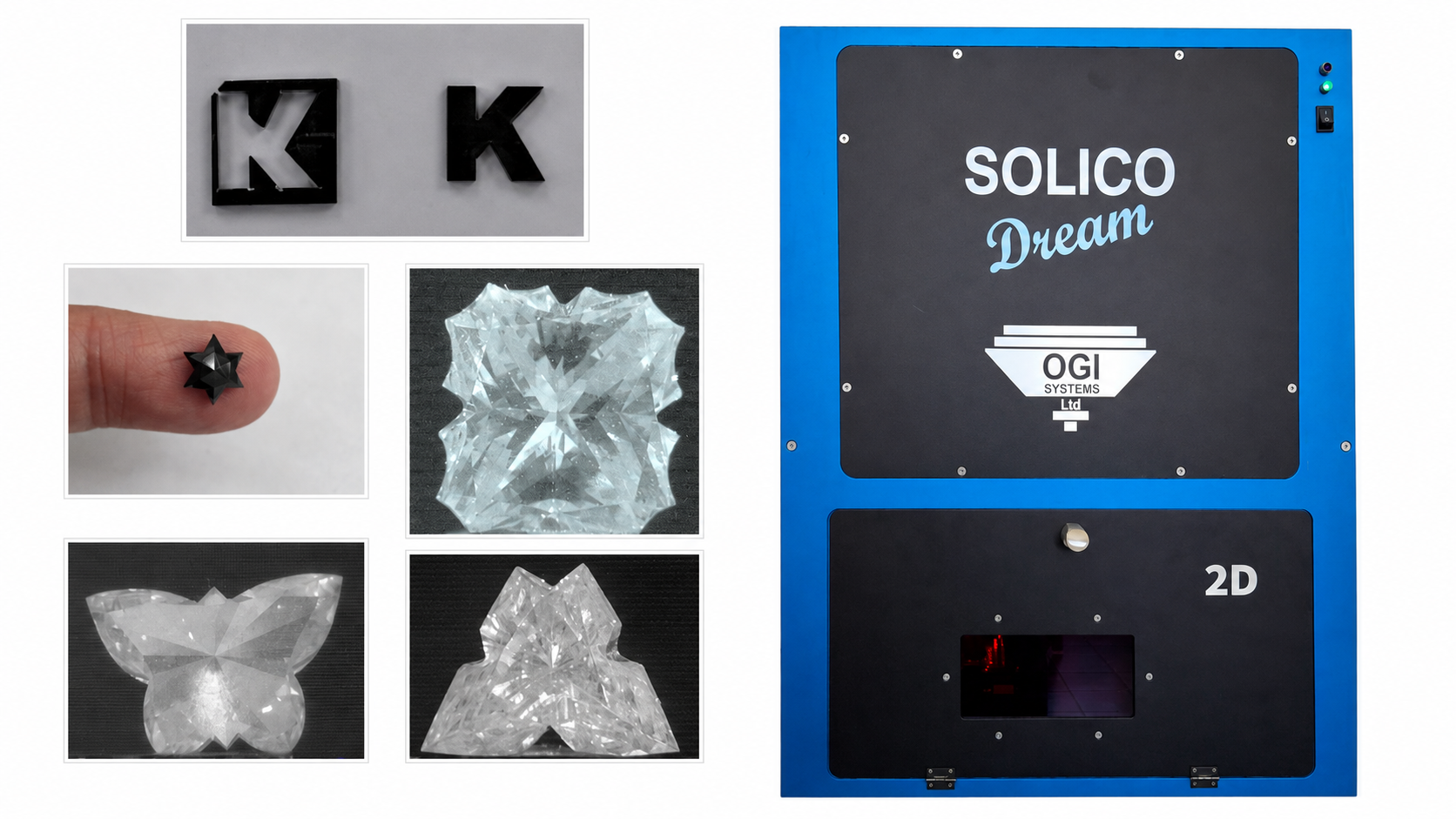
SOLICO DREAM could be especially relevant to the lab-grown diamond sector. Lower rough values and greater willingness to experiment with non-traditional forms make LGDs a natural platform for customised cutting, typography, logos, portrait forms, pendants and design components. OGI itself highlights marking and engraving of large lab-grown diamonds as one of DREAM's applications.
For designers, this suggests a shift from using diamonds only as calibrated stones toward using them as engineered design elements. The commercial opportunity could therefore extend beyond traditional polishing into branded, personalised and application-specific diamond products.
Tech Radar Snapshot
|
Specification |
Details |
|
Product |
SOLICO DREAM |
|
Manufacturer |
OGI Systems Ltd., Israel |
|
Technology |
Desktop diamond-laser processing |
|
Core functions |
Internal planning, 3D laser sawing, 2D cutting, marking and engraving |
|
Applications |
Natural and lab-grown diamonds; customised shapes; jewellery and watch inlays; logos; letters; portraits; personalised diamond products |
|
SOLICO DREAM price* |
US$95,000 FOB Israel |
|
SOLICO Diamonds price* |
US$68,000 FOB Israel |
|
Innovation Rating |
8.5 / 10 |
Monthly Expert Answer
Why Does the Same Casting Program Produce Perfect Jewellery for One Design but Porosity or Incomplete Filling in Another?
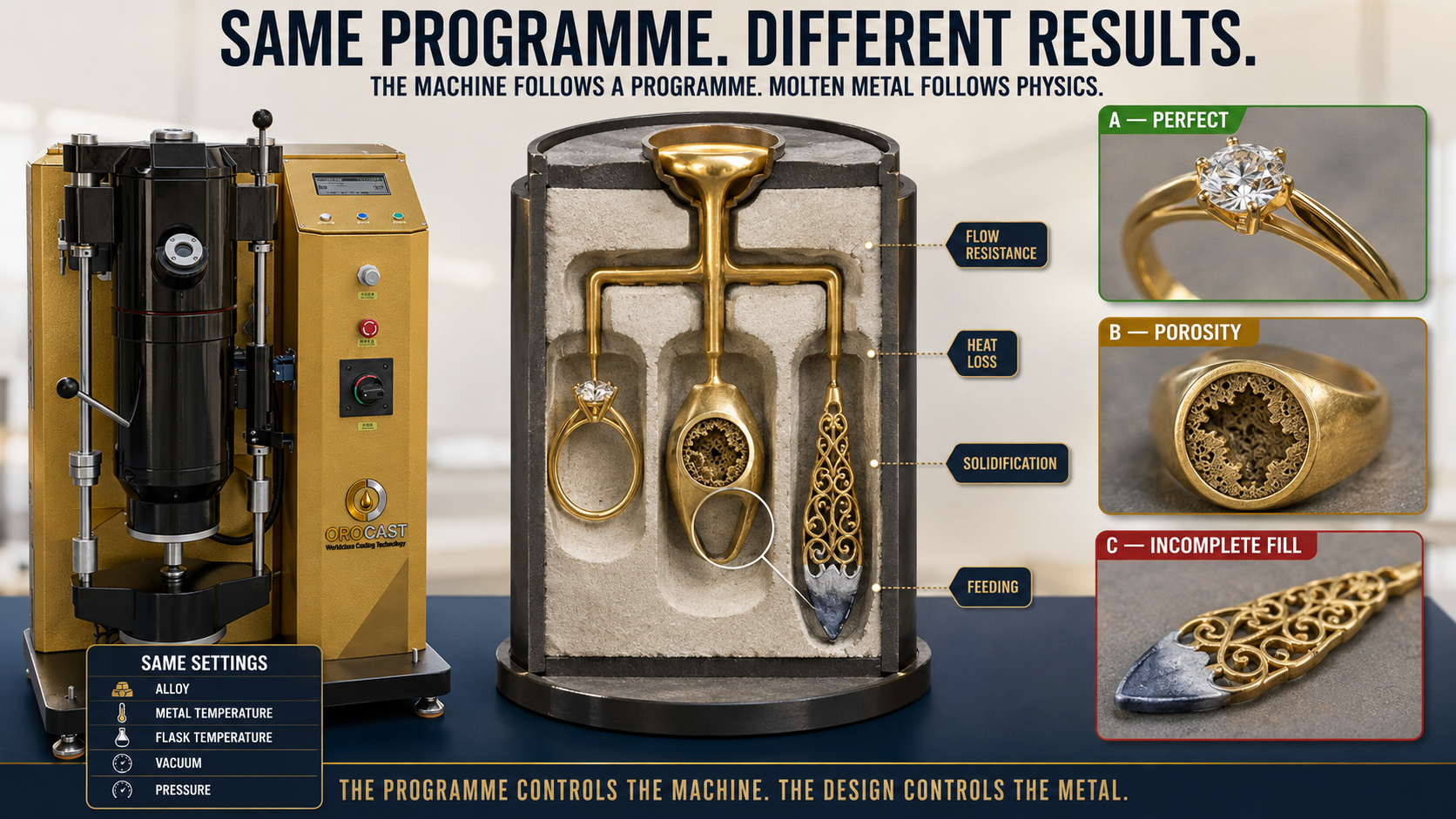
The short answer:
Because the casting machine follows a program—but molten metal follows physics.
This is one of the most important lessons in jewellery casting.
You can use the same alloy, same casting machine, same metal temperature, same vacuum, same pressure and apparently the same flask temperature—and still obtain a perfect casting for one design and porosity, cold shuts or incomplete filling in another.
That does not automatically mean that something is wrong with the casting machine.
The reason is that every jewellery design creates its own combination of metal-flow resistance, heat loss, solidification pattern and feeding requirement. Research into precious-metal investment casting has long shown that fluid flow, heat transfer and solidification are central to casting quality, while sprue location, pouring temperature, flask temperature and alloy composition can materially change the result.
After looking at casting problems for decades, I would put it very simply:
A casting program controls the machine. The jewellery design controls what happens to the metal after it enters the mould.
1. A 0.6 mm Filigree and a 6 mm Heavy Ring Are Not the Same Casting
Imagine putting two products into the same flask.
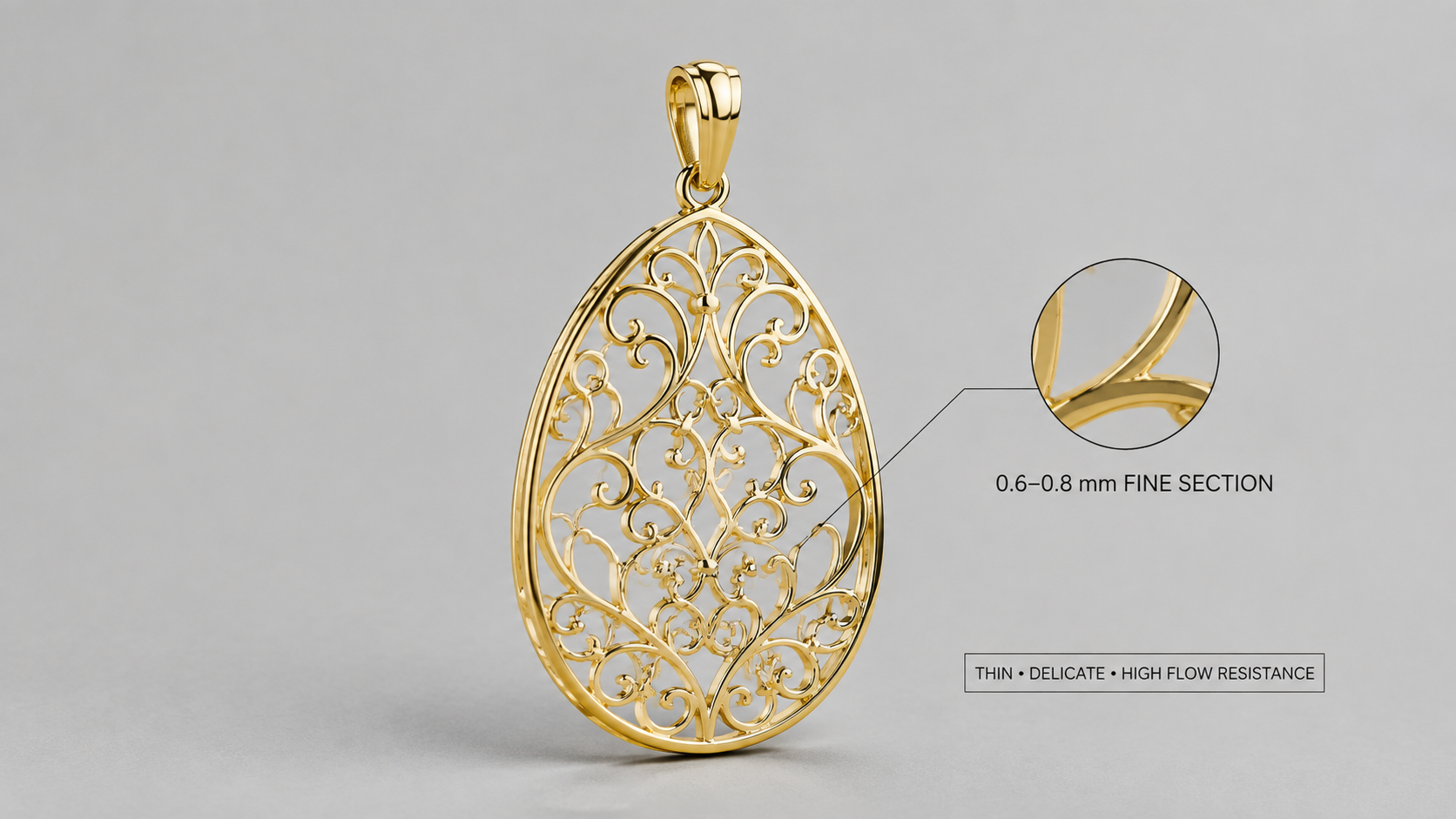
One is an extremely fine lattice pendant with walls around 0.6–0.8 mm. The second is a heavy solid ring with a thick central section. The casting machine may deliver exactly the same metal temperature and pressure to both pieces.
But the molten metal experiences completely different thermal conditions. The thin filigree has a very high surface area compared with the amount of metal flowing through it. Heat is transferred rapidly from the molten alloy into the investment. If the metal loses enough temperature before reaching the extremities, it begins solidifying while the mould is still filling.
The result can be:
incomplete filling, rounded missing sections or cold shuts.
Ransom & Randolph describes cold shut/non-fill as a condition where metal streams meet but fail to merge completely, with insufficient temperature and insufficient mould permeability among the causes.
The heavy ring has the opposite problem.
Its large cross-section retains heat longer. That thick area may remain molten after the neighbouring sprue or thinner section has already started freezing. Now the problem is no longer filling.
The problem becomes feeding during solidification.
2. Filling the Mould Is Only Half the Job
This is where many casters make a mistake.
They think:
“The cavity filled completely, therefore my sprue worked.”
Not necessarily.
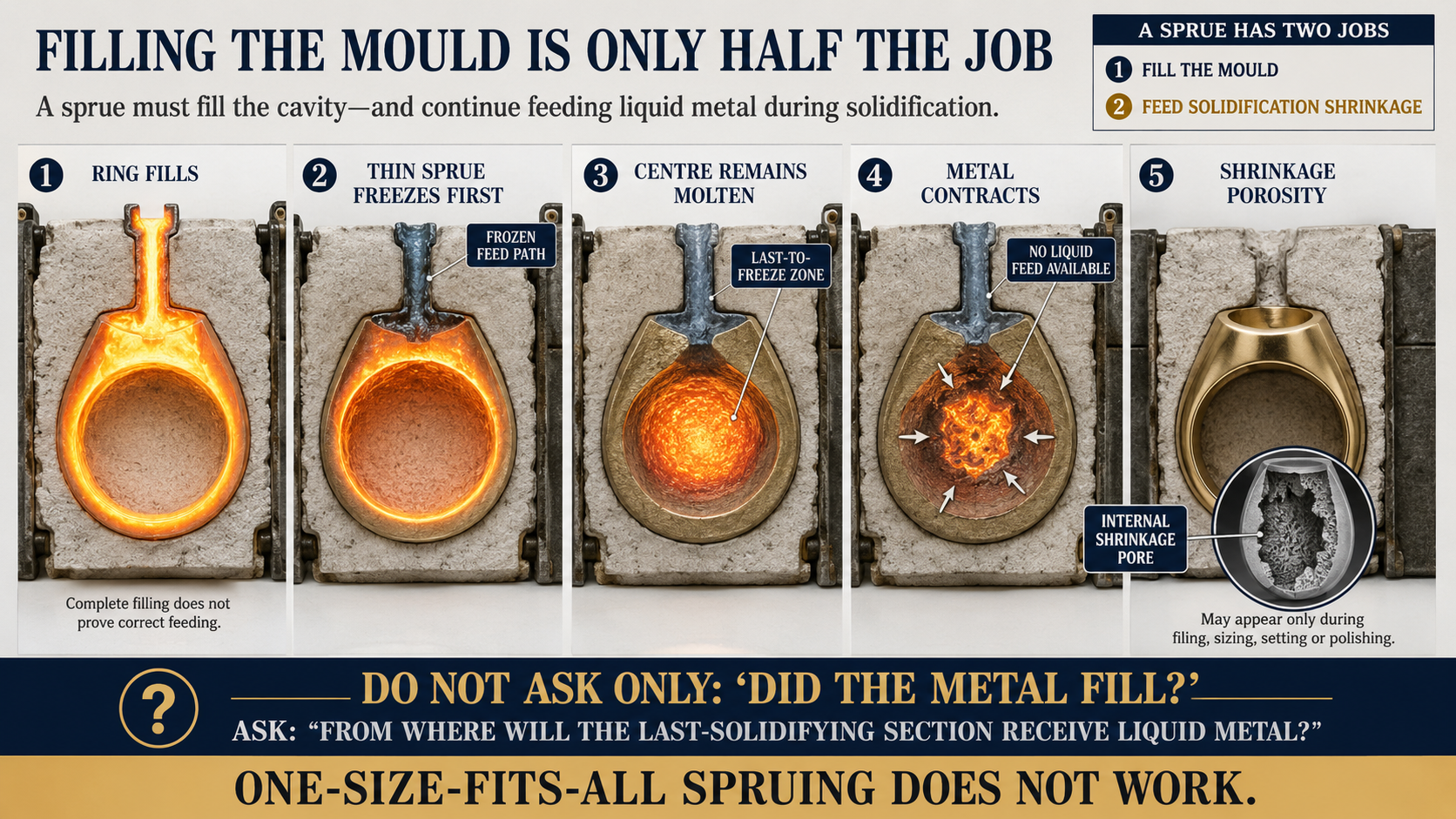
A sprue has two jobs.
First, it must carry molten metal into the mould.
Second—and often more importantly—it must remain capable of supplying additional liquid metal while the jewellery solidifies and contracts.
Precious-metal casting research has repeatedly identified sprue/gating design as critical to both castability and porosity. Research comparing different sprue attachments found significant differences in porosity and castability depending on the attachment geometry.
Think of a heavy ring connected through a very thin sprue.
The ring fills.
Everything appears successful.
But the thin sprue freezes first.
The centre of the ring is still molten.
As the central metal solidifies, it contracts. It now needs additional liquid metal.
But its supply line is already frozen.
Where does the missing volume come from?
It cannot.
So a void develops inside the jewellery.
That is shrinkage porosity.
The jewellery may look perfect immediately after casting. The defect might only appear when filing, sizing, setting or polishing exposes the pore.
This is why an experienced caster does not ask only:
“Did the metal fill?”
He asks:
“From where will this section receive liquid metal during the last stage of solidification?” The Santa Fe Symposium’s work on jewellery spruing describes exactly this often-overlooked thermal function of the sprue system and stresses that one-size-fits-all feed-sprue design is problematic.
3. Every Design Has Its Own Solidification Map
If I could see one thing inside every flask during casting, I would not first ask to see the pressure.
I would want to see the temperature map.
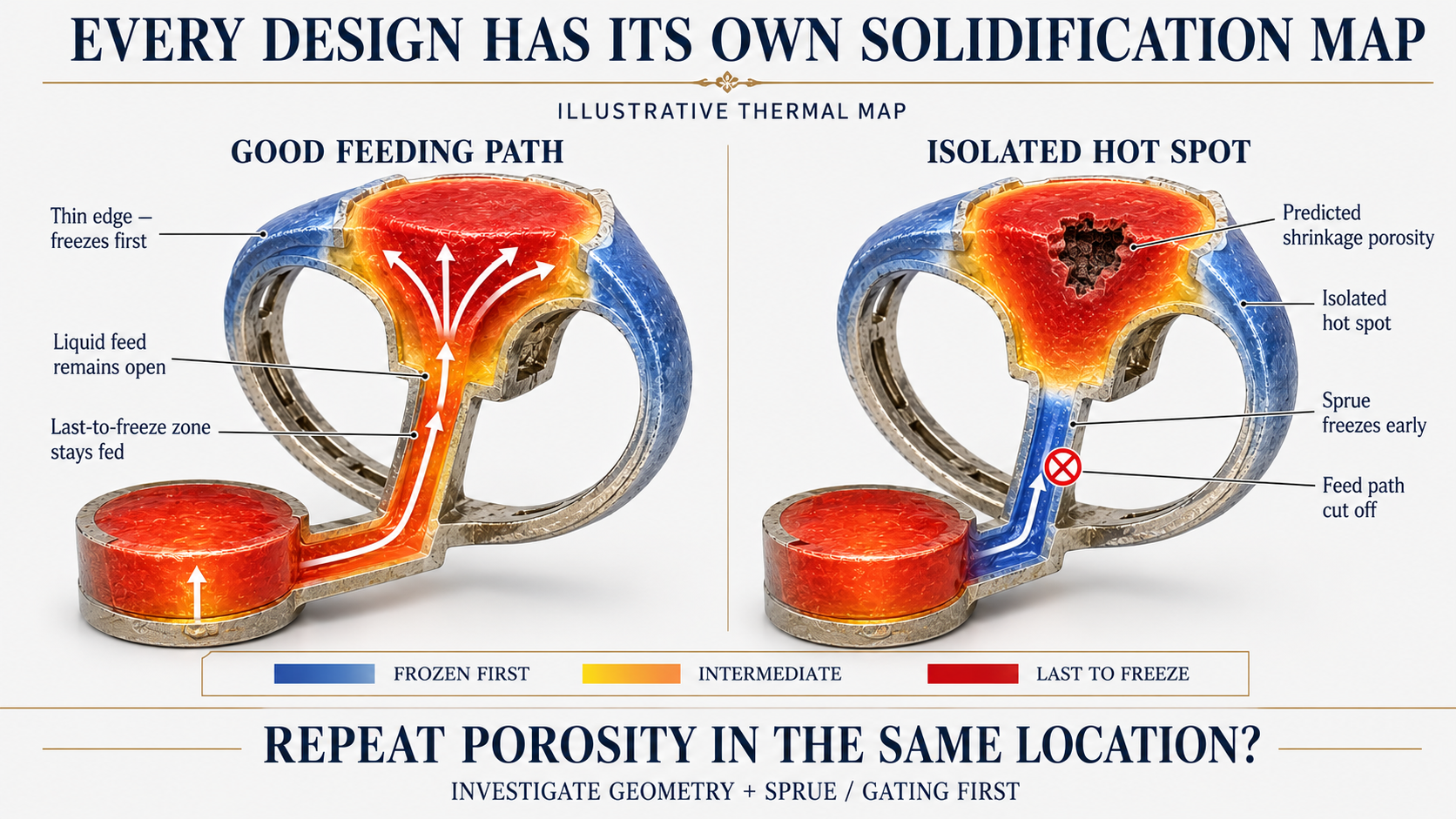
During solidification, different areas of the jewellery freeze at different times.
Thin edges usually freeze relatively quickly.
Heavy masses remain hot longer.
Junctions where several sections meet can become hot spots.
A successful casting should ideally maintain a feeding path from the jewellery toward a reservoir of still-liquid metal.
If instead the sprue freezes and isolates a hot section, shrinkage is likely to develop inside that isolated area.
This explains a very important factory observation:
If porosity repeatedly appears in exactly the same location on exactly the same design, do not immediately change the casting machine program.
First investigate the geometry and feeding system. Casting simulation has been applied to precious-metal investment casting specifically to visualise temperature, filling and predicted porosity, and to evaluate changes in gate position, temperatures and alloy composition before physical trials.
4. Why Increasing Temperature Sometimes “Solves” the Problem—and Creates Another One
When a delicate design does not fill, the first reaction in many casting departments is:
“Increase the metal temperature.”
Sometimes it works.
But it can be a dangerous habit.
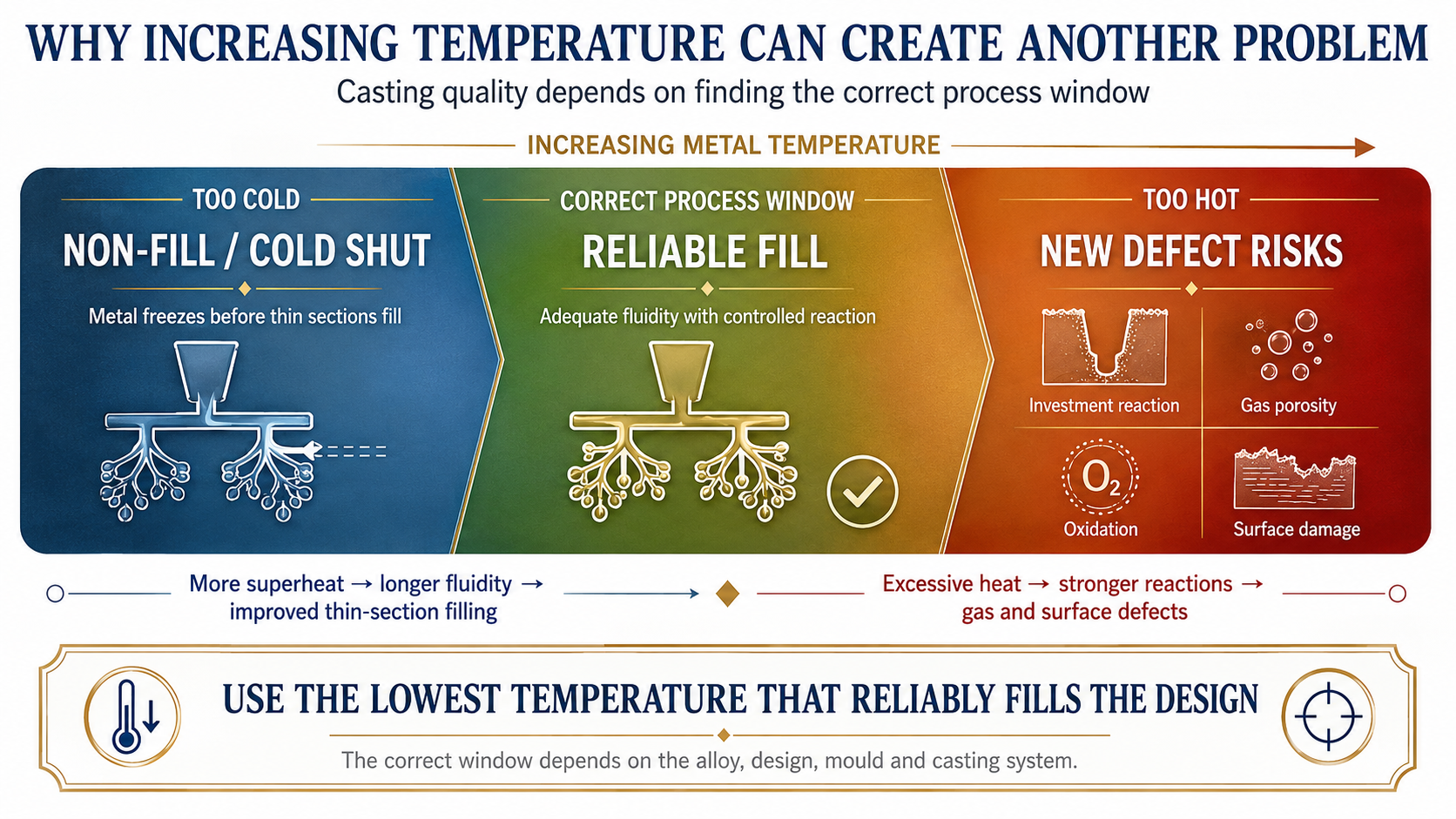
Higher superheat gives the metal more thermal energy before it begins to freeze, so a difficult thin section may fill more successfully.
But excessive temperature can also increase metal–investment interaction, oxidation and gas-related defects.
Gypsum-bonded investment contains calcium sulphate. Peer-reviewed jewellery research has demonstrated that under casting conditions calcium-sulphate-containing investments can decompose and release sulphur-containing gases, which can contribute to gas porosity in gold alloys. Residual carbon from incomplete wax burnout can also participate in detrimental reactions.
Therefore:
Too cold → non-fill.
But:
Too hot → potentially increased surface reaction, gas problems, oxidation or other defects.
The correct answer is not:
“Use the highest temperature possible.”
It is:
“Use the lowest temperature that reliably fills that design with the selected alloy, mould and casting system.”
Modern jewellery alloys are specifically engineered to improve flow and filling without relying exclusively on ever-higher casting temperatures. Progold, for example, highlights controlled viscosity, deoxidation and improved form filling as metallurgical tools for managing difficult investment casting.
5. Flask Temperature Can Be Just as Important as Metal Temperature
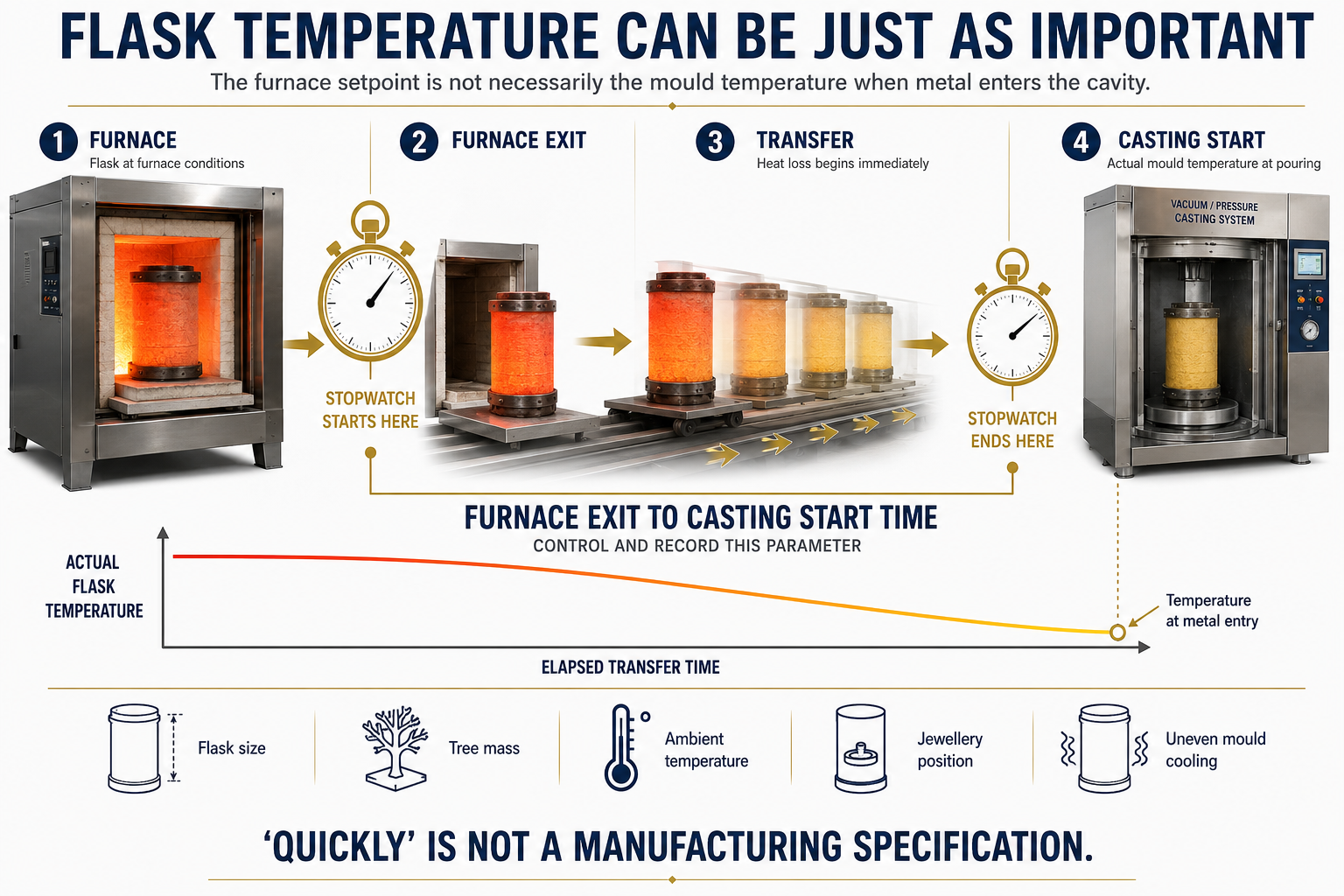
Suppose the machine says:
Metal temperature: X
and your burnout furnace says:
Flask temperature: Y.
It is tempting to assume that every flask is therefore receiving identical conditions.
But what is the actual mould temperature when the metal enters the cavity?
That depends on more than the oven setpoint.
A flask starts losing heat the moment it leaves the furnace.
Transfer time matters.
Flask size matters.
Tree mass matters.
Factory temperature matters.
Where the jewellery sits inside the flask matters.
And the investment does not necessarily cool uniformly.
Work presented at the Santa Fe Symposium on temperature-gradient casting demonstrated that even delaying casting after removing a flask from the furnace can alter shrinkage behaviour—while also noting that results depend on alloy, flask temperature, metal temperature and casting equipment.
This is why in a serious production department I would control:
“Furnace exit to casting start time”
as an actual process parameter.
Not:
“Take the flask quickly.”
“Quickly” is not a manufacturing specification.
6. Vacuum and Pressure Cannot Correct Bad Geometry Forever
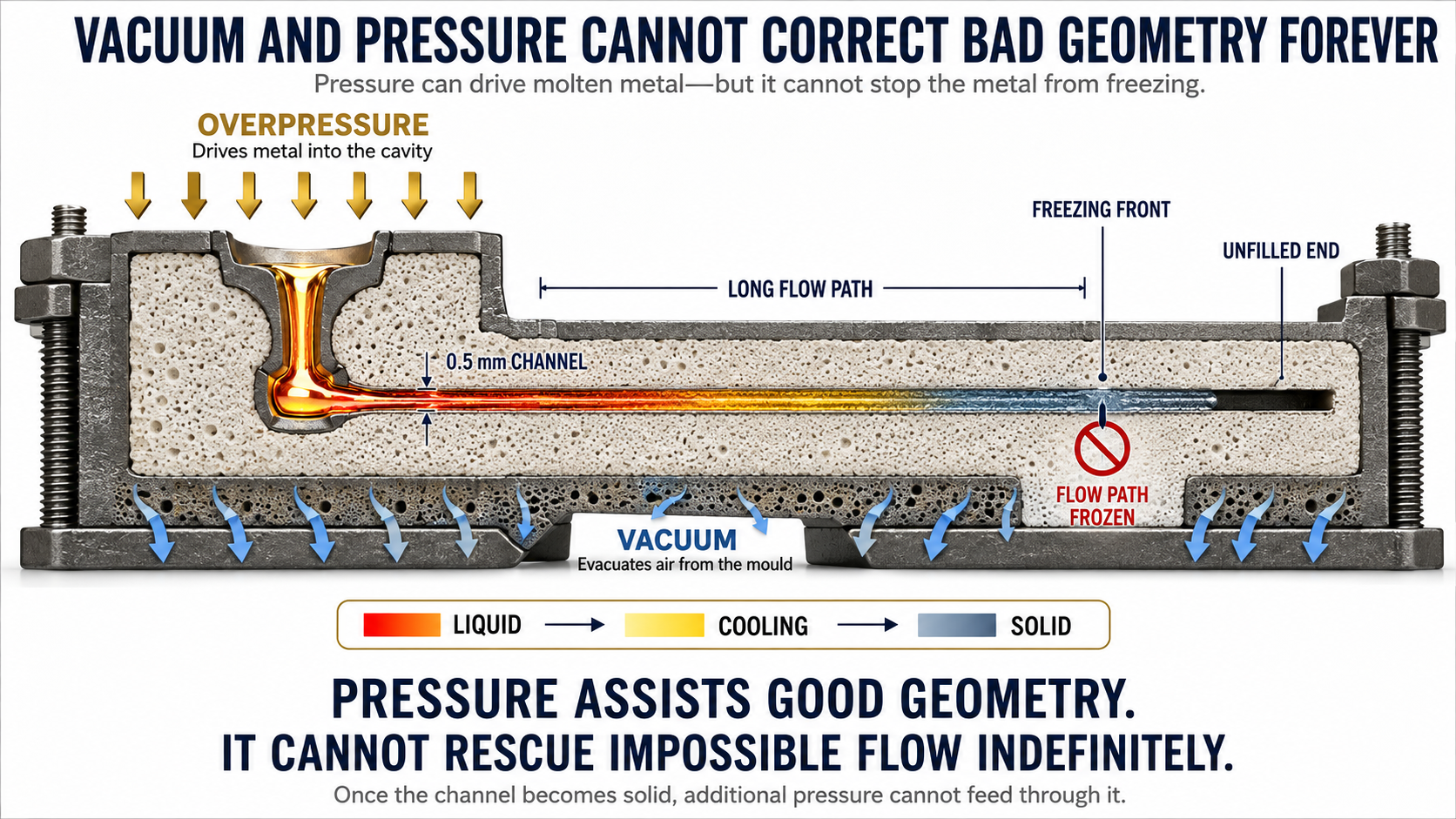
Modern vacuum-pressure casting machines are extremely capable.
Vacuum helps evacuate air from the mould system, while overpressure increases the pressure differential driving molten metal into fine cavities. Indutherm’s current systems specifically use vacuum, overpressure and—in some models—vibration to improve mould filling and reduce porosity in delicate and stone-in-place jewellery.
But there is a limit.
If a 0.5 mm channel travels a long distance from the sprue and the alloy freezes before reaching the end, simply adding more pressure is not necessarily the correct engineering solution.
Likewise, if a heavy section is connected through a sprue that freezes prematurely, pressure cannot feed it after the feeding channel has become solid metal.
Therefore pressure should assist a properly engineered casting system, not compensate indefinitely for poor spruing or unsuitable geometry.
7. Turbulence Is Another Hidden Enemy
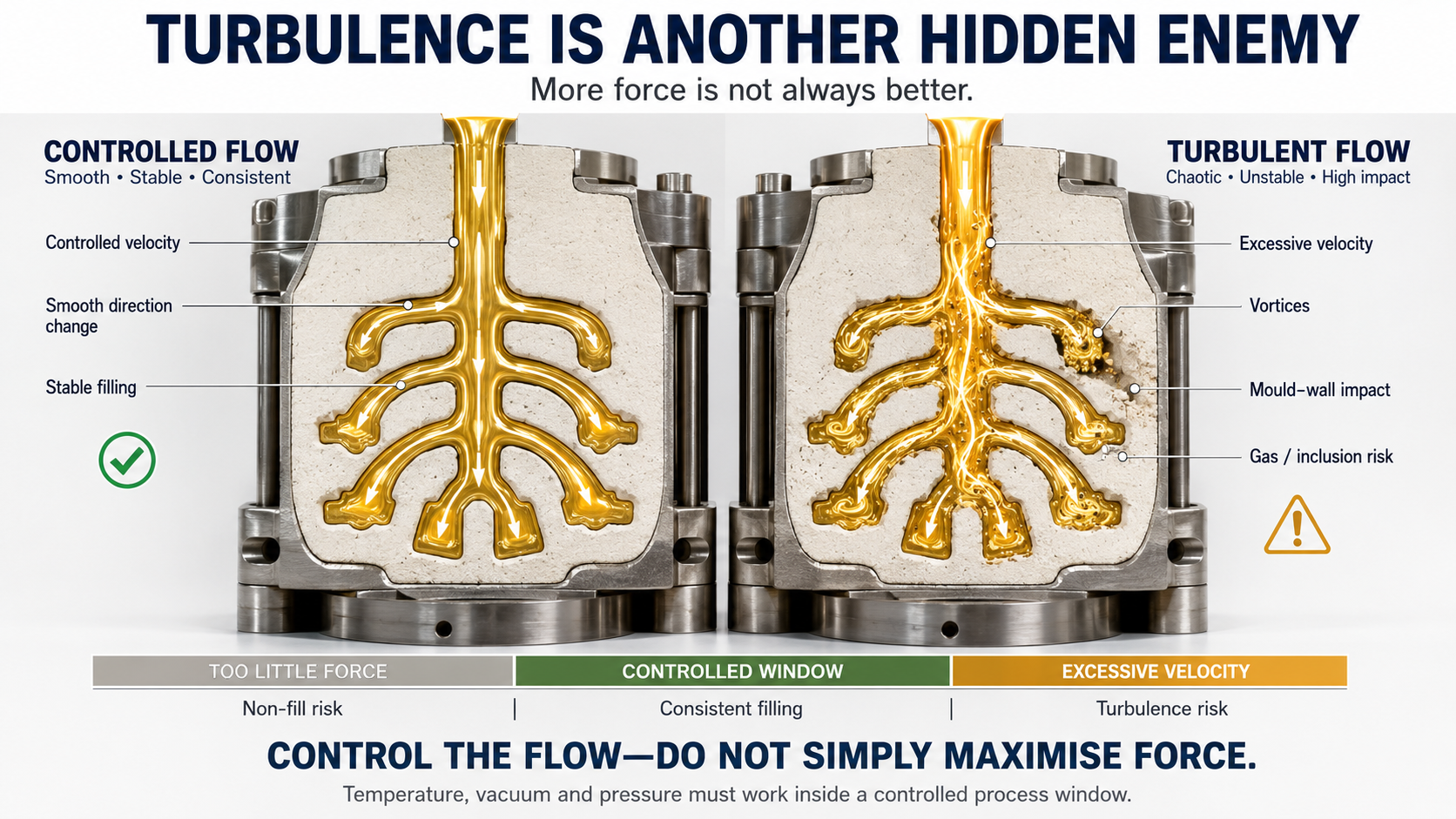
More force is not always better.
Molten metal entering a complicated tree at excessive velocity can become turbulent.
Turbulent flow can increase interaction with the mould surface and create unstable filling conditions. Modern casting-machine manufacturers even use flow-control strategies specifically intended to promote more consistent or laminar filling and reduce mould damage and inclusions.
So there is a balance.
Too little driving force can produce incomplete filling.
Too much uncontrolled velocity can introduce another family of defects.
That is why experienced casting is not simply about maximizing:
temperature + vacuum + pressure.
It is about controlling the complete flow and solidification window.
8. Investment Permeability Changes the Result
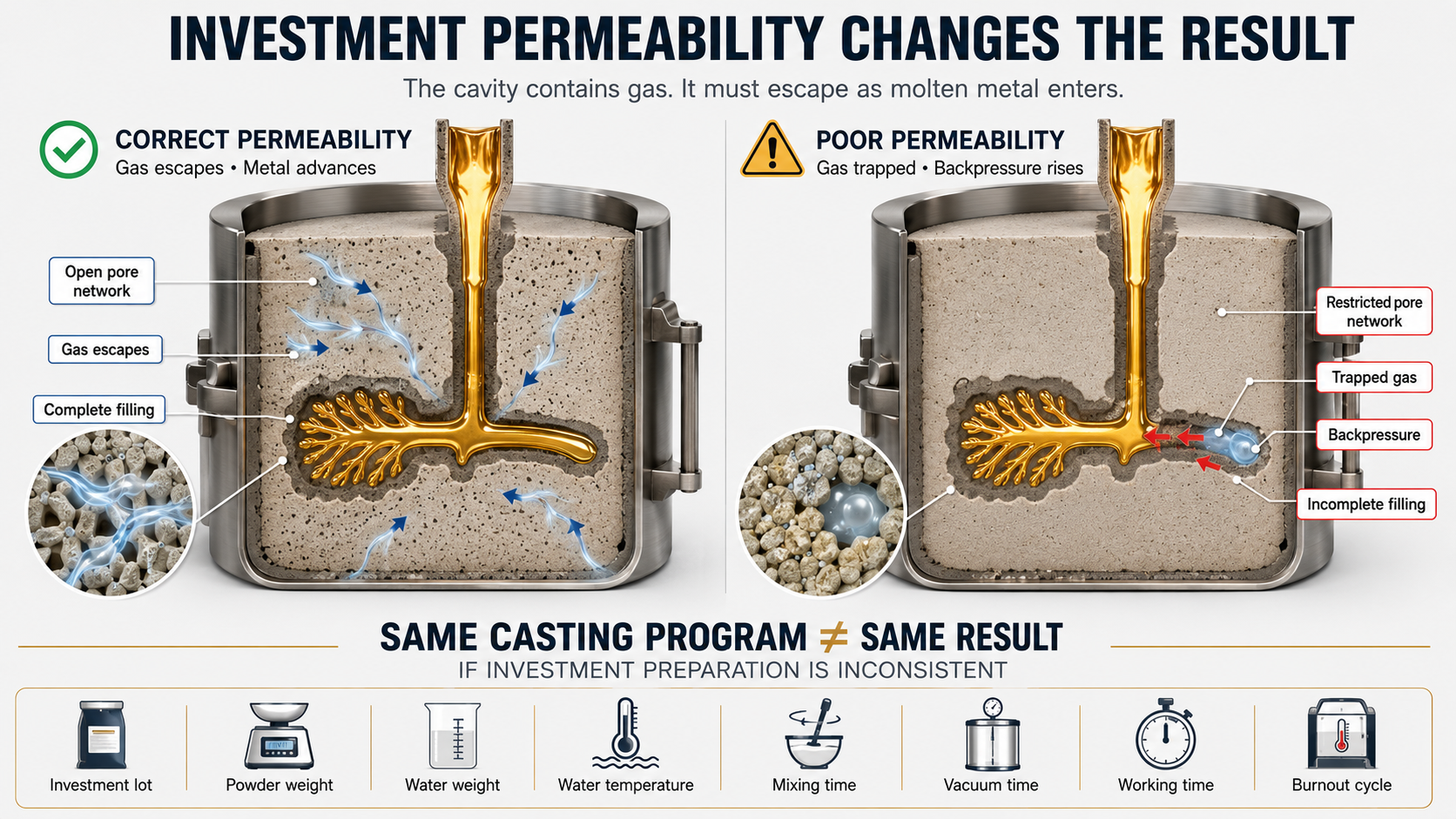
Remember something else.
When molten metal enters the mould, something already occupies that cavity:
Gas.
That gas must escape.
If the investment is insufficiently permeable, backpressure opposes the incoming metal and fine sections may not fill properly.
Ransom & Randolph’s research specifically examined whether investment permeability affects jewellery casting and notes that insufficient permeability can prevent complete mould filling. The manufacturer also stresses correct water-to-powder ratio because changes in this ratio alter investment properties and therefore casting behaviour.
This means two flasks can run under the same casting program but behave differently if investment preparation is inconsistent.
A production manager therefore needs to control:
investment lot + powder weight + water weight + water temperature + mixing time + vacuum time + working time + burnout cycle.
If those variables are uncontrolled, blaming the casting program becomes meaningless.
9. Gas Porosity and Shrinkage Porosity Must Not Be Treated as the Same Defect
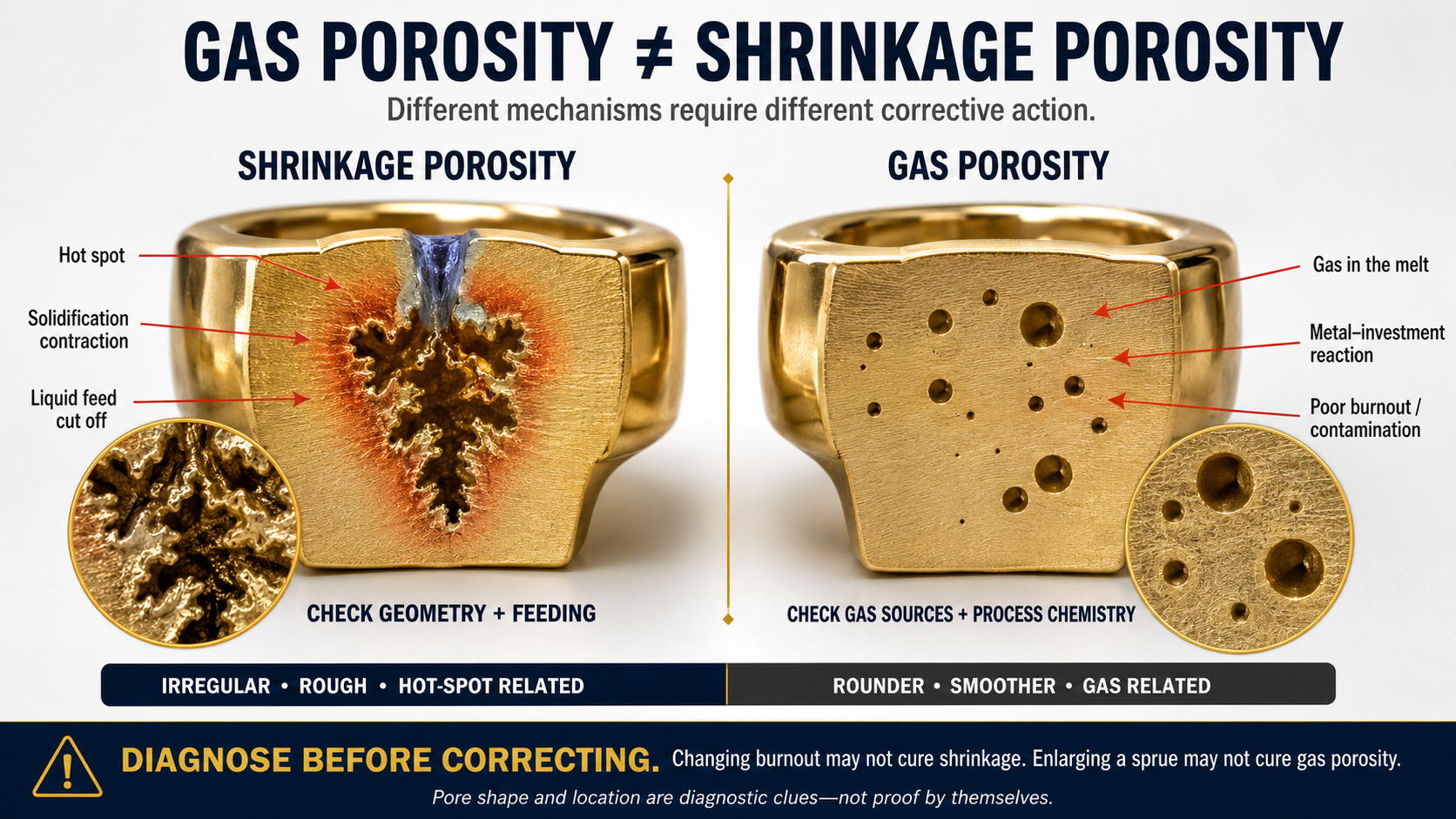
This distinction is critical.
Shrinkage porosity
Usually relates to solidification and inadequate feeding.
Think:
hot spot → contraction → no liquid feed → void.
Gas porosity
Can arise from gases already present in the melt, reactions between metal and investment, poor burnout, contaminated metal or other gas-generating conditions.
The classic Gold Bulletin research on carat-gold jewellery distinguished shrinkage porosity from gas porosity and specifically investigated reactions between molten gold alloys and calcium-sulphate-bonded investment.
From a production standpoint, this distinction changes everything.
If I have shrinkage porosity and I spend three days modifying the burnout cycle, I may never solve the real problem.
If I have gas porosity and I keep increasing sprue diameter, I may also be attacking the wrong cause. Diagnose before correcting.
10. How I Would Read the Defect in a Factory
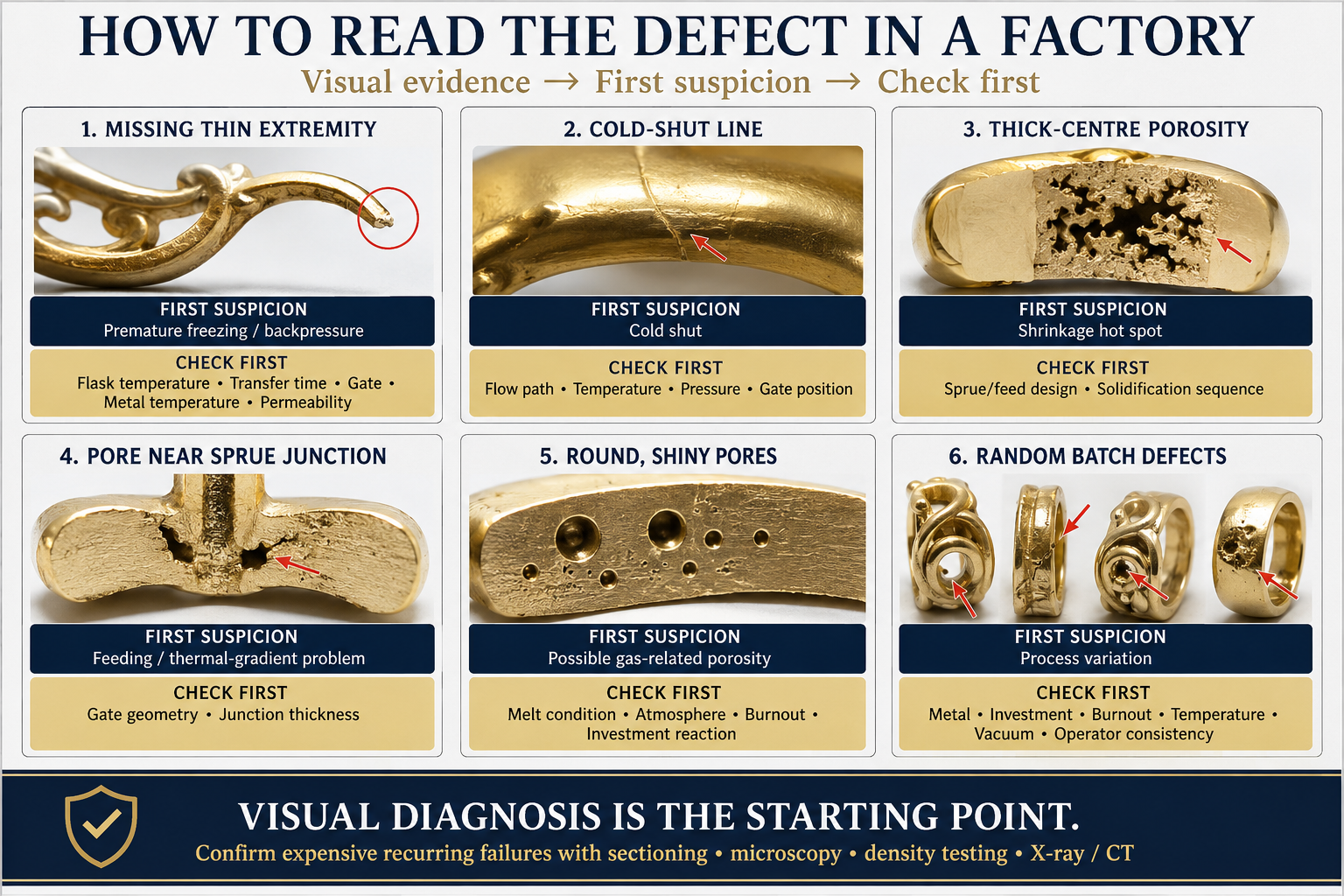
|
What I observe |
First suspicion |
What I investigate first |
|
Thin extremity missing |
Premature freezing /backpressure |
Flask temperature, transfer time, gate, metal temperature, permeability |
|
Two fronts meet but leave a line |
Cold shut |
Flow path, temperature, pressure, gate position |
|
Porosity repeatedly in thick centre |
Shrinkage hot spot |
Sprue/feed design and solidification sequence |
|
Porosity near sprue junction |
Feeding / thermal-gradient problem |
Gate geometry and junction thickness |
|
Rounder, shiny internal pores |
Possible gas-related porosity |
Melt condition, atmosphere, burnout, investment reaction |
|
Same defect on same design every flask |
Design/process interaction |
CAD thickness, sprue location and thermal map |
|
Different random defects throughout batch |
Process variation |
Metal, investment, burnout, temperature, vacuum and operator consistency |
This visual diagnosis is only a starting point. For expensive recurring failures, sectioning, microscopy, density testing, X-ray or CT analysis can prevent a factory from repeatedly “correcting” the wrong process variable. Modern jewellery-metallurgy laboratories now use X-ray tomography specifically to investigate internal porosity and cracks.
My 50-Year Caster’s Rule
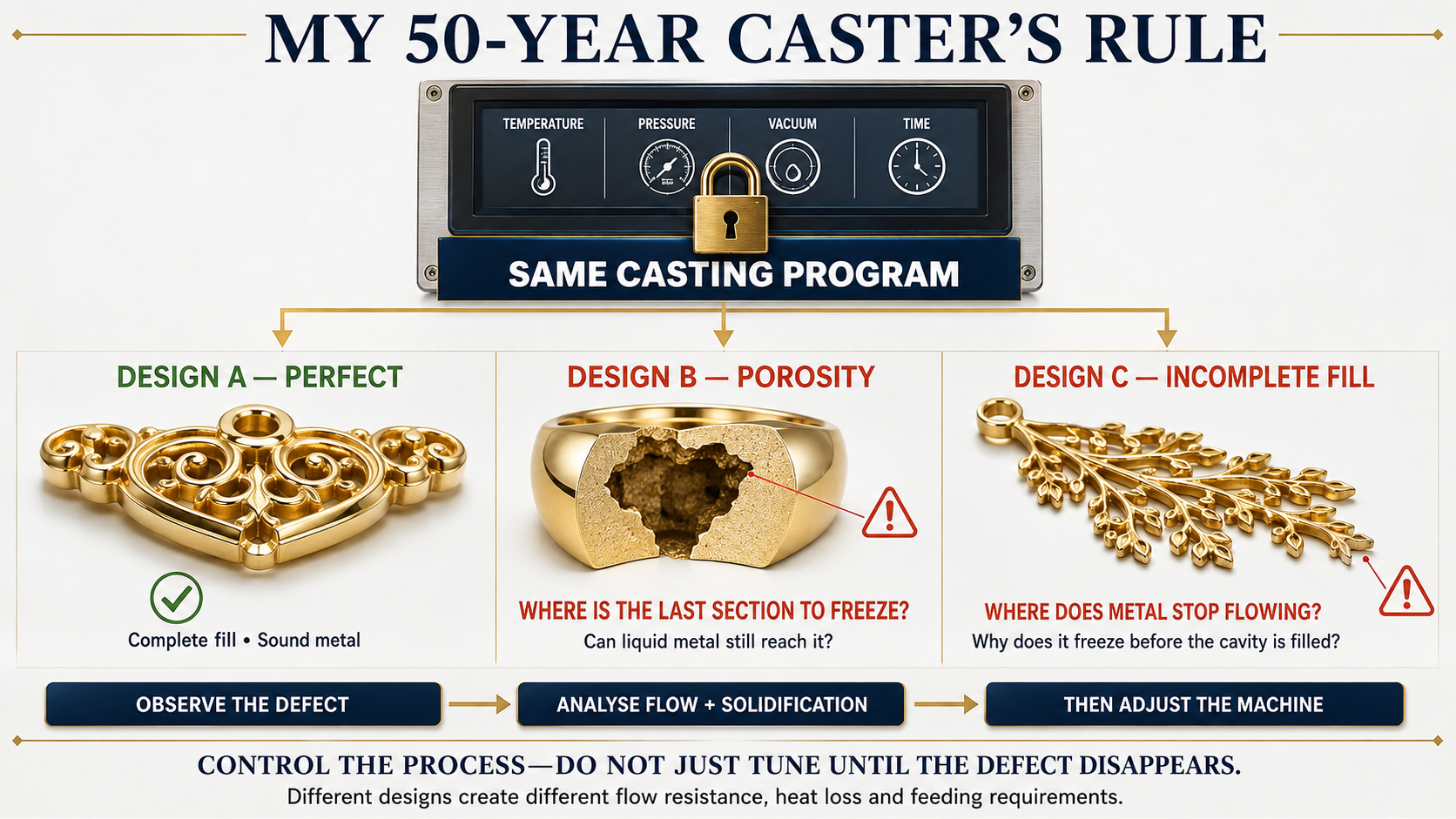
If one casting program produces:
Design A — perfect
Design B — porosity
Design C — incomplete filling
I would not immediately create three different machine programs.
First I would determine why B and C behave differently.
For Design B I would analyse:
Where is the last section to freeze, and can liquid metal still reach it?
For Design C I would analyse:
Where does the metal lose its ability to flow before the cavity is filled?
Only after understanding those two questions would I adjust temperature, pressure, vacuum or timing.
Otherwise you are not controlling the process.
You are tuning the machine until the defect disappears.
Those are not the same thing.
Should a Large Factory Use One Standard Casting Program?
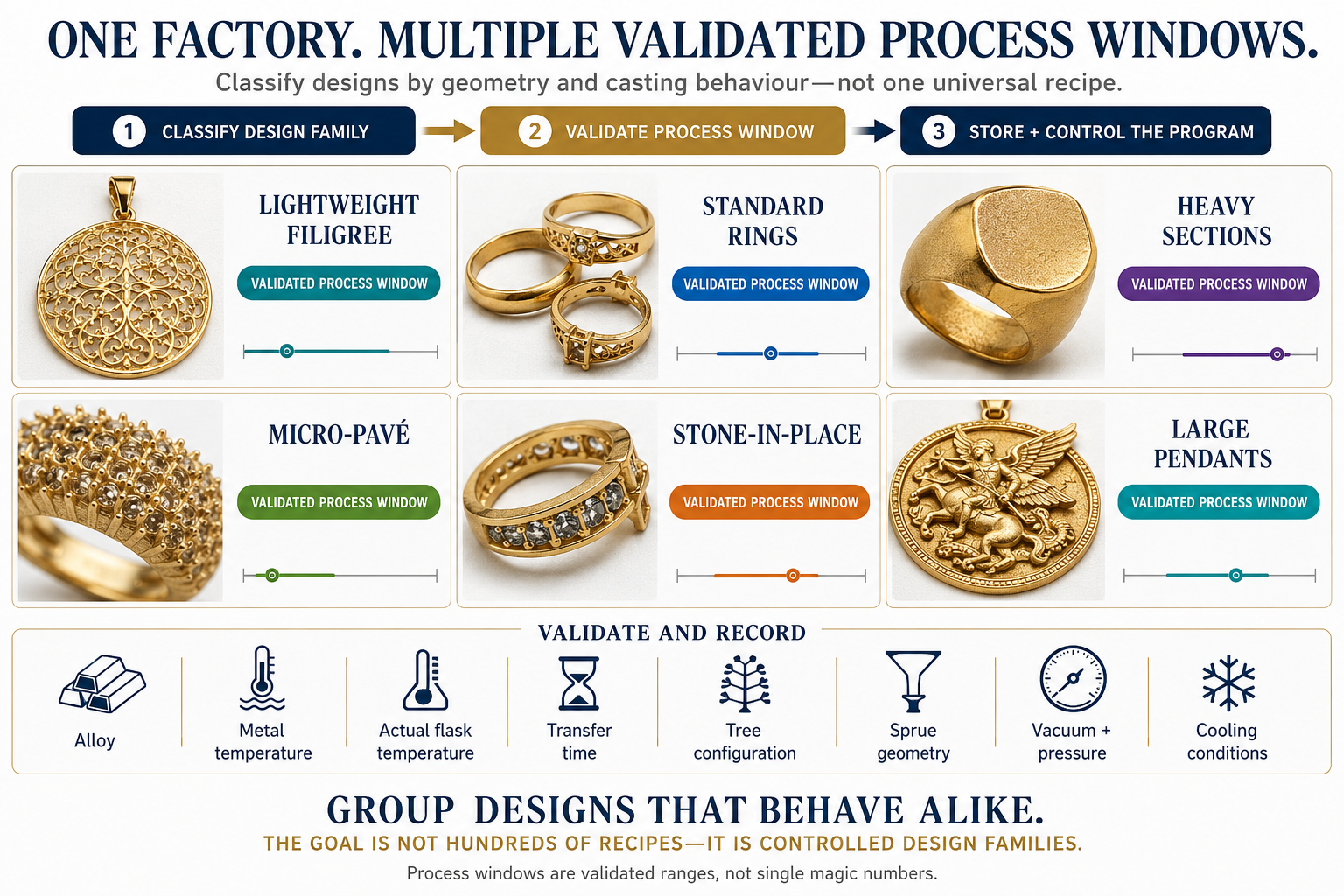
No—not as a universal rule.
A large jewellery factory should have a validated process window, not one magic recipe.
Modern casting equipment already supports multiple stored programs; Indutherm, for example, provides systems with numerous saved casting programs and individual parameter control precisely because alloys and casting requirements differ.
A serious factory should ultimately classify products into design families such as lightweight filigree, standard rings, heavy-section pieces, micro-pavé, stone-in-place, large pendants and other geometrically similar groups.
Then establish validated ranges for each family covering alloy, metal temperature, actual flask temperature, transfer time, tree configuration, sprue geometry, vacuum, pressure and cooling conditions.
The objective is not to create hundreds of recipes.
The objective is to understand which designs behave similarly enough to share a process window.
EXPERT VERDICT
The same casting program does not guarantee the same casting conditions inside every jewellery design.
A thin filigree design is primarily fighting heat loss and premature freezing.
A heavy design is often fighting solidification shrinkage and feeding.
A complicated tree may be fighting flow resistance, turbulence and trapped gas.
And an inadequately burnt-out or incorrectly prepared mould can introduce an entirely different class of defects.
So when one design casts perfectly and another fails under the same machine program, do not immediately ask:
“What parameter should I change?”
First ask:
“What is physically different about the way this design fills, cools and solidifies?”
Once that question is answered, the correct casting parameter usually becomes much easier to identify.
The best caster is not the person who knows the highest temperature, strongest vacuum or maximum pressure.
The best caster is the person who knows exactly when not to use them.